
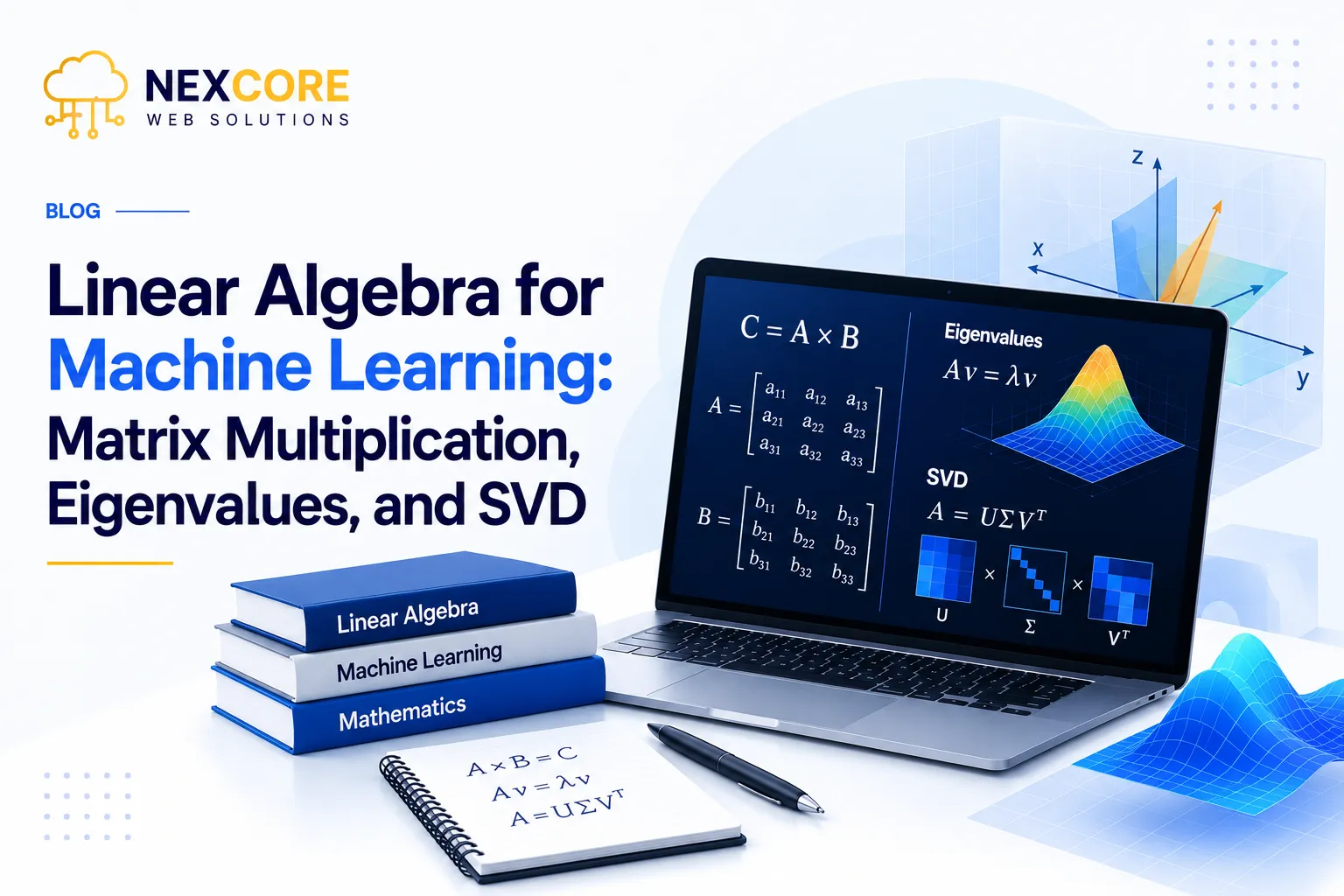
Linear algebra is one of the mathematical foundations behind modern machine learning. Although many machine learning libraries hide the underlying calculations, models still depend heavily on vectors, matrices, transformations, and decompositions. Matrix multiplication helps models process features and weights, eigenvalues reveal important properties of transformations, and Singular Value Decomposition (SVD) provides powerful ways to analyze and reduce high-dimensional data. Understanding these concepts makes machine learning algorithms easier to implement, debug, and interpret. It also helps developers understand why operations such as dimensionality reduction, recommendation systems, image compression, and neural network inference work efficiently. For students and practitioners, learning practical linear algebra is therefore far more useful than memorizing formulas without understanding how they connect to real machine learning problems.
Why Linear Algebra Matters in Machine Learning
Machine learning datasets are naturally represented using mathematical structures. A single observation can be represented as a vector, while a complete dataset can be stored as a matrix where rows represent samples and columns represent features. Model parameters are also commonly stored as vectors or matrices. This representation allows large collections of numerical operations to be performed efficiently using optimized libraries such as NumPy, PyTorch, and TensorFlow.
For example, consider a dataset containing customer information such as age, income, and purchase frequency. Each customer can be represented as a feature vector, while thousands of customers can form a data matrix. A prediction model can then combine these features with learned weights through matrix operations. This mathematical representation allows the same computation to be applied efficiently across many observations.
Matrix Multiplication
Matrix multiplication is one of the most frequently used operations in machine learning. If matrix A has dimensions m × n and matrix B has dimensions n × p, their product produces a matrix with dimensions m × p. Each output element is calculated by taking the dot product of one row from the first matrix and one column from the second matrix. The dimensions must therefore be compatible for multiplication to work.
In a neural network, matrix multiplication connects input features with learned weights. Suppose an input matrix contains the features of several samples and a weight matrix represents the parameters of a neural network layer. Multiplying them produces values that can then pass through an activation function. Repeating this process across multiple layers allows neural networks to transform raw inputs into increasingly useful representations.
A Practical Matrix Example
Consider a simple input matrix containing two samples and three features. A weight matrix may contain three rows and two columns, representing connections between three input features and two output units. Their multiplication produces two output values for each sample. This is essentially how a dense neural network layer performs part of its computation. Modern hardware accelerates these operations because machine learning workloads often involve very large matrix multiplications.
Eigenvalues and Eigenvectors
Eigenvalues and eigenvectors describe how a matrix transforms particular directions in space. An eigenvector is a nonzero vector whose direction remains unchanged after a matrix transformation, while its corresponding eigenvalue indicates how much that vector is scaled. This relationship provides useful information about the behavior of mathematical transformations. Eigenvalue analysis is especially important in statistics, optimization, dimensionality reduction, and numerical computing.
Connection to Principal Component Analysis
Principal Component Analysis, or PCA, uses linear algebra to identify directions that capture important variation within data. A common formulation involves calculating the covariance matrix and examining its eigenvectors and eigenvalues. Eigenvectors represent principal directions, while their associated eigenvalues indicate the amount of variance represented by those directions. By selecting components with larger eigenvalues, PCA can reduce dimensionality while preserving much of the important structure in the dataset.
For example, a dataset may contain twenty features even though most of its meaningful variation can be represented using five directions. PCA can transform the original feature space into a smaller set of principal components. This can simplify visualization, reduce computational requirements, and sometimes remove redundant information. The technique is widely used for exploratory analysis and preprocessing.
Singular Value Decomposition
Singular Value Decomposition, commonly called SVD, is another important matrix decomposition technique. It expresses a matrix as the product of three matrices, commonly written as U, Σ, and Vᵀ. The diagonal values in Σ are called singular values and describe the strength of different components in the original matrix. Unlike eigenvalue decomposition, SVD can be applied to rectangular matrices, making it especially useful for real-world datasets.
SVD in Machine Learning
SVD has many applications in machine learning and data science. It can be used for dimensionality reduction, noise filtering, recommendation systems, information retrieval, and image compression. By keeping only the largest singular values and their associated components, a large matrix can often be approximated using fewer dimensions. This process is known as low-rank approximation.
Imagine a large user-product rating matrix where many entries are missing. SVD can identify latent patterns that explain relationships between users and products. A recommendation system can use these hidden factors to estimate preferences that are not explicitly recorded. Similar mathematical ideas are also useful when compressing images because an image matrix can sometimes be represented accurately with fewer dominant components.
Matrix Multiplication, Eigenvalues, and SVD Together
These concepts are not isolated topics. Matrix multiplication provides the basic computational mechanism for transforming data, while eigenvalues help analyze particular matrix transformations. SVD provides a broader decomposition that can expose important structures within matrices, even when they are not square. Together, these techniques form part of the mathematical toolkit behind many machine learning algorithms.
Conclusion
Linear algebra becomes much easier to understand when its concepts are connected to practical machine learning operations. Matrix multiplication explains how features and model parameters interact, while eigenvalues and eigenvectors help identify important directions and transformations within data. SVD extends this understanding by decomposing matrices into components that can support dimensionality reduction, compression, and latent-feature analysis. Rather than treating these topics as abstract mathematical formulas, learners should practice them using small datasets and real machine learning examples. Implementing the operations with NumPy and then observing how libraries such as PyTorch use them can build both mathematical intuition and practical programming skills.
FAQs
1. Why is matrix multiplication important in machine learning?
Matrix multiplication allows machine learning models to efficiently combine input features with learned parameters. Neural network layers, linear regression calculations, transformations, and many other algorithms rely on matrix operations. Instead of processing every feature connection separately, matrix multiplication expresses the calculations in a compact form that optimized numerical libraries and hardware can execute efficiently.
2. What are eigenvalues and eigenvectors used for?
Eigenvalues and eigenvectors help describe how a matrix transforms particular directions. In machine learning, they are commonly associated with techniques such as PCA, where eigenvectors identify principal directions in data and eigenvalues indicate the amount of variance associated with those directions. They are also useful in optimization, numerical analysis, graph-based methods, and other mathematical applications.
3. What is SVD used for in machine learning?
SVD decomposes a matrix into components that reveal important patterns within the data. Machine learning applications use SVD for dimensionality reduction, low-rank approximation, recommendation systems, image compression, and information retrieval. By retaining dominant singular values and corresponding components, developers can represent complex matrices using fewer dimensions while preserving significant information.
4. Is SVD the same as eigenvalue decomposition?
No. Although both are matrix decomposition techniques, they have different mathematical definitions and applications. Eigenvalue decomposition is generally associated with square matrices and their eigenvectors, while SVD can decompose rectangular matrices as well. SVD represents a matrix using left singular vectors, singular values, and right singular vectors, making it broadly applicable to practical datasets.
5. How can beginners practice linear algebra for machine learning?
Beginners should start with vectors, matrices, dot products, matrix multiplication, and basic transformations before studying advanced decompositions. Using NumPy to manually perform these operations is a useful way to build intuition. After understanding the calculations, learners can implement PCA or SVD on small datasets and compare their results with established machine learning libraries.




