
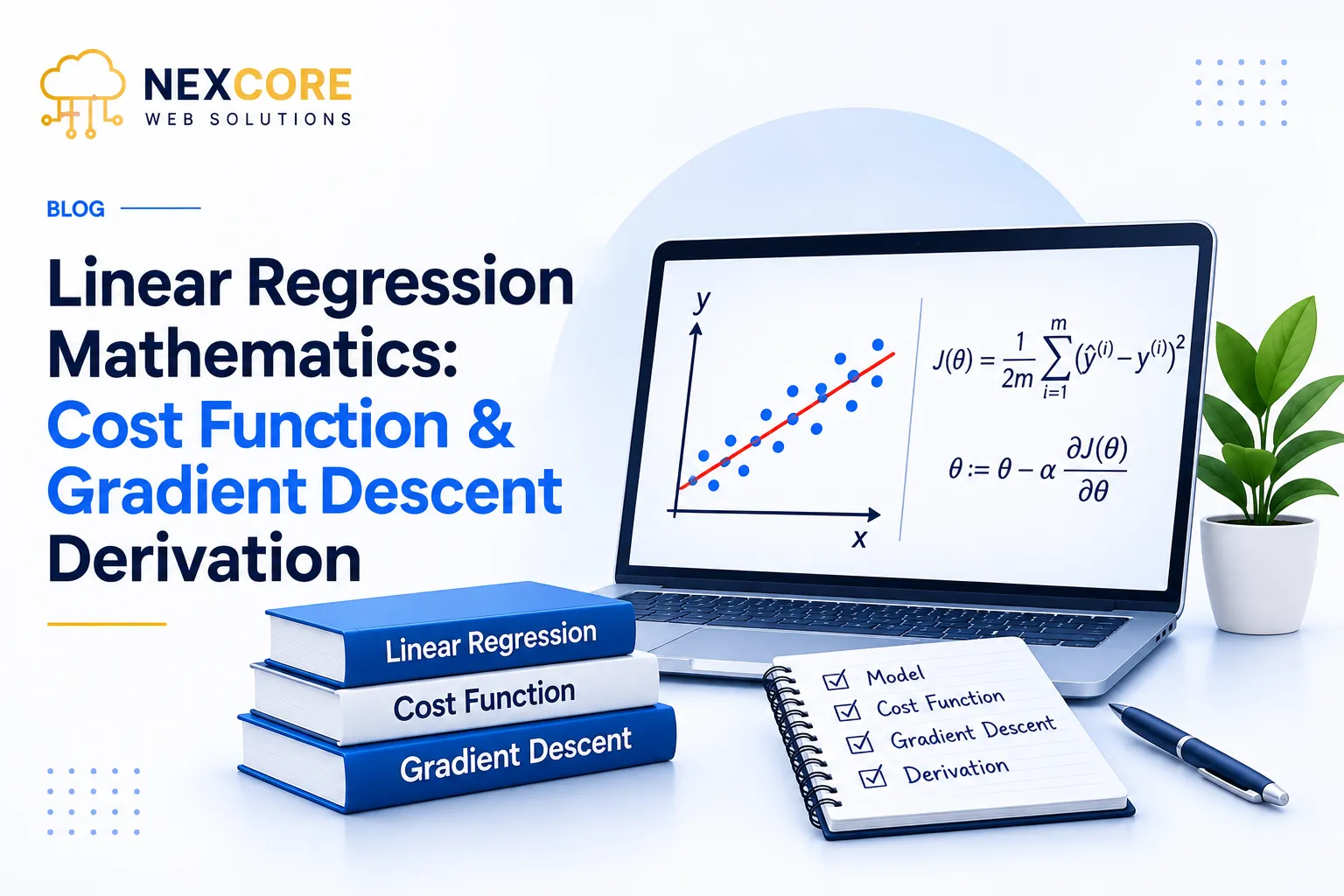
Linear regression is one of the most important foundations of machine learning. Although modern artificial intelligence systems use complex neural networks and large-scale models, many of their optimization principles can be understood by studying linear regression. The goal is simple: find a mathematical relationship between input data and an output value, then use that relationship to make predictions. Behind this simple idea are two essential concepts—the cost function and gradient descent. The cost function measures how accurately a model performs, while gradient descent provides a systematic method for improving it. Understanding the mathematics behind these concepts helps developers, students, and data professionals build a stronger foundation for more advanced machine learning algorithms.
Understanding the Linear Regression Model
Linear regression attempts to represent the relationship between variables using a straight line. In its simplest form, the model predicts an output using the equation:
ŷ = wx + b
Here, x represents the input feature, w is the weight or slope, b is the bias or intercept, and ŷ is the predicted output. For example, a model might use the size of a house to predict its selling price. The algorithm learns appropriate values for the weight and bias by comparing its predictions with actual values in the training data.
For datasets containing multiple input features, linear regression extends the same idea into a weighted mathematical equation. Each feature receives its own parameter, allowing the model to capture the influence of several variables simultaneously. The prediction can be written as ŷ = w₁x₁ + w₂x₂ + … + wₙxₙ + b. The central challenge is determining which parameter values produce the most accurate predictions. This is where the cost function becomes essential.
Why Linear Regression Needs a Cost Function
A machine learning model cannot improve unless it has a clear way to measure its mistakes. A cost function converts prediction errors into a single numerical value that represents the overall performance of the model. During training, the algorithm attempts to reduce this value by adjusting the model parameters. A lower cost generally means that predicted values are closer to the actual data.
For linear regression, the most commonly used cost function is Mean Squared Error, often expressed as:
J(w, b) = (1 / 2m) Σ(ŷᵢ – yᵢ)²
In this equation, m represents the number of training examples, ŷᵢ is the predicted value, and yᵢ is the actual value. The error is squared so that negative and positive errors do not cancel each other. Squaring also gives larger mistakes greater influence, encouraging the model to reduce significant prediction errors.
Deriving the Mean Squared Error Function
The derivation begins with the error for a single training example. If the actual output is y and the predicted output is ŷ, the prediction error is ŷ – y. Simply adding these errors across a dataset would be unreliable because positive and negative values could offset each other. Squaring each error ensures that every mistake contributes positively to the total cost.
The squared errors are then added for all training examples and divided by the number of examples to create an average. Many mathematical explanations use 1/2m instead of 1/m because the factor of two simplifies the derivative during optimization. The constant does not change which parameter values minimize the function. It simply makes the gradient calculations cleaner and easier to implement.
The Role of Gradient Descent
Once the model has a cost function, it needs a method to find the lowest possible cost. Gradient descent is an optimization algorithm that repeatedly adjusts model parameters in the direction that reduces the cost. Imagine standing on a hillside and trying to reach the lowest point while visibility is limited. The slope beneath your feet provides information about which direction leads downhill.
In mathematical terms, the gradient measures how the cost function changes when a parameter changes. If the gradient is positive, reducing the parameter may lower the cost, while a negative gradient suggests the opposite direction. Gradient descent takes small steps based on this information and repeats the process until the model approaches a minimum. This makes it practical for optimization problems where manually testing every possible parameter combination would be impossible.
Deriving the Gradient Descent Update Rule
For a parameter w, gradient descent uses the following update rule:
w := w – α × ∂J/∂w
The symbol α represents the learning rate, which controls the size of each adjustment. The expression ∂J/∂w is the partial derivative of the cost function with respect to the weight. By subtracting the gradient, the algorithm moves in the direction of decreasing cost.
For simple linear regression, substituting the prediction equation into the cost function and differentiating gives:
∂J/∂w = (1/m) Σ(ŷᵢ – yᵢ)xᵢ
The bias has a similar derivative:
∂J/∂b = (1/m) Σ(ŷᵢ – yᵢ)
These equations show that each parameter update depends on the model’s current prediction errors. The weight update also considers the corresponding input value, while the bias reflects the average direction of the errors.
Choosing the Right Learning Rate
The learning rate has a major influence on gradient descent performance. If it is too small, the algorithm takes tiny steps and may require a large number of iterations to reach a useful solution. If it is too large, the algorithm can repeatedly overshoot the minimum and fail to converge. Selecting an appropriate learning rate often requires experimentation and monitoring.
Data preparation also affects optimization. Features with very different numerical ranges can cause gradient descent to move inefficiently through the cost landscape. Feature scaling helps create more balanced updates and often improves convergence speed. In practical machine learning workflows, developers commonly normalize or standardize input data before training a model with gradient-based optimization.
From Mathematics to Real-World Predictions
Consider a company trying to predict monthly sales based on advertising spending. A linear regression model begins with random or simple initial values for its weight and bias. It makes predictions for each training example, calculates the cost, and determines the gradients. Gradient descent then updates the parameters and repeats the process until the cost stops improving significantly.
This same optimization pattern appears across many machine learning systems. Neural networks use more complicated architectures and loss functions, but they still depend on gradients to improve model parameters. Learning linear regression mathematics therefore provides more than a way to predict numerical values. It offers a practical introduction to the optimization principles behind modern artificial intelligence.
Conclusion
Linear regression demonstrates how mathematics transforms raw data into useful predictions. The model begins with a simple equation, but the cost function provides the objective needed to evaluate prediction quality. Mean Squared Error measures the difference between predicted and actual values, while gradient descent uses derivatives to steadily improve the model parameters. Understanding the derivation of these concepts makes machine learning less of a black box and more of a logical optimization process. Whether you are learning data science, developing predictive applications, or preparing for advanced AI topics, mastering cost functions and gradient descent provides a strong foundation for understanding how machine learning models learn from data.
FAQs
What is the main purpose of a cost function in linear regression?
A cost function measures how far a model’s predictions are from the actual values in the training dataset. It converts individual prediction errors into a single numerical value that can be minimized during training. In linear regression, Mean Squared Error is commonly used because it penalizes larger mistakes more heavily and provides a smooth function for optimization.
Why are prediction errors squared in Mean Squared Error?
Prediction errors are squared to prevent positive and negative errors from canceling each other out. Squaring also gives greater importance to larger mistakes, which encourages the model to improve significant prediction problems. Additionally, the squared error function is differentiable, making it well suited for gradient descent and other mathematical optimization techniques.
What does the learning rate do in gradient descent?
The learning rate determines how much the model parameters change during each gradient descent update. A very small learning rate can make training slow because the algorithm takes tiny steps. A learning rate that is too large may cause the algorithm to overshoot the minimum cost, leading to unstable training or failure to converge.
Can gradient descent find the best solution for linear regression?
For the standard linear regression cost function based on Mean Squared Error, gradient descent can reach the global minimum when configured correctly. This is because the cost surface is convex and does not contain multiple local minima. However, the speed and reliability of convergence still depend on factors such as feature scaling, learning rate selection, and implementation.
How is linear regression related to modern machine learning?
Linear regression introduces many concepts used throughout modern machine learning, including model parameters, loss functions, prediction errors, and gradient-based optimization. More advanced models, such as neural networks, apply these same principles to larger and more complex mathematical structures. Learning linear regression helps build the foundation needed to understand how sophisticated machine learning systems are trained.




