
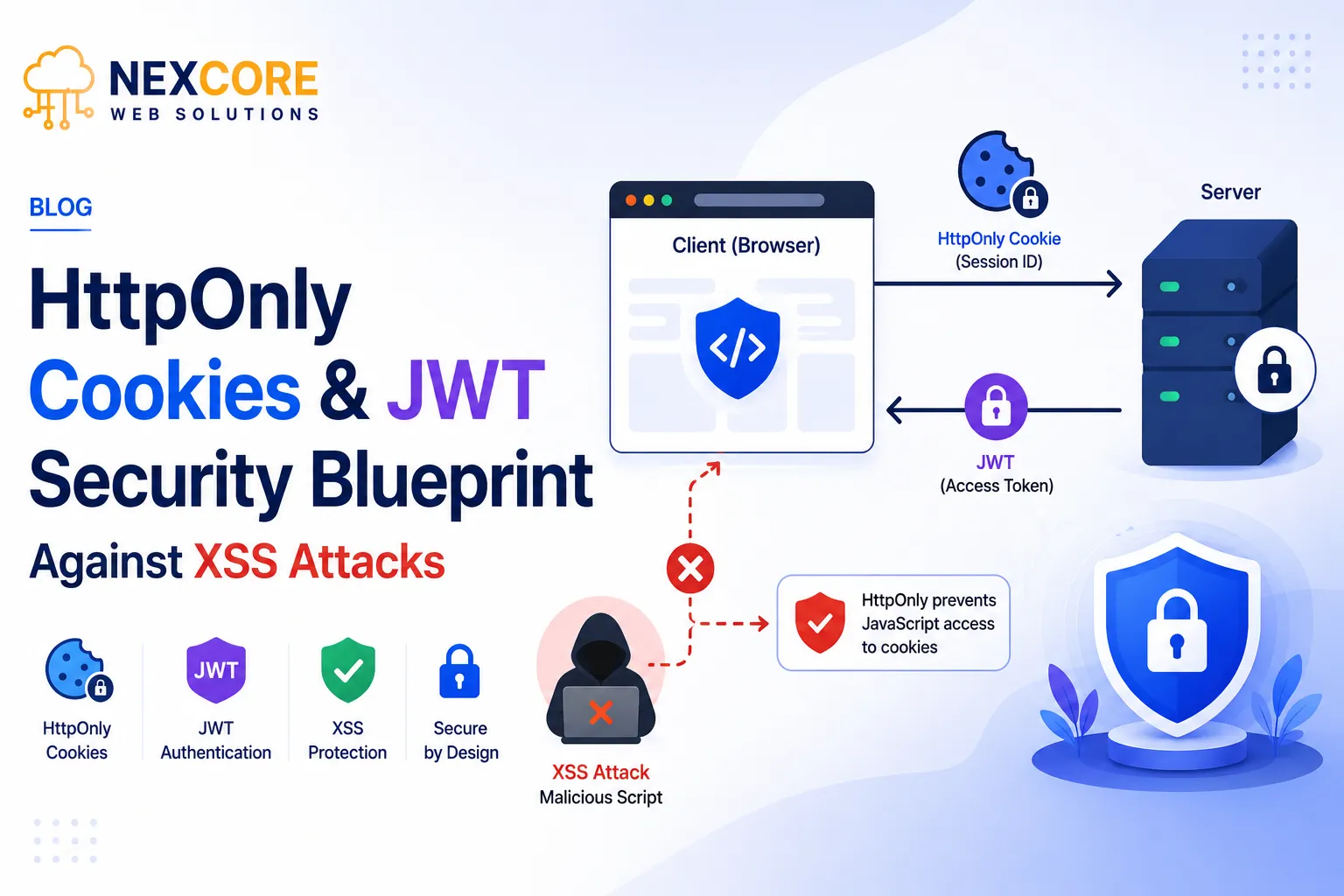
Web authentication often relies on session cookies or JSON Web Tokens (JWTs) to identify users after login. While JWTs provide a convenient way to secure APIs and distributed applications, their storage location can significantly affect the impact of a cross-site scripting (XSS) vulnerability. If an attacker can execute malicious JavaScript inside a victim’s browser and authentication credentials are directly accessible to that script, account takeover can become much easier. HttpOnly cookies provide an important defensive control because browser scripts cannot directly read cookies marked with the HttpOnly attribute. However, HttpOnly cookies are not a complete XSS solution. A strong authentication architecture combines secure cookie settings, short-lived credentials, CSRF protections, content security controls, careful input handling, and server-side authorization.
Understanding the XSS Threat
How XSS Affects Authentication
Cross-site scripting occurs when untrusted content is executed as JavaScript in a user’s browser. An attacker may attempt to inject code through forms, URL parameters, comments, stored content, or vulnerable third-party components. If authentication tokens are stored in browser-accessible storage, malicious scripts may potentially read those credentials and send them to an attacker-controlled destination. Protecting authentication credentials therefore becomes an important part of XSS defense.
Why Token Storage Matters
A JWT stored in a browser-accessible location can become attractive to an attacker because JavaScript may be able to access it directly. In contrast, an HttpOnly cookie is intentionally hidden from client-side JavaScript. The browser still sends the cookie automatically to matching requests, but scripts cannot retrieve its value through APIs such as document.cookie. This difference can limit the impact of some token-stealing attacks.
HttpOnly Cookies Explained
What HttpOnly Does
The HttpOnly cookie attribute instructs the browser not to expose the cookie to client-side scripts. This makes it useful for authentication sessions because injected JavaScript cannot simply read the token and copy it. HttpOnly does not prevent a compromised page from making requests within the victim’s browser, however. The server must therefore use additional controls to prevent unauthorized actions.
Secure and SameSite Attributes
Authentication cookies should also use the Secure attribute so browsers send them only over HTTPS connections. The SameSite attribute can restrict when browsers attach cookies to cross-site requests, helping reduce certain cross-site request forgery scenarios. Teams should choose SameSite behavior according to application requirements, especially when legitimate cross-site authentication or embedded workflows are needed. Cookie security depends on the combination of attributes rather than one setting alone.
Designing JWT Authentication
Keep Access Tokens Short-Lived
JWT access tokens should generally have limited lifetimes because a stolen token may remain usable until it expires or is otherwise rejected. Short expiration periods reduce the window available to an attacker after credential theft. Applications that require longer sessions can use refresh mechanisms rather than creating extremely long-lived access tokens. Refresh credentials should receive stronger protection and lifecycle controls.
Validate JWT Claims
APIs should verify more than the token signature. Important claims can include the issuer, audience, expiration time, and authorization scopes, depending on the architecture. Accepting a validly signed token without checking whether it was intended for the particular API can create authorization weaknesses. Strict validation reduces token reuse across unrelated services.
Protecting Cookies From Common Attacks
Prevent Session Fixation
Authentication systems should issue fresh session credentials after successful login or privilege changes. Reusing an attacker-controlled or previously established session identifier can create session fixation risks. Session identifiers should also be invalidated appropriately during logout and significant account-security events. Proper lifecycle management strengthens the authentication boundary.
Limit Cookie Scope
Authentication cookies should be scoped as narrowly as practical. Restricting the domain and path reduces the number of application areas that automatically receive the credential. Narrow scope can reduce unintended exposure between applications hosted under related domains. Cookie configuration should reflect the actual architecture instead of using unnecessarily broad settings.
Defending Against CSRF
HttpOnly cookies introduce an important consideration because the browser automatically attaches them to matching requests. If an attacker can cause a victim’s browser to send a state-changing request, the server may process it using the victim’s valid session. CSRF defenses such as appropriate SameSite settings, anti-CSRF tokens, and origin validation can help prevent unauthorized cross-site actions. The correct combination depends on whether requests are browser-based and how the application is structured.
Reducing XSS Risk
Encode and Validate Output
The strongest defense against XSS is preventing untrusted data from becoming executable code in the first place. Applications should use context-appropriate output encoding and safe templating mechanisms instead of inserting untrusted strings directly into HTML or JavaScript. Input validation can provide additional protection, but validation alone should not be treated as the primary XSS defense. Every rendering context requires appropriate handling.
Use Content Security Policy
A Content Security Policy can restrict which scripts and resources a browser is allowed to execute or load. A well-designed policy can reduce the impact of certain XSS vulnerabilities by preventing injected code from freely executing. CSP should complement secure coding practices rather than replace them. Organizations should test policies carefully before enforcing restrictive production configurations.
Monitoring and Incident Response
Security teams should monitor authentication anomalies such as unusual login locations, repeated session failures, unexpected token usage, privilege changes, and suspicious request patterns. Centralized logs can help correlate web application events with authentication activity and identify possible compromise. Organizations should also maintain procedures for invalidating sessions, rotating secrets, and responding to suspected credential theft. Incident preparation is especially important because no browser-side defense can eliminate every attack possibility.
Conclusion
HttpOnly cookies can significantly improve JWT-based authentication security by preventing client-side JavaScript from directly reading authentication cookies. However, they should be treated as one component of a broader security blueprint rather than a complete defense against XSS. Strong implementations combine HttpOnly and Secure cookies, suitable SameSite policies, short-lived access tokens, careful JWT validation, CSRF protection, output encoding, Content Security Policy, and effective monitoring. Developers should also minimize cookie scope and maintain clear session lifecycle rules. The most secure architecture assumes that individual controls can fail and builds multiple defensive layers around authentication. By combining browser protections with secure application design, organizations can substantially reduce the risk and potential impact of XSS-driven authentication attacks.
FAQs
1. Does HttpOnly completely protect JWTs from XSS attacks?
No. HttpOnly prevents JavaScript from directly reading the cookie value, which can reduce the risk of token theft through many XSS scenarios. However, malicious JavaScript may still attempt to perform actions through the victim’s authenticated browser session. Strong XSS prevention, CSRF defenses, authorization checks, and secure cookie configuration are therefore still required.
2. Should JWTs be stored in localStorage?
Storing authentication tokens in localStorage can increase their exposure to JavaScript running in the browser. If an XSS vulnerability exists, malicious code may potentially access tokens stored there. For browser-based authentication, developers often consider secure HttpOnly cookies when the application’s architecture supports them, combined with appropriate CSRF protections and strict session controls.
3. What cookie settings should be used for authentication?
Authentication cookies should generally use HttpOnly and Secure attributes, while SameSite should be configured according to the application’s cross-site requirements. Domain and Path should be restricted as narrowly as practical. Developers should also ensure authentication occurs over HTTPS and verify that cookie behavior matches the application’s legitimate login, API, and session workflows.
4. Can HttpOnly cookies prevent account takeover?
HttpOnly cookies can reduce one important attack path by preventing JavaScript from directly extracting the authentication credential. They cannot guarantee protection from account takeover because attackers may exploit other weaknesses, including credential theft, session abuse, CSRF, authorization flaws, or server-side vulnerabilities. Effective security requires multiple defensive controls working together.
5. How can developers reduce XSS risks in JWT-based applications?
Developers should use secure output encoding, safe templating systems, careful input handling, strict Content Security Policy controls, dependency management, and regular security testing. Authentication cookies should use appropriate security attributes, while APIs should validate JWT claims and enforce authorization independently. Preventing XSS at the application layer remains essential even when HttpOnly cookies are used.




