
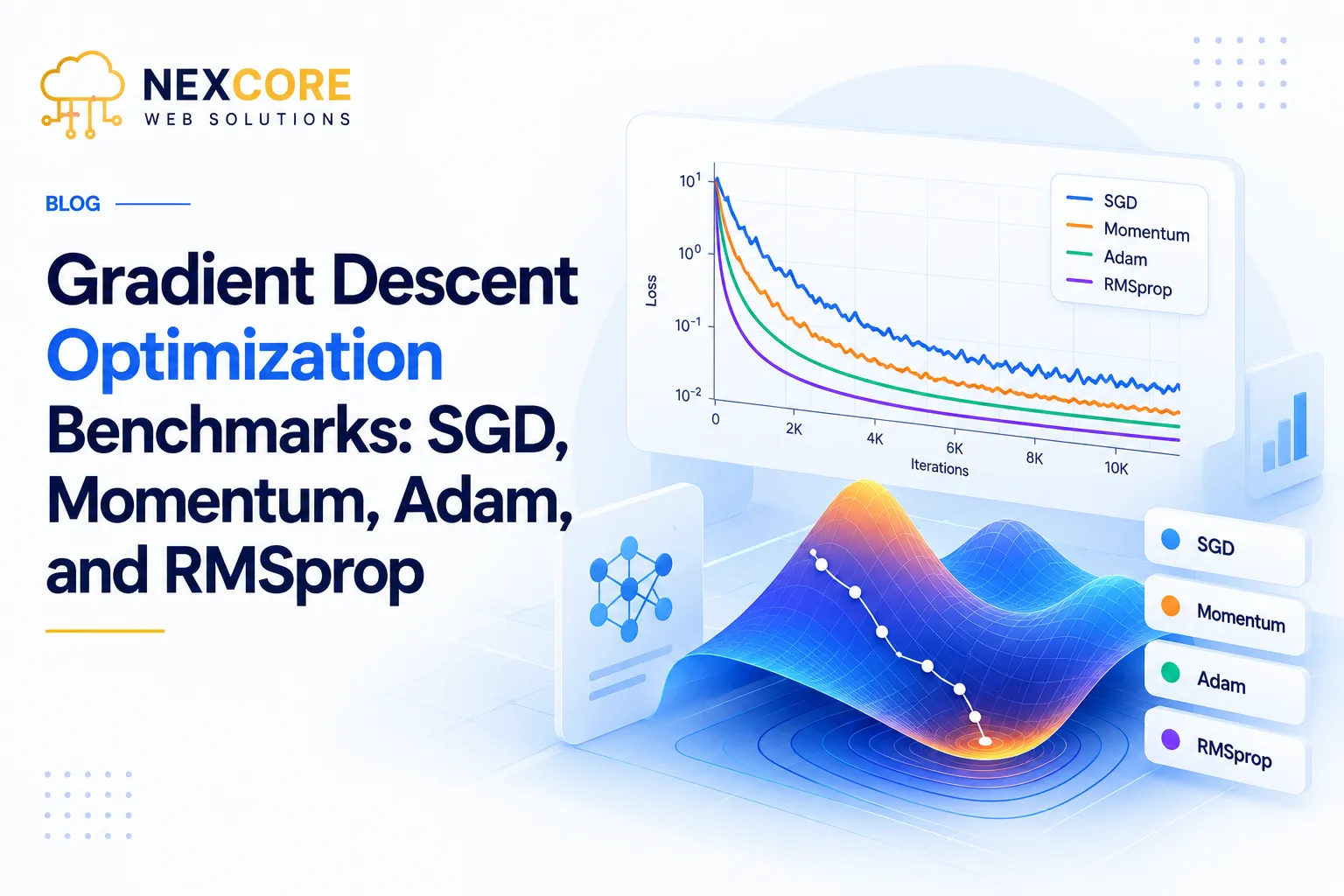
Training a machine learning model requires an optimization method that can adjust parameters while reducing prediction error. Gradient descent provides the basic mechanism by using derivatives of the loss function to determine which direction model parameters should move. Several optimizers build on this idea, including Stochastic Gradient Descent (SGD), Momentum, Adam, and RMSprop. They differ in how they use gradients, learning rates, historical information, and parameter-specific updates. These differences can strongly influence convergence speed, training stability, memory usage, and final model performance. Comparing optimizers through controlled benchmarks is therefore more useful than assuming that one algorithm is always superior. A practical evaluation should consider the dataset, model architecture, learning-rate settings, computational resources, and the behavior of the training and validation curves.
Understanding Gradient Descent Optimization
Gradient descent attempts to minimize a loss function by updating model parameters in the direction that reduces the loss. The learning rate determines how large each update should be. A rate that is too small can make training unnecessarily slow, while a rate that is too large can cause unstable updates or prevent convergence. Optimizers modify the basic update process to handle these challenges more effectively.
Batch and Stochastic Updates
Traditional batch gradient descent calculates gradients using the complete training dataset before updating parameters. SGD instead estimates the gradient using individual examples or small mini-batches. This makes each update cheaper and introduces controlled noise into the optimization process. That noise can sometimes help the optimizer move through difficult regions of the loss landscape, although it can also make training curves less smooth.
SGD as the Baseline
SGD is often the best starting point for optimizer comparisons because its behavior is straightforward. Given a learning rate and gradient, it updates each parameter directly in the opposite direction of the gradient. Its simplicity results in relatively low computational and memory overhead. However, SGD can converge slowly when gradients vary significantly across dimensions or when the loss landscape contains long, narrow valleys.
A fair SGD benchmark requires careful learning-rate selection. An optimizer can appear weak simply because its learning rate is poorly configured. Researchers should therefore test reasonable learning-rate ranges rather than comparing algorithms using arbitrary defaults. Momentum or adaptive optimizers may reach useful accuracy faster, but SGD can remain competitive when carefully tuned.
Momentum for Faster Movement
Momentum extends SGD by incorporating information from previous updates. Instead of responding only to the current gradient, it maintains a running direction that encourages movement when successive gradients point similarly. This can accelerate progress through shallow regions and reduce some of the oscillation that ordinary SGD may experience. Momentum is particularly useful when optimization repeatedly moves back and forth across steep dimensions.
A typical benchmark should compare SGD with and without momentum under similar conditions. The improvement is often visible through smoother and faster training, although the exact benefit depends on the model and learning-rate configuration. Momentum introduces a small amount of additional state for each parameter, but its computational requirements remain relatively modest.
RMSprop and Adaptive Learning Rates
RMSprop adjusts parameter updates according to a moving average of squared gradients. Parameters receiving consistently large gradients can receive smaller effective updates, while parameters with smaller gradients can receive relatively larger updates. This adaptive behavior can make optimization more stable when different parameters have very different gradient scales. RMSprop has historically been useful for neural networks and problems involving non-stationary optimization behavior.
One advantage of RMSprop is that it reduces the need for a single learning rate to work equally well for every parameter. However, it still requires hyperparameter choices such as the base learning rate and decay factor. A benchmark should therefore evaluate RMSprop across multiple configurations instead of treating one default setting as representative of the optimizer.
Adam: Combining Momentum and Adaptation
Adam combines momentum-like first-moment tracking with second-moment gradient scaling. It maintains estimates of both the average gradient and the average squared gradient, then uses those estimates to calculate adaptive parameter updates. This combination often allows Adam to make rapid progress during early training. It has become a common default for many deep learning experiments because it generally requires less manual tuning than basic SGD.
Adam Is Not Always the Winner
Fast initial convergence does not automatically mean better final generalization. In some tasks, SGD with momentum can eventually achieve competitive or better validation performance after careful learning-rate scheduling. Adam can also consume more memory than plain SGD because it maintains additional state for each parameter. Therefore, benchmark results should include both training speed and final validation behavior rather than focusing only on the first few epochs.
Designing a Reliable Optimizer Benchmark
A useful benchmark keeps the model architecture, dataset split, preprocessing pipeline, batch size, number of training epochs, and evaluation metric consistent. Each optimizer should receive a reasonable hyperparameter search rather than a single arbitrary configuration. Multiple random seeds are also valuable because neural network initialization and mini-batch ordering can influence results. Recording training loss, validation loss, validation accuracy, time per epoch, and total training time provides a more complete comparison.
Hardware and implementation details should also remain consistent. Running one optimizer on a GPU and another on a different environment can make timing results misleading. Memory consumption is another useful metric when working with large models. A slightly slower optimizer that uses substantially less memory may be more practical than a faster method that exceeds available hardware capacity.
Interpreting Benchmark Results
Optimization benchmarks should distinguish convergence speed from generalization quality. An optimizer that reaches low training loss quickly may still produce weaker validation results. Researchers should examine whether validation loss continues improving, begins fluctuating, or starts increasing while training loss falls. Learning curves can reveal these patterns more clearly than a single final accuracy number.
The final choice should therefore depend on the actual objective. For rapid experimentation, Adam may provide a convenient starting point, while SGD with Momentum may be attractive when careful tuning and strong generalization are priorities. RMSprop can be useful when adaptive scaling is beneficial, and plain SGD remains valuable as a transparent baseline. There is no universal winner across every dataset and architecture.
Conclusion
SGD, Momentum, RMSprop, and Adam represent different strategies for improving gradient-based optimization. SGD offers simplicity and low memory usage, Momentum adds accumulated direction to accelerate updates, RMSprop adapts learning rates using gradient history, and Adam combines momentum with adaptive scaling. Meaningful benchmarking requires controlled experiments, sensible hyperparameter tuning, repeated runs, and measurements that include both efficiency and validation performance. Developers should avoid selecting an optimizer solely because it reaches low training loss quickly. Instead, compare convergence behavior, generalization, computational cost, and memory requirements within the specific machine learning problem. A well-designed benchmark turns optimizer selection from a guess into an evidence-based engineering decision.
FAQs
1. Which optimizer is best for machine learning?
There is no single optimizer that performs best for every machine learning problem. Adam is often a convenient starting point because it combines adaptive updates with momentum-like behavior, while SGD with Momentum can perform strongly after careful tuning. RMSprop may suit particular optimization problems, and SGD provides a useful baseline. The best choice should be determined through controlled experiments on the target model and dataset.
2. What is the main advantage of Momentum over SGD?
Momentum uses information from previous gradients to influence the current update. This can help the optimizer move faster in consistent directions while reducing oscillations caused by rapidly changing gradients. As a result, Momentum can converge more efficiently than basic SGD on some loss landscapes. It does, however, introduce additional state and still requires suitable learning-rate and momentum settings.
3. Why does Adam often converge faster than SGD?
Adam combines estimates of the average gradient with estimates of squared gradients, allowing it to adapt the effective learning rate for individual parameters. This can produce rapid progress during early training, particularly when gradient magnitudes vary across parameters. However, faster initial convergence does not guarantee better final validation performance. SGD with Momentum can sometimes achieve stronger generalization after careful tuning and scheduling.
4. When should RMSprop be used?
RMSprop can be useful when gradients have substantially different scales or when adaptive parameter updates improve optimization stability. It maintains a moving average of squared gradients and uses that information to adjust updates. Although Adam is more commonly used in many modern workflows, RMSprop remains a useful optimizer to benchmark, particularly when its adaptive behavior fits the characteristics of the model or training problem.
5. How should optimizers be benchmarked fairly?
A fair benchmark should keep the dataset, architecture, preprocessing, batch size, hardware, and evaluation procedure consistent across optimizers. Each method should receive reasonable hyperparameter tuning rather than being tested only with arbitrary defaults. Running multiple random seeds improves reliability, while recording convergence, validation performance, training time, and memory usage provides a balanced view of practical performance.




