
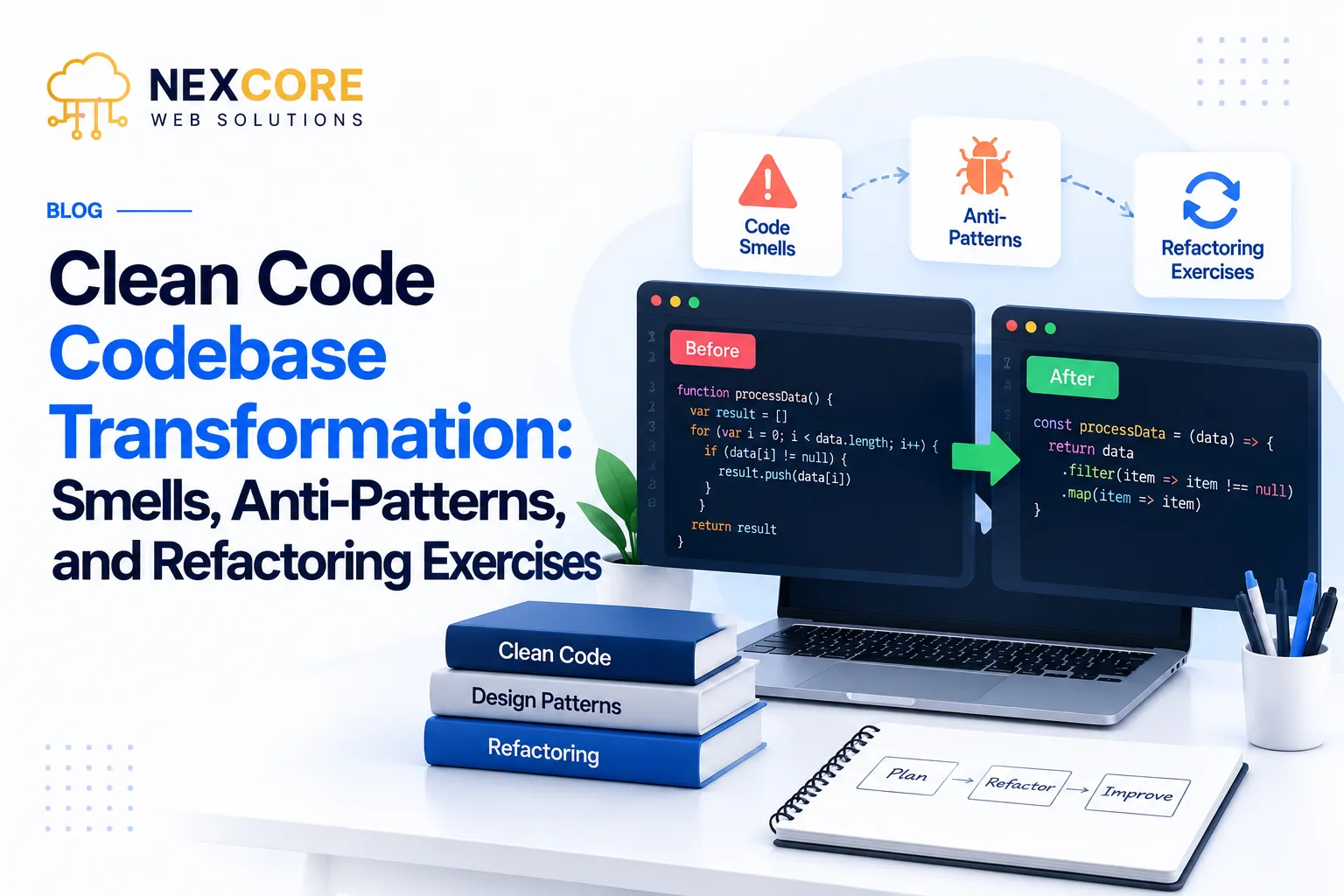
A codebase rarely becomes difficult to maintain because of one major mistake. More often, small shortcuts accumulate until developers struggle to understand logic, change features safely, or identify where bugs originate. Long methods, duplicated logic, unclear names, tightly coupled classes, and unnecessary dependencies are common examples of code smells that signal deeper maintainability problems. Anti-patterns can make these problems worse by introducing structures that repeatedly create technical debt. Clean code transformation is therefore not about rewriting everything from scratch. It is about identifying risky patterns, improving structure through focused refactoring, and creating a codebase that remains understandable as requirements evolve. Practical refactoring exercises provide a safe way to develop these skills while preserving existing behavior.
Understanding Code Smells
A code smell is a recognizable sign that code may have a design or maintainability problem. It does not necessarily mean the program is incorrect, but it suggests that future changes could become unnecessarily difficult. Common smells include duplicated code, excessively long methods, large classes, excessive parameters, unclear names, and deeply nested conditional logic. Developers should treat smells as signals for investigation rather than automatically rewriting every piece of code that looks unusual.
Common Smells to Identify
Long methods often contain multiple responsibilities that should be separated into smaller operations. Duplicate code creates maintenance risks because the same business rule may need to be updated in several places. Large classes can become difficult to test because they handle unrelated responsibilities and depend on too many collaborators. Poor naming creates another problem because developers must read implementation details simply to understand what a variable, method, or class is intended to represent.
Conditional complexity is another frequent warning sign. A method containing many nested if statements can become difficult to reason about, particularly when several conditions interact. In some situations, polymorphism, strategy objects, or clearly separated decision-making functions can make the logic easier to understand. The correct solution depends on the domain, so developers should understand the behavior before changing the structure.
Recognizing Anti-Patterns
Anti-patterns are recurring approaches that appear useful in the short term but tend to create problems over time. Examples include God objects that control too many parts of an application, excessive use of global state, shotgun surgery, and classes that depend directly on numerous implementation details. These structures often increase coupling and make testing or modification more difficult. Recognizing them helps teams address architectural problems before they become expensive.
Code Smells vs Anti-Patterns
The terms are related but not identical. A code smell usually identifies a suspicious characteristic in a specific part of the code, while an anti-pattern describes a broader approach that repeatedly produces undesirable results. For example, a very long method can be a code smell, while an application architecture built around one enormous controller may represent an anti-pattern. Both require careful analysis before refactoring.
Refactoring Without Changing Behavior
Refactoring means improving the internal structure of software while preserving its externally observable behavior. This distinction is important because a refactoring exercise should not quietly become a feature rewrite. Developers should establish tests before making significant changes so that existing behavior can be verified afterward. Small, incremental changes are generally safer than attempting a large transformation in one step.
A practical refactoring sequence might begin with renaming unclear variables, extracting repeated logic into methods, and separating unrelated responsibilities. After each meaningful change, run the relevant tests and inspect the resulting behavior. Once smaller improvements are stable, larger structural changes become easier to perform. Version control also provides a valuable safety net because each logical refactoring can be reviewed and reverted independently.
Practical Refactoring Exercises
Exercise 1: Extract a Long Method
Start with a method that validates an order, calculates totals, applies discounts, and generates an invoice. The method may technically work, but its multiple responsibilities make it difficult to understand and test. Extract each logical operation into a focused method with a descriptive name. The final method should communicate the overall workflow while implementation details remain separated.
Exercise 2: Remove Duplicate Logic
Find two or more functions that perform nearly identical calculations or validation steps. Compare them carefully to determine whether they represent the same business rule. Extract the shared behavior into a reusable function or service while keeping genuinely different behavior separate. This exercise teaches developers to distinguish meaningful reuse from abstraction created only to reduce line count.
Exercise 3: Replace Complex Conditionals
Choose a method containing several branches for different payment methods, notification channels, or user types. First document what each branch does and identify the behavior that varies. Then consider a strategy pattern, polymorphic classes, or smaller decision functions if those structures improve clarity. The objective is not to eliminate every conditional but to make changing or extending the behavior safer.
Building a Refactoring Workflow
Effective refactoring requires discipline rather than occasional cleanup sessions. Start by identifying the highest-risk areas using bug history, change frequency, test failures, and developer feedback. Prioritize code that changes regularly because improvements there can produce benefits repeatedly. Keep refactoring commits focused so reviewers can distinguish structural changes from functional modifications.
Automated tests are particularly important during codebase transformation. Unit tests can verify isolated behavior, while integration and end-to-end tests can protect important workflows. Static analysis tools may also identify duplication, complexity, unused code, or naming problems. Together, these tools provide evidence that structural improvements are reducing risk rather than merely changing the appearance of the code.
Measuring Code Quality Improvements
Clean code should be evaluated through maintainability and developer outcomes rather than aesthetics alone. Useful indicators include reduced complexity, fewer duplicated sections, easier testing, smaller responsibilities, and faster implementation of related changes. Code review feedback can reveal whether developers understand the new structure more quickly. The best refactoring is often the change that makes the next feature or bug fix noticeably easier.
Conclusion
Transforming a codebase into cleaner software is an ongoing engineering practice rather than a one-time rewrite. Code smells help developers locate areas that deserve attention, while anti-patterns reveal broader structural problems that can create long-term technical debt. Refactoring exercises such as extracting methods, removing duplication, and simplifying complex decisions provide practical ways to improve structure while preserving behavior. The safest approach combines automated tests, small changes, focused commits, and regular measurement of maintainability. Developers should avoid chasing perfect-looking code and instead prioritize clarity, appropriate responsibility boundaries, testability, and ease of change. A clean codebase ultimately gives teams more confidence when building, debugging, and extending software.
FAQs
1. What is a code smell in software development?
A code smell is a recognizable characteristic that suggests code may have a maintainability or design problem. It does not necessarily indicate a bug or incorrect behavior. Examples include duplicated logic, long methods, unclear names, excessive parameters, and large classes. Developers use smells as signals to investigate whether restructuring could make the software easier to understand, test, and modify.
2. What is the difference between a code smell and an anti-pattern?
A code smell usually describes a suspicious characteristic within a particular section of code, while an anti-pattern generally describes a recurring approach that causes broader design or architectural problems. A long method can be a code smell, whereas a system centered around an oversized God object may represent an anti-pattern. Both can indicate areas where thoughtful restructuring would reduce future maintenance difficulty.
3. How can developers refactor code safely?
Developers should begin with reliable tests that describe existing behavior and then make small, focused structural changes. After each meaningful refactoring step, run automated tests and review the resulting code. Keeping changes separate in version control makes them easier to inspect and reverse. This incremental approach reduces the risk of accidentally changing business behavior while improving the internal design.
4. What are useful refactoring exercises for beginners?
Beginners can start by renaming unclear variables, extracting long methods, removing duplicated code, and simplifying deeply nested conditionals. These exercises are relatively easy to observe because the original behavior can remain unchanged. Working with small examples also helps learners understand why separation of responsibilities, meaningful abstractions, and clear naming matter before they attempt larger architectural refactoring.
5. Should every code smell be refactored immediately?
No. Not every unusual pattern creates enough risk to justify immediate changes. Developers should consider how frequently the code changes, how difficult it is to test, whether bugs occur there, and whether the current structure blocks future work. Refactoring is most valuable when it reduces meaningful maintenance risk. Prioritizing high-impact areas prevents teams from spending excessive time on cosmetic improvements.




