
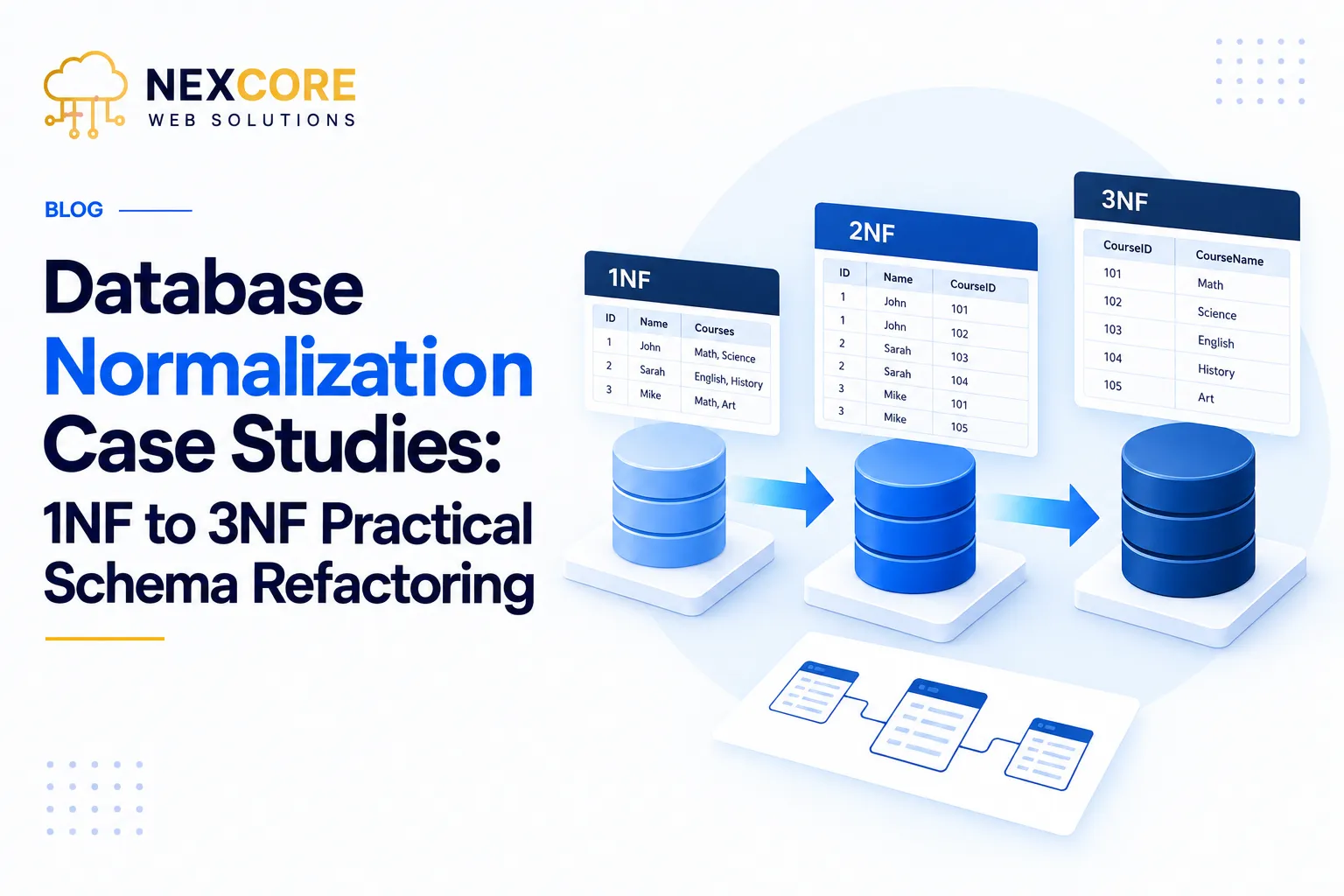
Database normalization is a structured approach to organizing relational data so that information is stored consistently and unnecessary duplication is reduced. It becomes especially useful when a database grows from a simple prototype into an application that handles frequent inserts, updates, and queries. The first three normal forms, commonly called 1NF, 2NF, and 3NF, provide a practical foundation for designing cleaner schemas. Understanding normalization through real case studies is often easier than memorizing definitions because each stage changes the way related data is represented. By refactoring a poorly structured table step by step, developers can see how normalization improves data integrity, reduces update anomalies, and creates clearer relationships between entities.
Understanding the Starting Point
Consider a college enrollment system that stores students, courses, instructors, and enrollments in one large table. A poorly designed table might contain StudentID, StudentName, CourseID, CourseName, InstructorName, InstructorEmail, and multiple course values inside a single row. At first, this design may appear convenient because all information is available in one place. However, repeated course and instructor details quickly create duplicate data and make updates difficult. The first step in normalization is identifying repeating groups, duplicated attributes, and dependencies between columns.
Case Study: Moving to First Normal Form
First Normal Form requires each column to contain atomic values rather than lists or repeating groups. Suppose a student’s courses are stored as CSE101, CSE202, CSE305 in one Courses column. This structure makes individual course searches and updates unnecessarily complicated. A normalized design instead creates separate rows for each student-course relationship. Each field now represents one value, making the table easier to query and process.
A simplified enrollment table might contain StudentID, StudentName, CourseID, CourseName, and InstructorID. If one student takes three courses, that student appears in three rows, with one course represented per row. Although StudentName is now repeated, the repeating group problem has been removed. This demonstrates an important point about normalization: eliminating one type of redundancy does not necessarily mean eliminating every duplicate value immediately.
Second Normal Form and Partial Dependencies
Second Normal Form builds on 1NF by requiring the table to be in 1NF and removing partial dependencies from composite keys. A partial dependency occurs when a non-key attribute depends on only part of a composite primary key. In the enrollment example, assume (StudentID, CourseID) forms the primary key. StudentName depends only on StudentID, while CourseName depends only on CourseID. Keeping these attributes in the enrollment table therefore creates dependencies on only part of the key.
Refactoring the Enrollment Schema
The solution is to separate attributes according to what they describe. A Student table can contain StudentID and StudentName, while a Course table contains CourseID, CourseName, and InstructorID. The Enrollment table then stores StudentID and CourseID as foreign keys, representing which student is registered for which course. This structure removes partial dependencies and makes the relationships more explicit. Updating a student’s name now requires changing the value in one Student record rather than modifying multiple enrollment rows.
Third Normal Form and Transitive Dependencies
Third Normal Form takes normalization another step by removing transitive dependencies. A transitive dependency exists when a non-key attribute depends on another non-key attribute rather than directly on the primary key. Suppose the Course table stores CourseID, CourseName, InstructorID, InstructorName, and InstructorEmail. InstructorName and InstructorEmail depend on InstructorID, not directly on CourseID. This means instructor information should be moved into a separate Instructor table.
Final 3NF Structure
After refactoring, the schema can contain Student, Course, Instructor, and Enrollment tables. Student stores student-specific attributes, Course stores course-specific information and references InstructorID, Instructor stores instructor details, and Enrollment connects students with courses. Each table now represents a clear entity or relationship. Foreign keys preserve the connections between these entities while avoiding unnecessary repetition. The resulting structure is easier to maintain because changes to an instructor or student are isolated to the appropriate table.
Practical Benefits of Normalization
Normalization provides several practical benefits beyond satisfying academic database rules. It reduces update anomalies because the same fact is not unnecessarily stored in many locations. It also reduces insertion and deletion anomalies by separating independent entities and their relationships. Referential integrity becomes easier to enforce through primary and foreign keys. Queries may require more joins after normalization, but the trade-off is usually a clearer and more reliable representation of business data.
When Over-Normalization Can Be a Problem
Normalization should be applied with the application’s requirements in mind. Highly normalized schemas can require many joins for frequently accessed data, potentially increasing query complexity. Some systems therefore use controlled denormalization for reporting, analytics, caching, or performance-sensitive workloads. Denormalization should be deliberate rather than the result of poor schema design. A good database design starts with normalized structures and introduces duplication only when there is a documented reason.
Conclusion
Database normalization becomes much easier to understand when viewed as a practical refactoring process rather than a collection of definitions. In the college enrollment example, 1NF removes repeating groups, 2NF separates attributes that depend on only part of a composite key, and 3NF removes transitive dependencies. The final schema separates students, courses, instructors, and enrollments into logical entities connected through keys. This organization improves consistency and makes future changes easier to manage. Developers should still consider workload, query patterns, and performance before deciding whether selective denormalization is appropriate. A strong understanding of 1NF through 3NF provides a dependable foundation for designing relational databases that remain maintainable as applications grow.
FAQs
What is database normalization?
Database normalization is a method of organizing relational data to reduce unnecessary duplication and improve consistency. It divides information into related tables based on dependencies and relationships. Normalization also helps prevent insertion, update, and deletion anomalies. The first three normal forms provide commonly used guidelines for creating structured relational schemas.
What does First Normal Form mean?
First Normal Form requires each field to contain an atomic value and prevents repeating groups within a relational table. For example, storing several course IDs in one column violates the basic idea of 1NF. Separating those values into individual rows creates a structure where each column contains one value for each record.
Why is Second Normal Form important?
Second Normal Form addresses partial dependencies in tables with composite keys. A non-key attribute should depend on the complete composite key rather than only one part of it. Separating student information from enrollment information is a common example. This reduces repeated data and ensures that attributes are stored with the entity they actually describe.
What problem does Third Normal Form solve?
Third Normal Form addresses transitive dependencies, where a non-key attribute depends on another non-key attribute. For example, instructor email may depend on InstructorID rather than directly on CourseID. Moving instructor details into an Instructor table removes that dependency. This produces clearer entity boundaries and reduces duplicated instructor information.
Is database normalization always necessary?
Normalization is generally useful for maintaining consistent relational data, but every system has different performance and reporting requirements. Highly normalized schemas can require additional joins, while carefully planned denormalization can sometimes improve read performance. The important point is to make duplication intentional and controlled. Developers should evaluate workload, integrity requirements, query patterns, and maintenance costs before changing a normalized design.




