
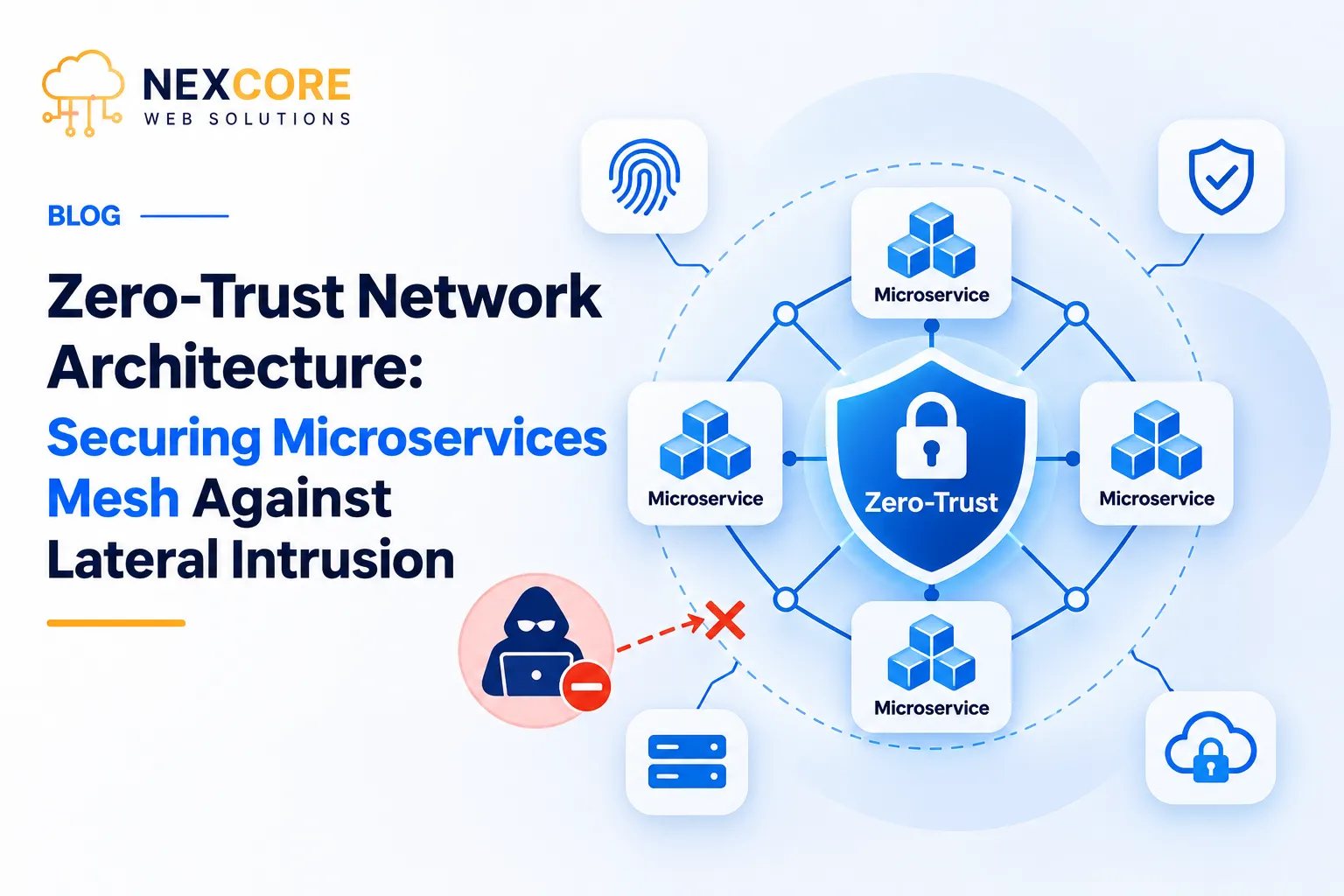
Modern applications increasingly rely on microservices, containers, APIs, and distributed cloud infrastructure. While this architecture improves scalability and development speed, it also creates a larger internal attack surface. Once an attacker gains access to a single workload, traditional network models may allow them to move laterally between services and reach valuable systems. Zero-trust network architecture addresses this problem by removing the assumption that anything inside a network should be automatically trusted. Every connection must be authenticated, authorized, and monitored. When combined with a service mesh and strong workload identity, zero trust can significantly reduce the damage caused by compromised credentials, vulnerable services, or unauthorized internal access.
Why Microservices Are Vulnerable to Lateral Intrusion
In a monolithic application, many functions operate inside one tightly controlled deployment. Microservices distribute those functions across numerous independently deployed services that constantly communicate over the network. A large production environment may contain hundreds of APIs, containers, databases, queues, and supporting services. Each connection creates another path that must be secured and monitored.
Traditional perimeter security focuses heavily on preventing attackers from entering the network. However, a compromised application account or exposed workload can place an attacker inside that perimeter. If internal services trust one another based only on network location, the attacker may scan endpoints, reuse credentials, and move toward sensitive systems. This lateral movement can turn a limited security incident into a major breach.
Zero trust changes the underlying assumption. Network location alone provides no access, and every service must prove its identity before communication is permitted. Authorization policies define exactly which workloads can communicate and what actions they can perform. This approach limits unnecessary pathways and makes a compromised service less useful to an attacker.
The Core Principles of Zero-Trust Architecture
Zero trust is not a single product or firewall configuration. It is an architectural approach based on continuous verification, least-privilege access, and strong visibility. Each request should be evaluated using reliable identity and policy information rather than assuming that internal traffic is safe. Security controls should also assume that a breach is possible and limit how far an attacker can move.
A practical zero-trust design for microservices generally includes several connected controls:
- Strong identity for users, services, and workloads.
- Mutual authentication between communicating services.
- Fine-grained authorization policies.
- Network segmentation based on application requirements.
- Continuous logging and monitoring of service activity.
These controls work together because no individual mechanism can stop every attack. Encryption protects data in transit but does not decide whether a service should have access. Identity verifies who is making a request, while authorization determines what that identity can do. Monitoring then provides evidence of unusual behavior and potential policy violations.
Building Identity Into the Service Mesh
A service mesh can provide a strong foundation for zero-trust communication in distributed applications. Instead of requiring every development team to implement encryption and authentication independently, the mesh can manage secure service-to-service communication at the infrastructure layer. Workloads receive verifiable identities that can be used to establish trusted connections.
Mutual TLS, commonly called mTLS, is an important part of this model. Both the client and server authenticate each other, preventing services from blindly accepting connections from unknown workloads. Certificates are usually rotated automatically to reduce the operational risks associated with long-lived credentials. Encryption also protects internal traffic from interception when services communicate across shared infrastructure.
Identity alone is not enough, however. A valid service should not automatically gain access to every other service in the environment. Policies should define explicit relationships, such as allowing an order-processing service to contact inventory and payment APIs while blocking access to administrative databases. This creates a smaller and more intentional communication graph.
Applying Least Privilege to East-West Traffic
Microservices generate significant east-west traffic, meaning communication between systems inside the same infrastructure. This traffic often receives less scrutiny than external requests, even though it can provide attackers with valuable opportunities. A zero-trust architecture treats internal requests as security-sensitive and verifies them before access is granted.
The most effective approach is to begin with a clear inventory of service dependencies. Teams should understand which services communicate, which protocols they use, and what data is exchanged. Policies can then allow required connections while denying everything else by default. This reduces the number of routes available for unauthorized movement.
For example, a public API gateway may need access to an authentication service and selected business APIs. It should not have direct access to a financial database simply because both resources operate within the same cloud environment. Separating permissions according to actual application needs makes lateral movement more difficult and easier to detect.
Monitoring and Detecting Suspicious Movement
Zero trust should include continuous visibility rather than relying only on static access policies. Logs from the service mesh, identity provider, API gateway, and cloud platform can help security teams understand normal communication patterns. Unexpected connections, repeated authorization failures, or sudden increases in requests may indicate a compromised workload.
Behavioral monitoring is particularly valuable in large microservices environments. A service that normally communicates with three internal APIs may suddenly attempt to contact dozens of unfamiliar endpoints. Even if some requests are technically valid, the change in behavior deserves investigation. Effective monitoring helps teams identify these signals before an attacker reaches more sensitive systems.
Incident response plans should also account for distributed environments. Teams need the ability to quickly revoke a workload identity, isolate a namespace, or block a communication path without shutting down unrelated services. Practicing these procedures reduces confusion during a real security event and improves operational resilience.
Common Challenges When Adopting Zero Trust
Implementing zero trust in an existing microservices environment requires careful planning. Legacy applications may depend on broad network permissions or use protocols that were not designed for modern identity-based controls. Teams can face operational complexity when managing policies across many services, especially if ownership is distributed across multiple departments.
A gradual approach is usually more practical than attempting to secure every workload at once. Organizations can first map service dependencies and introduce monitoring before enforcing restrictive policies. High-value services and sensitive data paths should receive priority because they create the greatest potential impact. As teams gain confidence, policies can become more precise and default-deny controls can expand.
Automation is also essential for long-term success. Manual certificate management and policy updates become difficult at scale. Integrating identity, deployment pipelines, and policy validation helps ensure that security controls remain consistent as applications evolve.
Conclusion
Zero-trust network architecture provides a practical way to protect microservices against lateral intrusion by removing automatic trust from internal networks. Strong workload identity, mutual authentication, least-privilege policies, and continuous monitoring create multiple barriers that limit an attacker’s ability to move through distributed systems. A service mesh can simplify many of these controls by standardizing secure communication across applications. The most successful implementations begin with visibility and accurate dependency mapping before gradually enforcing stricter access rules. Zero trust is ultimately an ongoing security practice rather than a one-time deployment. As services, teams, and threats change, policies and monitoring must evolve to keep internal infrastructure secure.
FAQs
What is zero-trust network architecture?
Zero-trust network architecture is a security approach that requires users, devices, and workloads to verify their identity before accessing resources. It does not assume that systems inside a corporate or cloud network are automatically safe. Access is granted according to explicit policies and the principle of least privilege, helping organizations reduce unauthorized access and limit lateral movement after a security incident.
How does a service mesh support zero trust?
A service mesh can standardize security controls for communication between microservices. It can provide workload identity, mutual TLS encryption, traffic policies, and detailed observability without requiring every application to implement these capabilities independently. This makes it easier to apply consistent authentication and authorization rules across distributed environments while giving security teams better visibility into internal network activity.
What is lateral movement in a microservices environment?
Lateral movement occurs when an attacker who has gained access to one system attempts to reach additional services or resources. In a microservices environment, poorly controlled internal connections can make this easier. Zero-trust policies reduce the risk by limiting each workload to only the services and resources required for its legitimate function.
Is mutual TLS enough to secure microservices?
Mutual TLS is important because it encrypts traffic and allows services to authenticate each other, but it does not provide complete security by itself. Organizations also need authorization policies that control which authenticated services can communicate. Monitoring, secure identity management, segmentation, and incident response procedures provide additional protection against compromised workloads and unauthorized activity.
How should organizations begin implementing zero trust?
Organizations should start by identifying critical services, sensitive data, and existing communication paths between workloads. Monitoring can reveal normal traffic patterns before restrictive policies are introduced. Teams can then implement strong identities, mutual authentication, and least-privilege rules for high-risk systems first. A phased approach helps avoid unexpected application failures while steadily reducing unnecessary internal access.




