
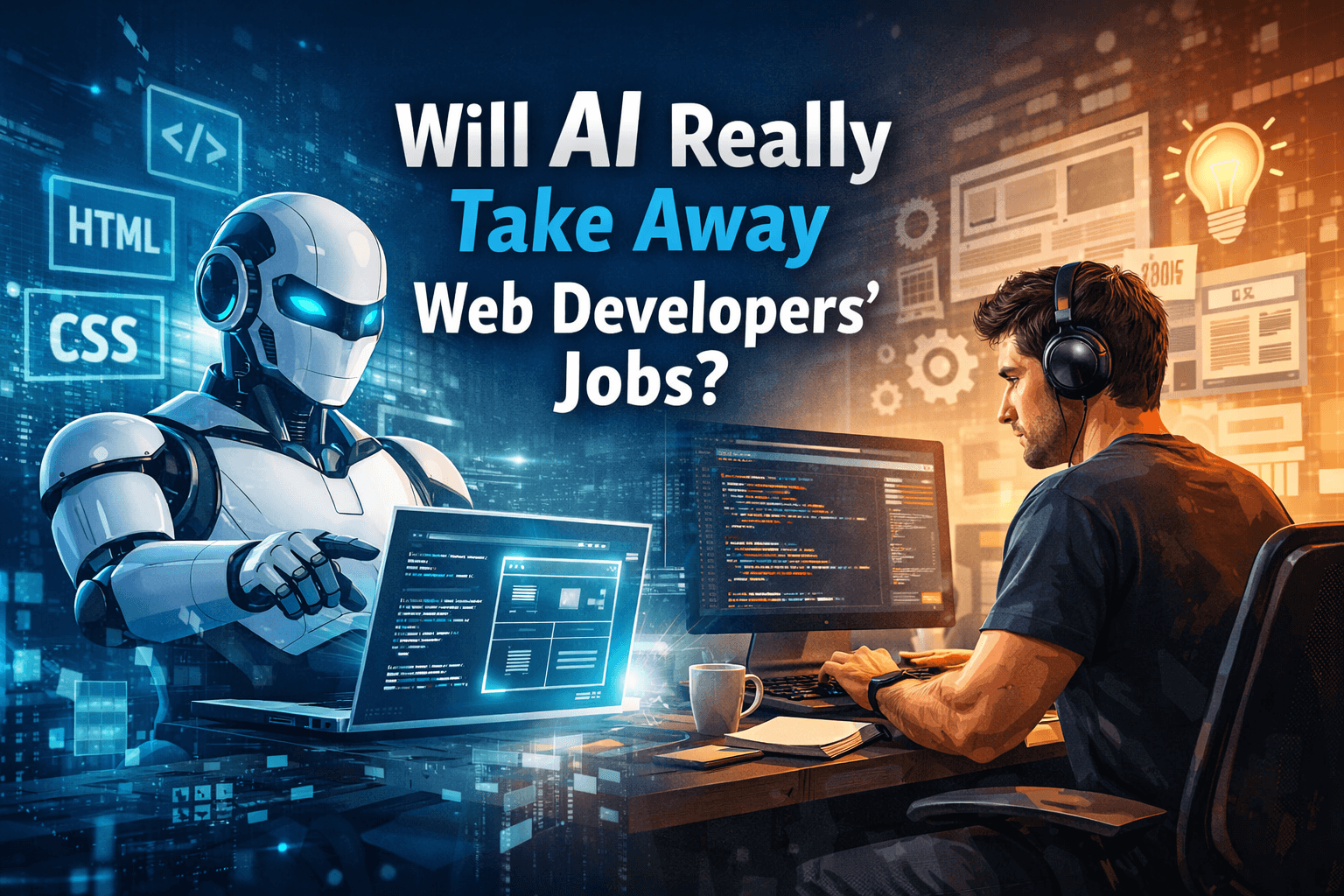
Over the last few years, Artificial Intelligence has advanced with startling velocity. What once appeared experimental now feels almost routine. Tools can draft code in seconds, sketch out full web interfaces, correct syntax blunders, and even propose refinements before a human has finished their coffee. Such acceleration has unsettled many within the technology sphere.
A pressing question lingers in quiet conversations and late-night reflections:
Will AI truly displace web developers?
For freelancers and boutique agency owners, the concern is not abstract. It is intimate. When algorithms assemble landing pages in mere minutes, anxiety is understandable. Yet before surrendering to alarm, it is wise to widen the lens.
The panorama is far less ominous than it first appears.
Why the Fear Feels Justified
On the surface, AI seems almost omnipotent.
Today, one can:
- Command it to compose HTML, CSS, or JavaScript.
- Produce a polished landing page from a single directive.
- Diagnose coding errors instantly.
- Construct a rudimentary website without manual scripting.
From a client’s vantage point, this appears seductive—expedited delivery, diminished expense, reduced reliance on developers.
It becomes tempting to conclude:
If AI performs these tasks, why retain web developers at all?
Yet that conclusion rests on a narrow understanding of what web development actually entails.
Crafting a Website Is Far More Than Writing Code
To the uninitiated, web development resembles mere syntax assembly. Seasoned professionals know otherwise. Code is only the visible scaffolding; the real labor resides beneath the surface.
When building a site for a client, a developer is:
- Interpreting commercial objectives.
- Anticipating user behavior patterns.
- Engineering structural logic.
- Weighing performance thresholds and scalability.
- Addressing unforeseen technical snags.
- Translating abstract ideas into functional systems.
AI can generate outputs. It cannot internalize intention.
A thoughtful developer asks:
- Who precisely is the intended audience?
- What behavioral action should the interface encourage?
- How will the system evolve over the next several years?
- Where might vulnerabilities emerge?
Artificial Intelligence produces responses derived from data patterns. A human architect formulates solutions rooted in comprehension.
The distinction is profound.
AI as an Instrument, Not a Substitute
History offers perspective. When calculators entered classrooms, some predicted the obsolescence of mathematicians. That prophecy never materialized. Calculators accelerated arithmetic; they did not abolish mathematical reasoning.
AI occupies a similar role within web development.
It enables developers to:
- Assemble repetitive code with swiftness.
- Rectify minor defects instantly.
- Generate structural templates effortlessly.
- Expedite routine workflows.
Rather than exhausting hours on boilerplate tasks, developers can now devote attention to architectural foresight, system resilience, and inventive problem-solving.
In truth, AI amplifies the capabilities of competent professionals.
Where the Tremors May Be Felt
Honesty demands acknowledgment: the terrain is shifting.
Developers who subsist solely on elementary assignments—minor template alterations or simplistic static pages—may encounter intensified competition. If a client can fabricate a basic site independently, they may bypass outsourcing that specific function.
However, digital ecosystems are becoming increasingly intricate. Growing enterprises require:
- Customized administrative dashboards.
- Secure payment infrastructures.
- Seamless API integrations.
- Intelligent automation layers.
- High-grade performance calibration.
These endeavors demand analytical rigor and contextual understanding—territory where human cognition remains paramount.
The True Hazard: Stagnation
The genuine peril does not stem from AI itself.
It arises from immobility.
Technological evolution has always unsettled the status quo. When WordPress proliferated, murmurs of extinction circulated. When no-code platforms gained traction, skepticism surged. Yet developers who refined their expertise did not vanish—they flourished.
The same trajectory is unfolding now.
Those who:
- Integrate AI into their workflow intelligently,
- Deepen their mastery of frameworks and architecture,
- Comprehend commercial strategy alongside technical execution,
- Prioritize user experience design,
- Remain vigilant toward emerging paradigms,
will not merely endure—they will ascend.
Resistance, not automation, breeds obsolescence.
The Enduring Human Edge
There remains a dimension AI cannot replicate: nuanced human discernment.
Clients seldom engage developers purely for syntax. They seek:
- Strategic counsel.
- Reliability.
- Creative interpretation.
- Sustained collaboration.
A business owner values someone who listens, challenges assumptions, and assumes responsibility. An algorithm does not shoulder accountability.
When a platform falters at an inconvenient hour, no one telephones a machine. They reach out to a trusted professional.
Moreover, aesthetic judgment, brand storytelling, and experiential design demand emotional sensitivity. AI extrapolates from precedent; humans originate from imagination.
There is a qualitative difference between prediction and creation.
The Trajectory Ahead
The future will not resemble a duel between AI and web developers.
It will reflect a divergence between developers who harness AI and those who disregard it.
Organizations will increasingly favor professionals adept at leveraging intelligent tools—individuals capable of accelerating delivery, refining precision, and elevating outcomes without sacrificing strategic depth.
AI will recalibrate expectations. It will intensify competition. It will refine standards.
Such transformation is not destructive; it is catalytic.
So, Will AI Really Take Away Web Developers’ Jobs?
The candid answer is this:
AI will reconfigure the profession, but it will not eradicate it.
It will eliminate monotonous repetition.
It will mechanize elementary coding.
It will reshape developmental methodologies.
Yet it will not supplant the necessity for perceptive, adaptable, and strategically minded web developers.
Technological advancement rarely annihilates skilled practitioners. Instead, it compels evolution. Those who cultivate adaptability, intellectual agility, and a symbiotic relationship with AI will not merely survive within this new epoch—they will define it.
Written by Divyam Roy
Published on: February 18, 2026
Reading Time: 8–10 Minutes
Author Background: Web Developer & Software Engineer with 5+ Years of Experience in Website and Application Development




