
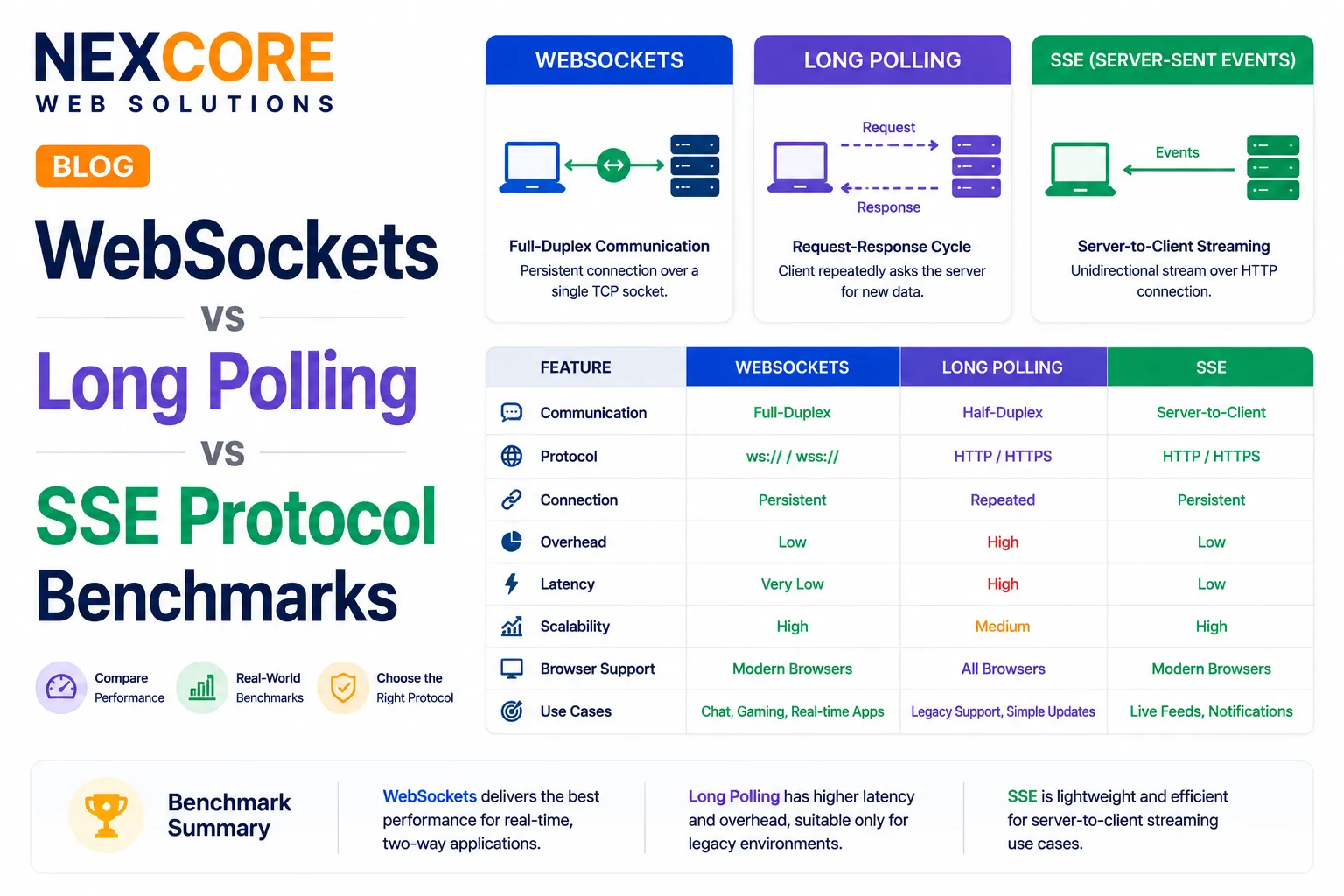
Modern web applications often need to deliver information to users without requiring them to repeatedly refresh a page. Chat applications, live dashboards, notifications, trading interfaces, multiplayer systems, and monitoring tools all benefit from some form of real-time or near-real-time communication. Three commonly discussed approaches are WebSockets, long polling, and Server-Sent Events (SSE). Each uses a different communication model, which affects latency, connection overhead, scalability, browser compatibility, and implementation complexity. Comparing these technologies through meaningful benchmarks is more useful than simply declaring one protocol the fastest. Network conditions, message frequency, payload size, concurrent connections, server architecture, and application behavior can significantly influence results. The right choice therefore depends on the workload the application actually needs to support.
How the Three Protocols Work
WebSockets
WebSockets create a persistent connection between the client and server that supports two-way communication. After the initial HTTP-based handshake, the connection remains open so either side can send messages whenever necessary. This makes WebSockets particularly suitable for applications where the client frequently sends data back to the server as well as receiving updates. Chat systems, multiplayer games, collaborative applications, and live trading interfaces are common examples.
Long Polling
Long polling uses ordinary HTTP requests but keeps each request open until the server has new information or a timeout occurs. When the server responds, the client immediately starts another request. This creates a near-real-time experience without requiring a persistent bidirectional protocol. Long polling can work with infrastructure that already supports standard HTTP, but repeated requests introduce additional connection and request-management overhead.
Server-Sent Events
SSE allows a server to maintain an HTTP connection and continuously send events to a browser. Unlike WebSockets, communication is primarily one-way, from server to client. Browsers provide the EventSource API for receiving SSE streams, which makes the technology relatively straightforward for browser-based notification and update systems. SSE is useful when the server needs to push information while the client does not need an equivalent persistent channel for sending messages.
Latency Benchmarks
Latency measures how quickly an update travels from the server to the client. WebSockets generally perform well for low-latency applications because an established connection can carry messages immediately in either direction. SSE can also provide low-latency server-to-client delivery because the connection remains open and events can be streamed as they become available. Long polling may introduce additional delay when a request reaches its timeout or when the client must establish a new request after receiving a response.
However, real-world latency depends on more than protocol design. Network distance, proxies, TLS overhead, server processing time, buffering behavior, mobile connectivity, and application-level queues can all affect results. A benchmark showing a few milliseconds of difference in a local environment may not represent production behavior. Testing should therefore use realistic network conditions and representative message patterns.
Connection Overhead
Connection overhead becomes important when an application maintains thousands or millions of clients. WebSockets and SSE can maintain persistent connections, reducing the need to repeatedly establish HTTP requests. Long polling requires a continuous cycle of requests and responses, which can increase request processing and connection-management overhead. The actual resource impact depends on HTTP version, server implementation, proxy configuration, and how efficiently connections are handled.
CPU and Memory Considerations
Persistent connections consume server resources even when no messages are being transmitted. WebSockets and SSE therefore require infrastructure capable of maintaining many open connections efficiently. Long polling may distribute the workload differently because requests periodically close and reopen, but the repeated request lifecycle can create its own CPU and network costs. Benchmarking should measure both active traffic and idle connection scenarios.
Throughput and Message Frequency
Throughput describes how efficiently a system can handle a volume of messages or events. WebSockets are generally strong for high-frequency bidirectional communication because both sides can send messages over the same persistent connection. SSE can efficiently stream frequent server-generated events, particularly when the client mainly receives information. Long polling can work well for relatively infrequent updates but becomes less attractive when events arrive constantly because the request-response cycle creates additional overhead.
Scalability Benchmarks
Scalability depends heavily on the architecture surrounding the protocol. A WebSocket deployment may require connection-aware load balancing and appropriate handling of persistent sessions. SSE deployments also need infrastructure capable of maintaining long-lived HTTP connections and correctly forwarding streaming responses through proxies. Long polling may integrate more naturally with conventional HTTP infrastructure, but high request volumes can increase application and network overhead.
A useful benchmark should measure more than the number of successful connections. Teams should record CPU usage, memory consumption, network bandwidth, connection failures, message latency, throughput, reconnect rates, and behavior during traffic spikes. Testing should also include realistic disconnects because mobile devices and unstable networks frequently cause clients to reconnect.
Reliability and Reconnection
Network interruptions are unavoidable in many production environments. SSE includes browser-oriented reconnection behavior through its standard API, which can simplify certain applications. WebSocket clients typically require explicit reconnection logic, including backoff and connection-state management. Long polling naturally creates repeated requests, but clients still need appropriate timeout and retry handling to prevent aggressive reconnect loops.
Choosing the Right Protocol
The best protocol depends primarily on communication requirements.
- WebSockets: Best for bidirectional, low-latency communication and high-frequency interaction.
- SSE: Best for continuous server-to-client updates such as notifications, dashboards, and feeds.
- Long polling: Useful when persistent streaming protocols are unsuitable or existing HTTP infrastructure strongly favors request-response communication.
The decision should also consider proxy support, infrastructure capabilities, browser requirements, message frequency, security controls, and operational complexity. A simple notification feed does not necessarily need the additional complexity of WebSockets.
How to Run a Meaningful Benchmark
A useful benchmark should reproduce the expected production workload. Test different concurrent connection counts, message frequencies, payload sizes, network conditions, and connection durations. Measure p50, p95, and p99 latency rather than relying only on average latency because tail performance often reveals problems affecting real users. Run tests long enough to expose memory growth, connection leaks, reconnect storms, and performance degradation.
Conclusion
WebSockets, long polling, and SSE each provide valid approaches to delivering timely information through web applications, but their performance characteristics differ. WebSockets are generally well suited to highly interactive bidirectional workloads, while SSE provides a simpler solution for continuous server-to-client streaming. Long polling remains useful in environments where conventional HTTP behavior is preferred or persistent streaming is impractical. Rather than selecting a protocol based on isolated benchmark numbers, teams should test realistic workloads involving concurrency, latency, message frequency, failures, and reconnect behavior. A well-designed benchmark provides evidence about the application’s actual bottlenecks and helps engineers choose a communication model that balances performance, reliability, scalability, and implementation complexity.
FAQs
1. Which is faster: WebSockets, SSE, or long polling?
There is no universal winner for every workload, but WebSockets and SSE generally provide efficient low-latency delivery because they maintain persistent connections. Long polling can introduce additional request and response overhead, particularly when updates are frequent. The practical difference depends on network conditions, server architecture, message frequency, and payload size. Production benchmarks should therefore measure latency and resource usage under realistic workloads.
2. When should I use WebSockets?
WebSockets are a strong choice when both the client and server need to communicate frequently over a persistent connection. Common examples include chat applications, multiplayer games, collaborative interfaces, live trading systems, and interactive dashboards. They provide bidirectional communication with low messaging overhead after connection establishment. Developers should still account for reconnection, authentication, scaling, connection management, and load-balancing requirements.
3. Is SSE better than WebSockets for notifications?
SSE can be a simpler choice when notifications only need to travel from the server to the browser. It uses standard HTTP and provides a convenient browser API for receiving a continuous event stream. WebSockets become more appropriate when the client also needs frequent real-time communication through the same connection. The choice should depend on whether the application requires one-way or bidirectional communication.
4. Is long polling still useful?
Yes, although newer applications often prefer persistent streaming approaches when their infrastructure supports them. Long polling can be useful when compatibility with conventional HTTP infrastructure is important or when updates are relatively infrequent. It is also conceptually straightforward because it uses normal HTTP requests. However, repeated requests can create additional overhead as concurrency and message frequency increase.
5. What should I measure in a real-time protocol benchmark?
A meaningful benchmark should measure latency, throughput, CPU consumption, memory usage, network bandwidth, connection stability, and reconnect behavior. Looking at p50, p95, and p99 latency can reveal slow outliers that averages hide. Tests should vary concurrent connections, message frequency, payload size, and network quality. Long-duration testing is also useful for detecting resource leaks and performance degradation over time.




