
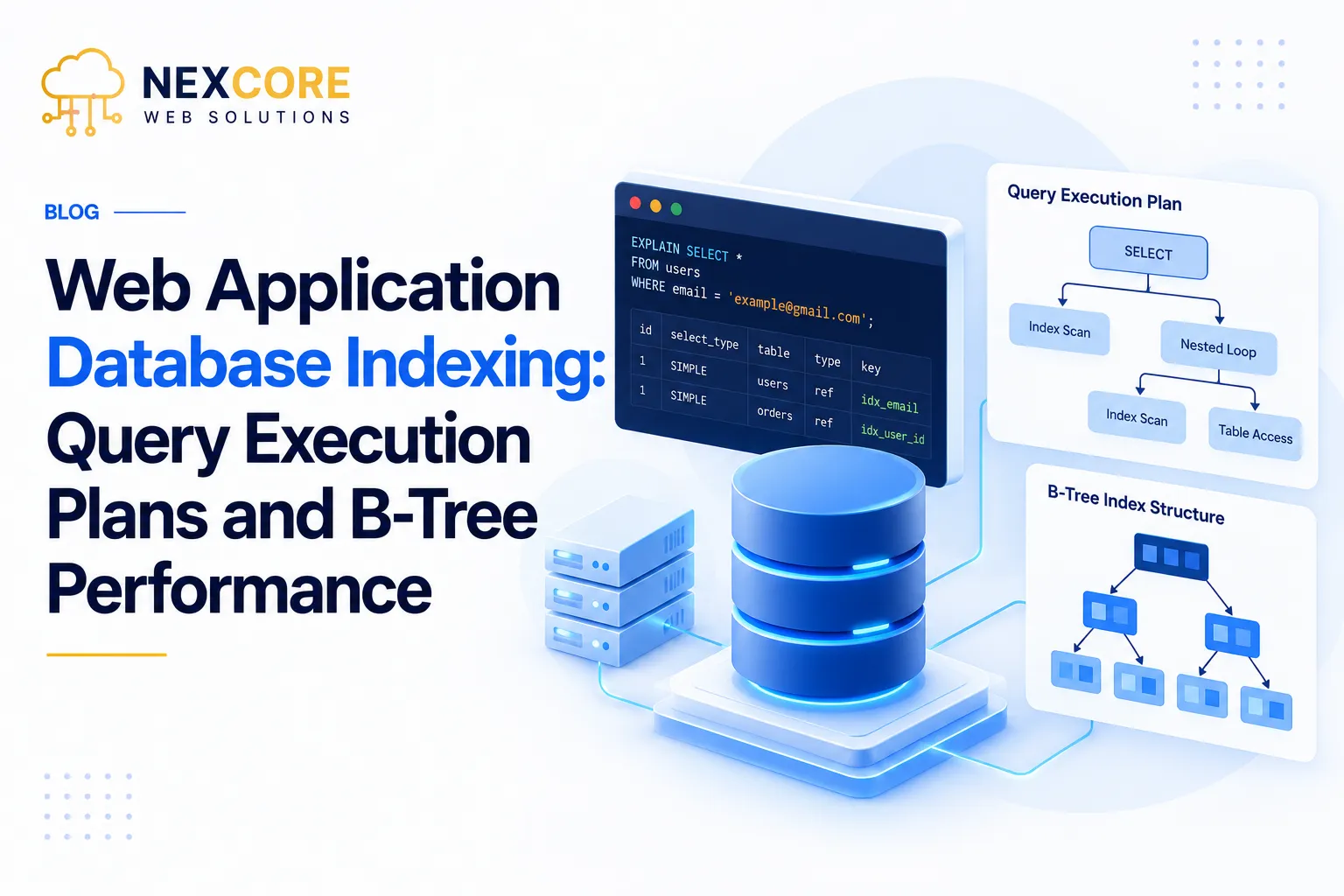
Database performance becomes increasingly important as a web application grows from hundreds to millions of records. A query that works instantly on a small development database can become noticeably slow when production data expands. Database indexes help reduce this problem by giving the database engine efficient paths for locating required rows instead of scanning an entire table. Among the available index structures, B-Tree indexes are widely used because they support common equality, range, sorting, and ordering operations efficiently. However, simply adding indexes does not guarantee better performance. Developers must understand query execution plans, index selectivity, table statistics, and workload patterns to determine whether an index actually improves a query.
What Database Indexing Does
Why Indexes Matter
A database index is an additional data structure designed to help the database locate rows more efficiently. Without an appropriate index, a database may perform a sequential scan, examining many or all rows before returning the requested results. With a suitable index, the database can often navigate directly toward matching records. This difference becomes significant when a web application frequently queries large tables using the same columns.
For example, consider an e-commerce application with millions of customer records and a query that searches for a customer by email address. An index on the email column can allow the database to locate the matching record without scanning every customer row. However, the index itself requires storage and must be updated when indexed data changes. Good database design therefore balances faster reads against additional storage and write overhead.
Understanding B-Tree Indexes
How B-Trees Work
B-Tree indexes organize values in a balanced tree structure that allows database engines to search efficiently. Instead of examining every indexed value sequentially, the engine navigates through tree levels until it reaches the relevant key and associated row location. Balanced structures keep search paths relatively short as the index grows. This makes B-Trees effective for many common application queries.
B-Tree indexes are especially useful for equality and range conditions. Queries using operators such as =, <, >, <=, and >= can often benefit from them, depending on the database system and query structure. They can also support ordering operations when the requested sort aligns with the index. For example, an index on created_at may help retrieve recently created records efficiently and reduce the work required for certain ORDER BY queries.
Query Execution Plans
What an Execution Plan Shows
A query execution plan describes how the database intends to retrieve and process data. It can reveal whether the optimizer chooses an index scan, sequential scan, join strategy, sorting operation, aggregation method, or another execution technique. Developers can inspect plans using database-specific tools such as EXPLAIN and, where supported, EXPLAIN ANALYZE. These tools are valuable because the SQL statement alone does not reveal the actual work performed by the database.
Suppose a developer creates an index on user_id but notices that a query still performs a sequential scan. That does not necessarily mean the index is broken. The optimizer may determine that scanning the table is cheaper because the query returns a large percentage of rows, the table is small, or statistics indicate that an index would provide little benefit. Execution plans therefore provide evidence for optimization decisions instead of encouraging developers to guess.
Index Selectivity and Query Performance
Why Selectivity Matters
Index selectivity describes how effectively an indexed column distinguishes between rows. A column containing mostly unique values, such as a user identifier, generally has higher selectivity than a column containing only a few possible values, such as a boolean status field. Highly selective indexes are often more useful for locating a small subset of records. Low-selectivity indexes may still be valuable in certain workloads, but their usefulness depends on the query and database optimizer.
For instance, an index on email is usually highly selective because different users typically have different email addresses. An index on is_active, containing only true and false values, may provide limited benefit when most rows have the same value. Developers should evaluate actual data distribution rather than assuming every frequently filtered column deserves an index. Production statistics often reveal patterns that are not visible in small development datasets.
Composite B-Tree Indexes
Indexing Multiple Columns
Composite indexes contain multiple columns and can be useful when applications frequently filter or sort using a combination of fields. For example, a web application might repeatedly query orders by customer_id and created_at. A composite index involving those columns can support such queries more efficiently than unrelated single-column indexes in some workloads.
Column order matters significantly in a composite index. A database may be able to use the leading portion of the index effectively while gaining less benefit from columns that appear later when the query does not constrain the earlier columns. Developers should therefore design composite indexes around real query patterns rather than simply combining columns with high usage. Reviewing execution plans and application query logs can help identify appropriate ordering.
Common Indexing Mistakes
Adding too many indexes is a common performance mistake. Every additional index consumes storage and may increase the cost of INSERT, UPDATE, and DELETE operations because index structures must also be maintained. Duplicate or rarely used indexes can add overhead without providing meaningful benefits. Indexes should therefore be treated as performance tools that require ongoing evaluation.
Another mistake is optimizing queries without checking execution plans. Developers sometimes create indexes based solely on intuition and assume that the database will automatically use them. In reality, the optimizer considers table statistics, estimated row counts, available indexes, filtering conditions, and execution costs. Measuring query behavior before and after an indexing change provides a much more reliable basis for optimization.
Practical Indexing Workflow
A practical workflow starts by identifying slow or frequently executed queries. Developers can then inspect their execution plans, check filtering and sorting conditions, and determine whether an appropriate index could reduce the amount of work. After creating or modifying an index, the query should be measured again using representative production-like data. This process prevents premature optimization and helps confirm that the change produces a measurable improvement.
Database indexing should also be reviewed as applications evolve. A query pattern that works well today may become inefficient after data volume, traffic, or application features change. Monitoring query latency, execution plans, and index usage helps teams identify emerging bottlenecks. Combining careful SQL design with appropriate B-Tree indexes usually produces more predictable database performance than relying on indexes alone.
Conclusion
Database indexing is one of the most important techniques for improving web application performance, but effective indexing requires more than adding indexes to frequently queried columns. B-Tree structures provide efficient support for many equality, range, and ordering operations, while query execution plans reveal how the database actually processes SQL statements. Selectivity, composite index design, data distribution, and write overhead all influence whether an index is beneficial. Developers should measure real queries, inspect execution plans, and validate changes against realistic datasets. By treating indexing as an evidence-based optimization process rather than a checklist, development teams can reduce query latency, control database resources, and build applications that remain responsive as their data grows.
FAQs
What is a database index?
A database index is a separate data structure that helps the database locate rows more efficiently. Instead of scanning an entire table for every query, the database can use an appropriate index to find relevant records more directly. Indexes can significantly improve read performance, especially on large tables, but they require additional storage and can increase the cost of data modification operations.
Why are B-Tree indexes commonly used?
B-Tree indexes are popular because they provide efficient searching across ordered values and support many common SQL operations. They can be useful for equality comparisons, range conditions, and certain sorting operations. Their balanced structure keeps search paths efficient as the amount of indexed data grows. This makes them a practical general-purpose index structure for many relational database workloads.
What is a query execution plan?
A query execution plan describes the strategy a database optimizer chooses to execute a SQL query. It can show operations such as sequential scans, index scans, joins, sorting, filtering, and aggregation. Developers can use tools such as EXPLAIN to inspect these decisions. Studying execution plans helps identify expensive operations and determine whether an index is actually being used effectively.
Can too many indexes slow down a database?
Yes. Although indexes can accelerate read operations, they also consume storage and must be maintained when indexed rows are inserted, updated, or deleted. A table with many unnecessary indexes can therefore experience increased write overhead. Duplicate or rarely used indexes may provide little value. Developers should periodically review index usage and remove indexes that no longer support important application queries.
How do I know whether an index improves a query?
The most reliable approach is to compare query execution before and after the indexing change. Inspect the execution plan, measure execution time, and examine estimated or actual rows processed when the database provides that information. Testing should use realistic data volumes because an index that appears unnecessary on a small development database may become valuable at production scale.




