
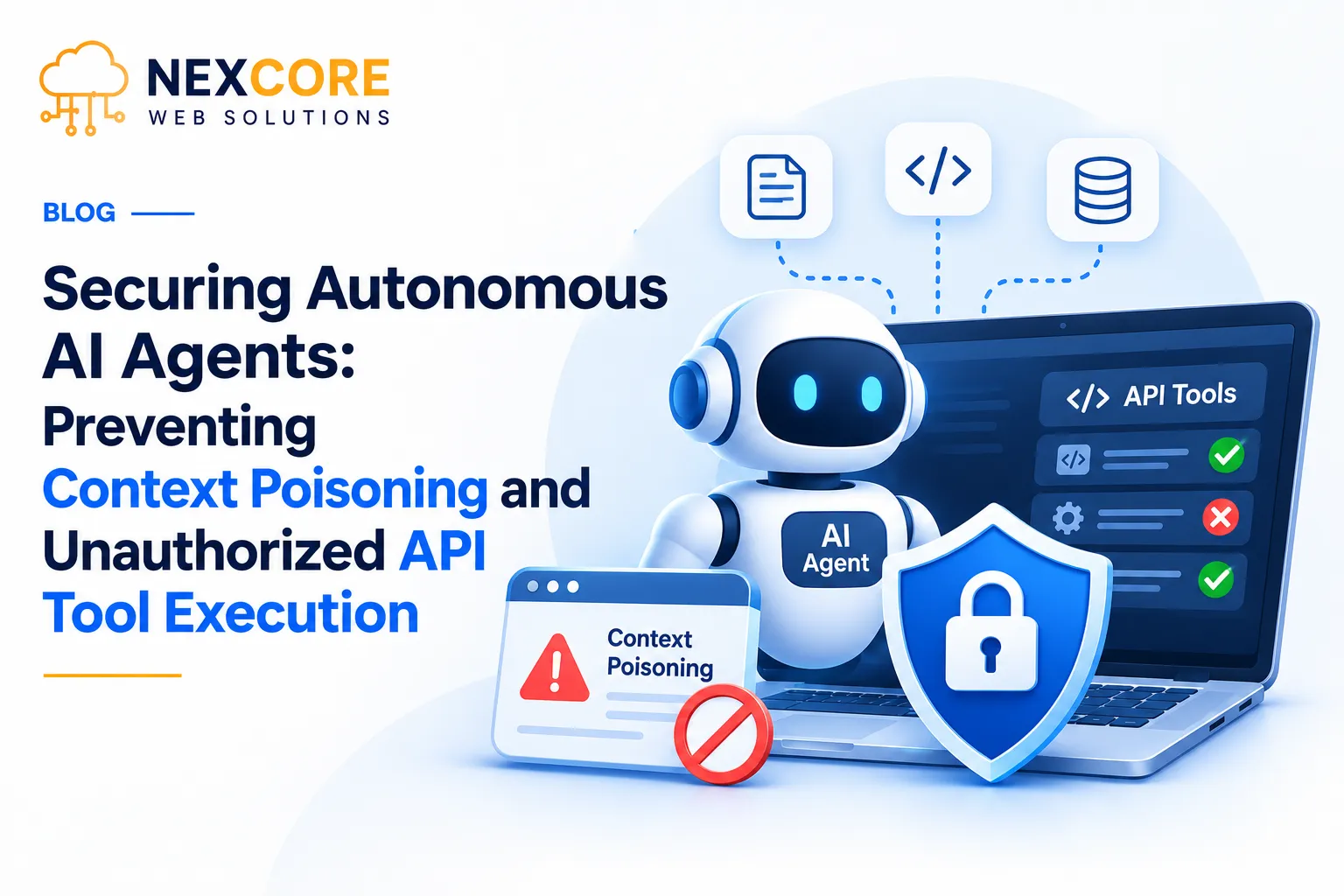
Autonomous AI agents are changing how organizations automate research, customer support, software operations, and business workflows. Unlike traditional chatbots, these systems can interpret information, make decisions, call external tools, and complete multi-step tasks with limited human intervention. That capability also introduces a broader security challenge because an agent may process untrusted content before taking actions in connected systems. Context poisoning and unauthorized API tool execution can turn seemingly harmless data into a path toward unintended behavior. Organizations therefore need security controls that protect the agent’s instructions, limit its permissions, and verify sensitive actions. Building secure autonomous agents requires treating prompts, tools, data sources, and execution environments as connected parts of a larger security boundary.
Understanding the Security Risks of Autonomous Agents
An autonomous agent typically combines a language model with memory, retrieval systems, APIs, and decision-making logic. It may read documents, search internal knowledge bases, send messages, update records, or trigger infrastructure workflows. Each additional capability creates another potential point where untrusted input can influence the system. Security teams must therefore evaluate the complete agent workflow rather than focusing only on the underlying language model.
The most serious risks often emerge when an agent cannot reliably distinguish between trusted instructions and untrusted data. A malicious instruction hidden inside a retrieved document may attempt to influence how the agent interprets its task. If the agent also has broad access to external tools, that manipulation could lead to an unauthorized action. Strong architecture separates information processing from permission to perform sensitive operations.
What Is Context Poisoning?
Context poisoning occurs when untrusted content influences an AI system’s behavior in an unintended way. This content may appear in documents, web pages, database records, emails, or other information processed by an agent. The goal may be to override legitimate instructions, manipulate decisions, or persuade the system to expose sensitive information. Because agents often retrieve large amounts of external context, identifying malicious or irrelevant instructions can be challenging.
A practical defense begins by treating retrieved content as data rather than as trusted commands. The agent should have clear system-level rules that cannot be replaced by text contained in a document or search result. Applications can also validate and filter external content before it enters a sensitive workflow. Logging retrieved sources helps security teams investigate whether unexpected behavior was influenced by a particular piece of context.
Establishing Clear Trust Boundaries
Every agent architecture should define which inputs are trusted and which are potentially hostile. System instructions, application policies, and authorization rules should remain separate from user-provided or retrieved content. Combining all information into a single undifferentiated prompt makes it harder to maintain these boundaries. Clear separation also helps developers understand which parts of a workflow require additional validation.
Trust boundaries should extend to memory systems as well. An agent that automatically stores every interaction may preserve malicious instructions and expose them during future tasks. Long-term memory should use validation rules, expiration policies, and appropriate access controls. Sensitive decisions should never depend solely on information that has not been verified.
Controlling API and Tool Permissions
An AI agent should not receive unrestricted access to every API available within an organization. The principle of least privilege is especially important because language models can make unexpected decisions when processing complex instructions. Each tool should receive only the permissions necessary for its intended task. For example, an agent that reads customer account information may not need permission to change billing records.
Tool access should also be scoped to specific actions rather than broad administrative capabilities. Instead of giving an agent complete database access, an organization can provide a narrowly defined service that performs approved operations. This reduces the potential impact if an agent is manipulated or behaves incorrectly. Smaller permissions are easier to monitor, audit, and revoke when necessary.
Require Validation Before Sensitive Actions
High-impact actions should pass through an additional validation layer before execution. The agent can prepare a proposed action, but a policy engine or approval workflow should determine whether the action is allowed. This approach is useful for financial transactions, data deletion, account changes, and production infrastructure operations. It prevents the language model from becoming the final authority on sensitive decisions.
Validation can examine the user’s identity, the requested operation, the target resource, and organizational policies. Some workflows may require explicit human approval when the potential impact exceeds a defined threshold. Automated approval can still be appropriate for low-risk and repetitive actions. The important principle is that risk determines the level of control.
Designing Safer Agent Tool Interfaces
The design of a tool interface can significantly affect agent security. Tools should use structured inputs with clearly defined parameters instead of accepting unrestricted natural-language commands. Input validation can reject unexpected values before an external API receives a request. This reduces the chance that manipulated context is converted directly into an unsafe action.
Developers should also avoid returning more sensitive information than the agent needs to complete a task. A tool can expose a limited response containing only the required fields instead of an entire customer record or system configuration. Data minimization reduces the impact of accidental disclosure. It also makes it easier to understand what information an agent can access during a particular workflow.
Monitoring Agent Behavior in Production
Secure agent systems require continuous monitoring after deployment. Organizations should record important events such as tool requests, authorization decisions, retrieved sources, and execution outcomes. These logs create an audit trail that can help identify unusual patterns or investigate incidents. Monitoring should focus on security-relevant behavior without unnecessarily storing sensitive user content.
Teams can establish alerts for unexpected tool usage, repeated failed authorization attempts, or unusually large volumes of data access. Rate limits can further reduce the impact of a compromised or malfunctioning agent. Regular reviews of permissions and tool usage help identify access that is no longer required. Security controls should evolve as agents gain new capabilities and connect to additional systems.
Testing for Agent Security Failures
Security testing should include scenarios where the agent encounters misleading or malicious content. Teams can evaluate whether untrusted documents influence tool selection or cause the agent to request actions outside its assigned role. Testing should also confirm that authorization systems reject prohibited operations even when the agent attempts them. These exercises help identify weaknesses before a workflow reaches production.
Red-team testing can provide valuable insights by simulating realistic attempts to manipulate agent behavior. The objective is not simply to test whether a model follows a prompt, but to examine the entire chain from input to execution. Developers should test retrieval systems, memory, APIs, policy controls, and monitoring together. A secure model interaction does not guarantee a secure agent architecture.
Conclusion
Autonomous AI agents can automate complex tasks, but their ability to access information and execute tools creates security responsibilities that traditional applications may not face. Context poisoning can manipulate an agent’s reasoning, while excessive API permissions can turn an incorrect decision into a damaging action. Effective protection starts with clear trust boundaries, least-privilege access, structured tool interfaces, and independent authorization controls. Organizations should also monitor agent behavior and regularly test workflows against realistic security failures. The safest approach is to assume that external content can be untrusted and that an AI model should not act as the final security authority. With layered controls and careful system design, enterprises can use autonomous agents while maintaining meaningful control over sensitive data and operations.
Frequently Asked Questions
What is context poisoning in an AI agent?
Context poisoning occurs when untrusted information processed by an AI agent influences its behavior in an unintended way. The content may come from retrieved documents, websites, emails, or stored memory. A secure architecture treats external information as data rather than trusted instructions and uses clear boundaries to prevent unverified content from controlling sensitive actions.
Why should AI agents use least-privilege API access?
Least-privilege access limits an agent to the tools and permissions required for its specific job. If the agent processes misleading content or behaves unexpectedly, restricted permissions reduce the potential impact. Narrowly scoped APIs are also easier to monitor and audit, helping organizations identify unnecessary access and maintain stronger control over sensitive operations.
Can human approval improve AI agent security?
Human approval can provide an important additional safeguard for high-impact actions. An agent can analyze information and prepare a proposed action, while a qualified person confirms sensitive decisions before execution. This approach is especially useful for financial transactions, data deletion, account changes, and production infrastructure operations where an incorrect automated action could have serious consequences.
How can organizations monitor autonomous AI agents?
Organizations can monitor agents by recording important events such as tool requests, authorization decisions, data access, and execution results. Security teams can create alerts for unusual activity, repeated failures, or unexpected use of sensitive tools. Regular reviews of these records help identify emerging risks and ensure that agent permissions remain appropriate as workflows change.
What is the most important security principle for AI agents?
A critical principle is to separate an agent’s ability to interpret information from its authority to perform sensitive actions. External content should not directly determine permissions or bypass security controls. Independent policy checks, least-privilege access, and structured validation create layers of protection, ensuring that an agent cannot execute unauthorized operations simply because it received misleading context.




