
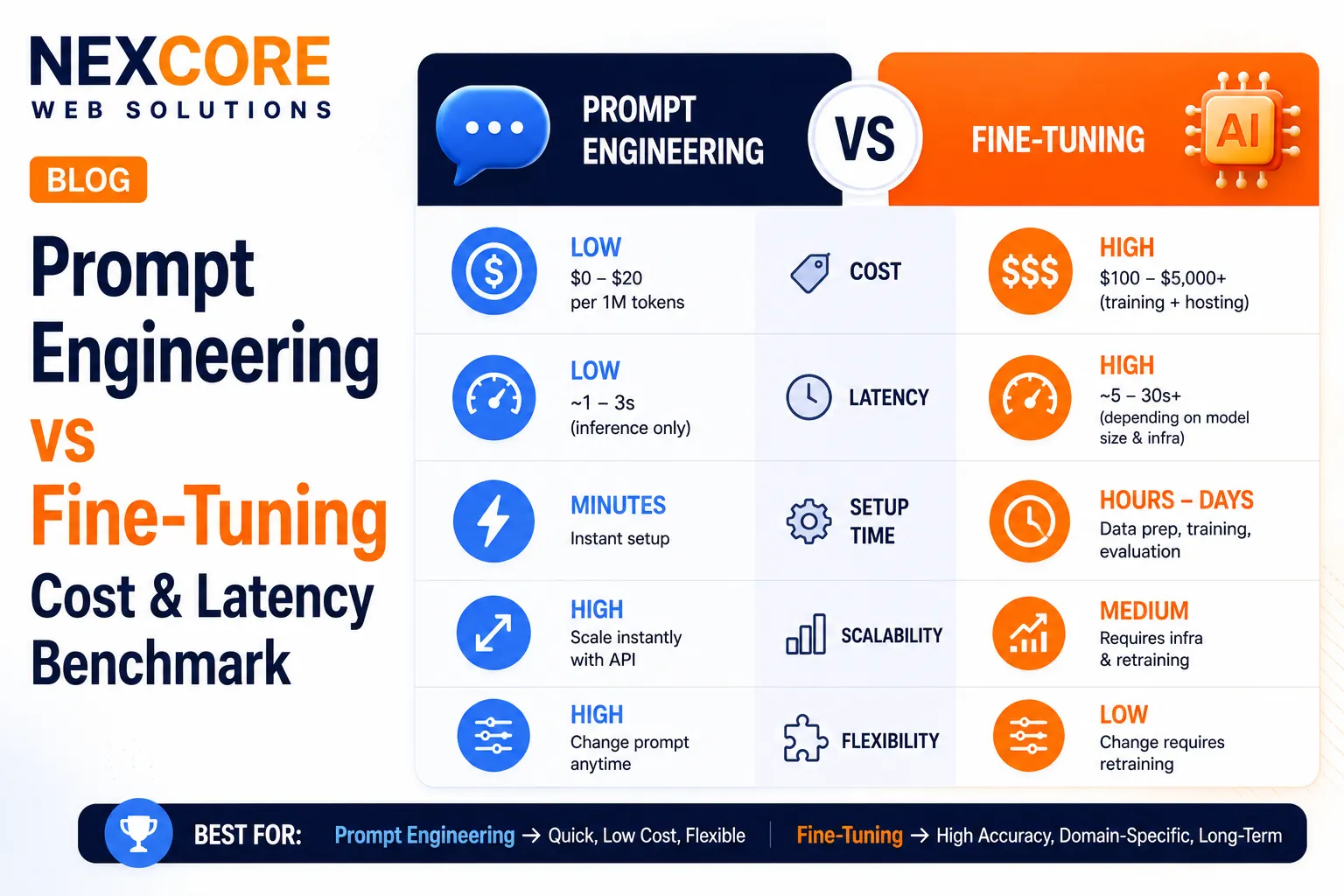
Choosing between prompt engineering and fine-tuning is an important decision when building production applications with large language models. Both approaches can improve how a model performs a specific task, but they affect cost, latency, maintenance, and development effort in different ways. Prompt engineering modifies the instructions and context sent to an existing model, while fine-tuning changes model parameters using a specialized training dataset. A well-designed prompt can often deliver improvements without the expense of creating and maintaining a training pipeline. Fine-tuning, however, can provide more consistent behavior for specialized tasks and may reduce the amount of instruction required at inference time. Comparing the two through cost and latency benchmarks helps teams choose an approach based on measurable workload requirements rather than assumptions.
Understanding Prompt Engineering
Prompt engineering involves designing instructions, examples, formatting requirements, and contextual information that guide a model toward a desired output. Developers can improve prompts without modifying the underlying model weights. Techniques include few-shot examples, structured instructions, role definitions, output schemas, and carefully selected context. This approach is usually fast to test because changes can be made directly at inference time.
Prompt Cost Model
Prompt-based systems incur inference costs every time the application sends instructions and context to the model. Long system instructions, examples, retrieved documents, and conversation history can increase input token usage. If the same large prompt is sent thousands or millions of times, these additional tokens can become a meaningful operational expense. Prompt optimization therefore includes reducing unnecessary context while preserving the information required for reliable outputs.
Understanding Fine-Tuning
Fine-tuning trains a base model on a specialized dataset so that its behavior adapts to particular examples and task requirements. Instead of repeatedly providing extensive demonstrations inside every prompt, some desired patterns can be learned into the model parameters. Fine-tuning can be useful for consistent formatting, classification, specialized writing behavior, or domain-specific task performance. It requires additional preparation and evaluation compared with changing a prompt.
Fine-Tuning Cost Model
Fine-tuning introduces costs beyond ordinary inference. Teams may need to prepare and clean training data, run training jobs, evaluate the resulting model, maintain model versions, and periodically retrain when requirements change. The resulting model may also have different inference pricing from the base model. A realistic cost benchmark should therefore include both the initial investment and the ongoing operating cost.
Latency Comparison
Latency depends on model size, token count, infrastructure, network conditions, and the amount of computation required to generate the response. Prompt engineering can increase latency when large instructions or contextual documents substantially increase the input token count. Fine-tuning may reduce the need for repeated examples or lengthy instructions, potentially reducing input processing. However, fine-tuning does not automatically make model generation faster because output length and model architecture remain major contributors to response time.
First-Token Latency
Time to first token is particularly important for interactive applications. Large prompts can increase the amount of input the model must process before generating an answer. A shorter prompt made possible through fine-tuning may improve this component of latency. Nevertheless, benchmark results should separate time to first token from total response time because users can perceive these metrics differently.
Throughput Considerations
Throughput measures how many requests a system can process within a given period. Prompt-heavy applications may consume more input tokens per request, affecting model capacity and token-based billing. Fine-tuned models can potentially operate with smaller prompts for repetitive tasks, which may improve efficiency in certain workloads. The actual result depends on provider infrastructure, model configuration, concurrency limits, and request patterns.
A Practical Benchmark Framework
A useful benchmark should compare both approaches using the same model family, task dataset, output requirements, and production-like request distribution. Measure several dimensions rather than focusing on one number.
| Metric | Prompt Engineering | Fine-Tuning |
|---|---|---|
| Initial development cost | Usually lower | Usually higher |
| Training cost | None | Required |
| Prompt size | Can be larger | Can often be smaller |
| Inference cost | Depends on prompt length | Depends on model pricing and tokens |
| Latency | Sensitive to input context | May benefit from shorter prompts |
| Flexibility | High | Requires retraining for major changes |
| Maintenance | Prompt management | Model and dataset management |
This table is a planning framework rather than a universal performance result. Actual costs and latency vary significantly between providers, models, workloads, and deployment configurations.
When Prompt Engineering Wins
Prompt engineering is often the better starting point when requirements change frequently or the task is still being explored. It allows developers to test different instructions quickly without preparing a training dataset. It is also useful when applications require dynamic context, such as retrieved documents, user-specific information, or changing business rules. For many general-purpose tasks, a carefully designed prompt can provide sufficient quality at lower development complexity.
When Fine-Tuning Wins
Fine-tuning becomes more attractive when the same specialized behavior is required repeatedly at high volume. If a model consistently needs the same examples, formatting instructions, or task-specific behavior, embedding some of that behavior into the model may reduce prompt complexity. Fine-tuning can also improve consistency for narrow classification or structured-generation workloads. However, teams should validate quality improvements against the additional training and maintenance costs before committing to it.
Hidden Costs and Maintenance
A benchmark that measures only API pricing can produce misleading conclusions. Prompt engineering may require extensive experimentation and prompt-version management, while fine-tuning requires dataset maintenance, evaluation pipelines, model versioning, and retraining. Fine-tuned models can also become outdated when business requirements change. Prompt-based systems can adapt more easily to changing instructions but may require more inference context.
Benchmarking Under Real Traffic
Testing should use realistic concurrency, input sizes, output lengths, and failure scenarios. Measure average latency as well as p50, p95, and p99 values because tail latency can affect user experience significantly. Track input and output tokens, cost per request, requests per second, error rates, and quality scores. If the application uses retrieval or external tools, those components should be measured separately so they do not distort the model comparison.
Quality Must Be Included
Cost and latency are meaningful only if the resulting outputs meet the required quality standard. A cheaper approach that produces incorrect classifications may create greater business costs downstream. Build an evaluation dataset containing typical, difficult, ambiguous, and edge-case inputs. Compare accuracy, consistency, formatting compliance, and failure behavior alongside performance metrics before choosing an architecture.
Conclusion
Prompt engineering and fine-tuning solve different optimization problems, so there is no universal winner. Prompt engineering usually offers lower initial complexity, faster experimentation, and greater flexibility, while fine-tuning can provide consistent specialized behavior and potentially reduce repeated prompt context. The right decision depends on workload volume, quality requirements, input size, latency targets, model pricing, and how frequently requirements change. Teams should benchmark both approaches using the same evaluation dataset and realistic traffic patterns. Cost per request, total latency, throughput, quality, and maintenance effort should all be considered. In many projects, prompt engineering is the sensible first step, with fine-tuning introduced only when measured evidence shows that it provides a worthwhile advantage.
FAQs
1. Is prompt engineering cheaper than fine-tuning?
Prompt engineering is often cheaper to start because it does not require a training dataset or fine-tuning job. However, long prompts can increase recurring inference costs because input tokens are processed on every request. Fine-tuning introduces upfront training and evaluation costs but may reduce prompt length for repetitive workloads. The cheaper option depends on request volume, prompt size, model pricing, and long-term maintenance requirements.
2. Does fine-tuning make an AI model faster?
Fine-tuning does not automatically make a model faster. However, it can reduce the amount of repeated instruction or examples required in each prompt, potentially lowering input processing time. Total latency still depends heavily on model architecture, output length, network conditions, and provider infrastructure. Benchmarking time to first token and total response time is necessary to determine whether fine-tuning provides a meaningful latency improvement.
3. When should I choose prompt engineering?
Prompt engineering is a strong choice when requirements are changing, the application needs dynamic context, or the task can already be handled effectively by a general-purpose model. It is also useful during early development because prompts can be modified and evaluated quickly. If extensive examples or instructions are repeatedly required and the workload is large, fine-tuning may become worth evaluating later.
4. When is fine-tuning worth the additional cost?
Fine-tuning can be worthwhile when a high-volume application needs consistent specialized behavior that prompting alone cannot reliably achieve. It can be particularly useful for narrow classification, formatting, or domain-specific workflows. Before investing, teams should compare the quality improvement against training costs, inference costs, maintenance requirements, and retraining needs. A benchmark using real application data provides stronger evidence than theoretical assumptions.
5. How should I benchmark prompt engineering versus fine-tuning?
Use the same task dataset, model family, output requirements, and production-like traffic conditions for both approaches. Measure quality, input and output tokens, cost per request, time to first token, total latency, throughput, and error rates. Include p95 and p99 latency to capture slow requests. Testing representative edge cases is also essential because average performance can hide important reliability differences.




