
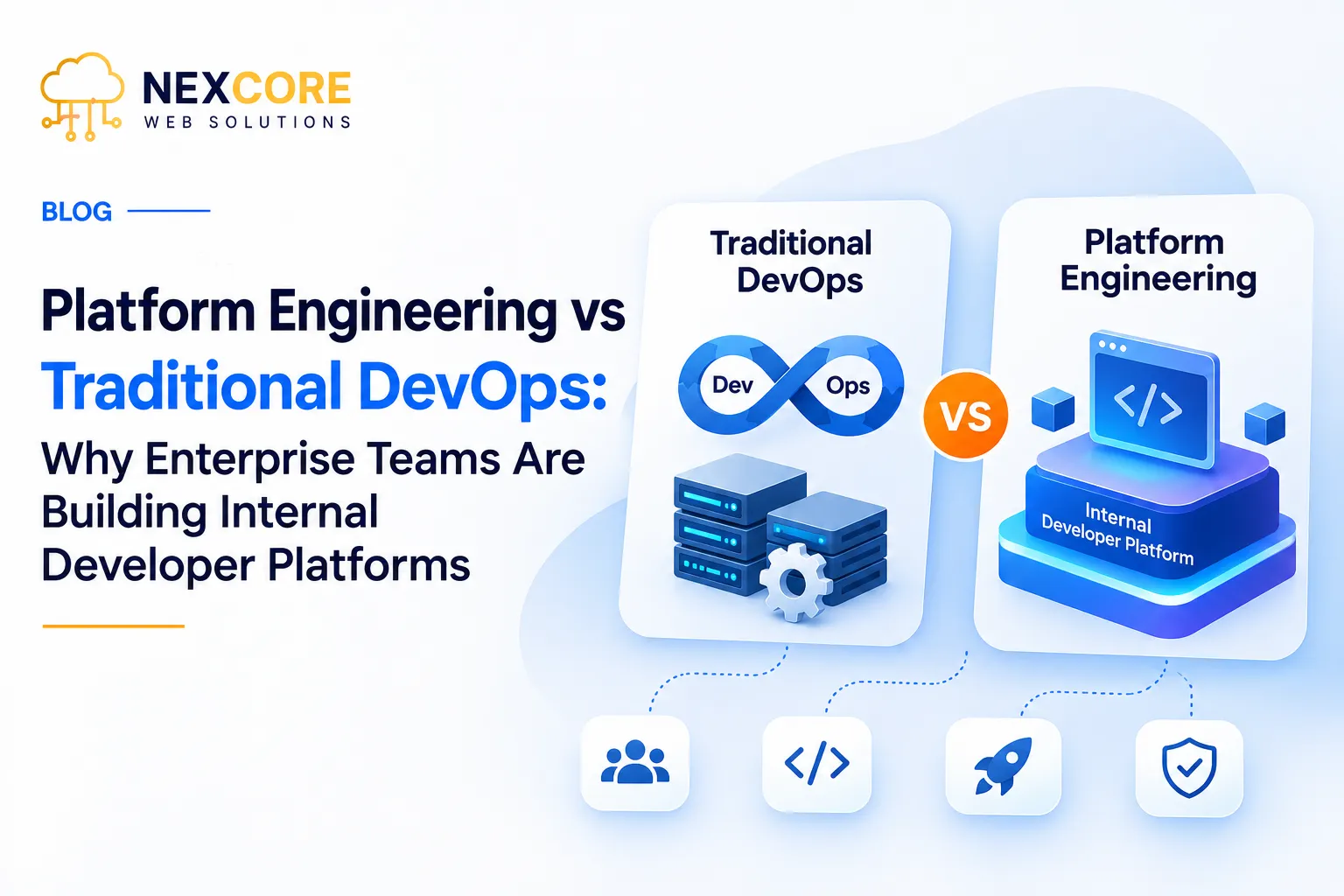
Enterprise software development has become more complex as organizations adopt cloud infrastructure, containers, microservices, and automated delivery pipelines. Traditional DevOps practices helped development and operations teams collaborate more closely, but scaling those practices across hundreds of engineers can create new challenges. Developers may spend too much time navigating infrastructure tools, requesting access, and maintaining deployment configurations instead of building products. Platform engineering addresses this problem by creating shared internal platforms that simplify common development and operational tasks. These Internal Developer Platforms, or IDPs, provide standardized workflows while allowing teams to retain flexibility where it matters. Understanding the difference between platform engineering and traditional DevOps helps enterprises decide how to improve developer productivity without creating another layer of unnecessary complexity.
Understanding Traditional DevOps
DevOps is primarily a cultural and operational approach that brings software development and IT operations closer together. Its goal is to reduce organizational silos and improve the speed and reliability of software delivery. Teams commonly adopt practices such as continuous integration, continuous delivery, infrastructure as code, automated testing, and shared monitoring. Rather than throwing an application over the wall to an operations department, developers take greater responsibility for how their software runs in production.
This approach works especially well when teams have the skills and autonomy to manage their own infrastructure. However, enterprise environments often contain many cloud accounts, security requirements, deployment tools, and shared services. Each product team may create its own scripts and workflows to solve similar problems. Over time, this freedom can produce inconsistent infrastructure and a growing maintenance burden for both developers and operations specialists.
What Platform Engineering Changes
Platform engineering applies product-thinking principles to internal infrastructure and developer tooling. A dedicated platform team builds reusable capabilities that other engineering teams can consume through self-service interfaces. Instead of asking every developer to understand the details of Kubernetes, networking, or cloud permissions, the platform provides a simpler path for common tasks. Developers can focus on application logic while the underlying platform handles approved infrastructure patterns.
An Internal Developer Platform does not replace DevOps culture. Instead, it can provide the technical foundation that makes DevOps practices easier to scale across a large organization. The platform team treats developers as internal customers and improves the platform based on real feedback. This product mindset distinguishes platform engineering from a traditional centralized operations team that simply controls infrastructure access.
The Developer Experience Becomes a Priority
A well-designed internal platform reduces unnecessary cognitive load. For example, a developer who wants to launch a new service should not need to manually configure logging, monitoring, secrets, networking, and deployment pipelines from scratch. The platform can provide approved templates and automated defaults for these common requirements. Teams still need visibility and control, but they no longer have to repeatedly solve the same infrastructure problems.
This consistency can also improve the onboarding experience. New engineers can follow established workflows instead of learning a different deployment process for every application. Documentation becomes more useful when the underlying platform follows common patterns. As a result, enterprises can reduce the time required to move from a new project idea to a working production service.
Comparing Platform Engineering and DevOps
Traditional DevOps and platform engineering share several goals, including faster delivery, reliable systems, and stronger collaboration. The main difference lies in how organizations scale those goals. DevOps often encourages individual teams to own the tools and processes required to operate their services. Platform engineering creates shared abstractions so teams can access those capabilities without managing every implementation detail.
| Area | Traditional DevOps | Platform Engineering |
|---|---|---|
| Primary focus | Collaboration and shared operational responsibility | Building reusable internal developer capabilities |
| Infrastructure ownership | Often managed directly by individual teams | Simplified through self-service platform services |
| Standardization | Can vary between teams | Encourages consistent, approved workflows |
| User perspective | Engineering teams operate their own systems | Developers are treated as internal platform customers |
| Scaling challenge | Tooling complexity can grow with the organization | Shared platform reduces duplicated infrastructure work |
Neither approach is automatically better in every situation. A small organization may not need a dedicated platform team because direct communication and simple tooling are sufficient. Larger enterprises, however, often benefit when common infrastructure capabilities become reliable products rather than collections of independently maintained scripts.
Why Enterprises Are Investing in Internal Developer Platforms
The biggest reason enterprises build IDPs is scale. As the number of applications and engineering teams increases, infrastructure complexity can become a significant productivity problem. Developers may need to understand multiple deployment systems, security policies, cloud services, and operational dashboards. A platform creates a consistent layer between developers and this increasingly complicated technical environment.
Security and governance also become easier to manage when common workflows are standardized. The platform can include approved identity controls, secret management, logging, and compliance checks by default. This reduces the need for developers to remember every organizational requirement during each deployment. Importantly, good platform engineering makes secure practices easier rather than adding more approval steps.
Self-Service Without Losing Control
Self-service is a central feature of successful Internal Developer Platforms. Developers should be able to create environments, deploy applications, and access approved services without waiting for repeated manual assistance. At the same time, the platform must enforce appropriate boundaries around security, cost, and reliability. The goal is not unrestricted access to every infrastructure resource.
For example, a development team might select a standard database or deployment template through an internal portal or configuration interface. The platform then applies organizational policies automatically in the background. This approach gives teams faster access to infrastructure while reducing the risk of inconsistent manual configuration. It also allows infrastructure specialists to focus on improving the platform rather than responding to repetitive support requests.
The Risks of Building the Wrong Platform
Platform engineering can fail when organizations build a large platform before understanding what developers actually need. An internal platform overloaded with features may become another complicated system that teams are forced to navigate. Enterprises should avoid treating the platform as a technology showcase or attempting to replace every existing tool at once. The most valuable platforms usually begin by solving a small number of frequent and expensive problems.
Developer feedback should guide platform priorities. Teams should measure whether common workflows are becoming faster, easier, and more reliable after adopting the platform. If engineers continue creating their own alternatives, the platform may not provide enough practical value. Successful adoption depends on making the preferred path genuinely easier than maintaining independent infrastructure solutions.
Building a Practical Platform Engineering Strategy
Organizations should start by identifying repeated engineering tasks that consume significant time across multiple teams. Common candidates include service creation, environment provisioning, deployment automation, observability, and access management. The platform team can then create a reusable workflow that addresses these needs without hiding important information from developers. Starting with proven pain points makes it easier to demonstrate value and earn internal trust.
The platform should evolve as a product rather than remain a fixed infrastructure project. Usage data, support requests, and developer feedback can reveal where the experience needs improvement. Clear ownership is essential because shared platforms require continuous maintenance and documentation. Enterprises should also allow exceptions when specialized workloads have legitimate requirements that do not fit the standard path.
Conclusion
Platform engineering represents an evolution in how large organizations scale DevOps practices. Traditional DevOps encourages collaboration and shared responsibility, but enterprise growth can make independent tooling difficult to manage. Internal Developer Platforms provide reusable, self-service capabilities that reduce infrastructure complexity and improve the developer experience. The strongest platforms do not remove developer autonomy; they eliminate repetitive operational work while preserving flexibility for meaningful technical decisions. Enterprises should begin with real developer problems, build simple and reliable workflows, and treat the platform as an internal product. When implemented thoughtfully, platform engineering can help teams deliver software faster while improving consistency, security, and operational reliability.
FAQs
What is an Internal Developer Platform?
An Internal Developer Platform is a collection of tools, workflows, and services designed to help developers build, deploy, and operate software more easily. It provides self-service access to common infrastructure capabilities while hiding unnecessary implementation complexity. The platform is usually managed by a dedicated team that treats developers as internal customers and continuously improves the experience.
Is platform engineering replacing DevOps?
Platform engineering is not replacing DevOps because the two approaches have closely related goals. DevOps focuses on collaboration, automation, and shared responsibility for software operations. Platform engineering provides reusable infrastructure and workflows that can help these practices scale across large organizations. Many enterprises use platform engineering as an extension of their existing DevOps culture rather than as a separate replacement.
Why do large enterprises need platform engineering?
Large enterprises often support many development teams, applications, cloud services, and security requirements. Without shared standards, teams can duplicate infrastructure work and create inconsistent processes. Platform engineering provides common, self-service capabilities that reduce this duplication. It also helps organizations apply security and governance requirements through automated workflows instead of relying entirely on manual reviews and individual knowledge.
What should an Internal Developer Platform include?
The contents of an Internal Developer Platform depend on the organization’s specific needs. Common capabilities include service templates, automated deployments, infrastructure provisioning, observability, access management, and secrets handling. A successful platform should focus on solving frequent developer problems instead of collecting every available tool. Simple workflows that provide clear value are generally more useful than an overly complex platform.
How can companies measure platform engineering success?
Companies can measure success by examining developer experience and operational outcomes. Useful indicators include reduced time to deploy applications, faster environment provisioning, fewer repetitive support requests, and greater adoption of approved workflows. Developer feedback is equally important because usage metrics alone cannot explain frustration or unnecessary complexity. A successful platform should make reliable software delivery easier for the teams that use it.




