
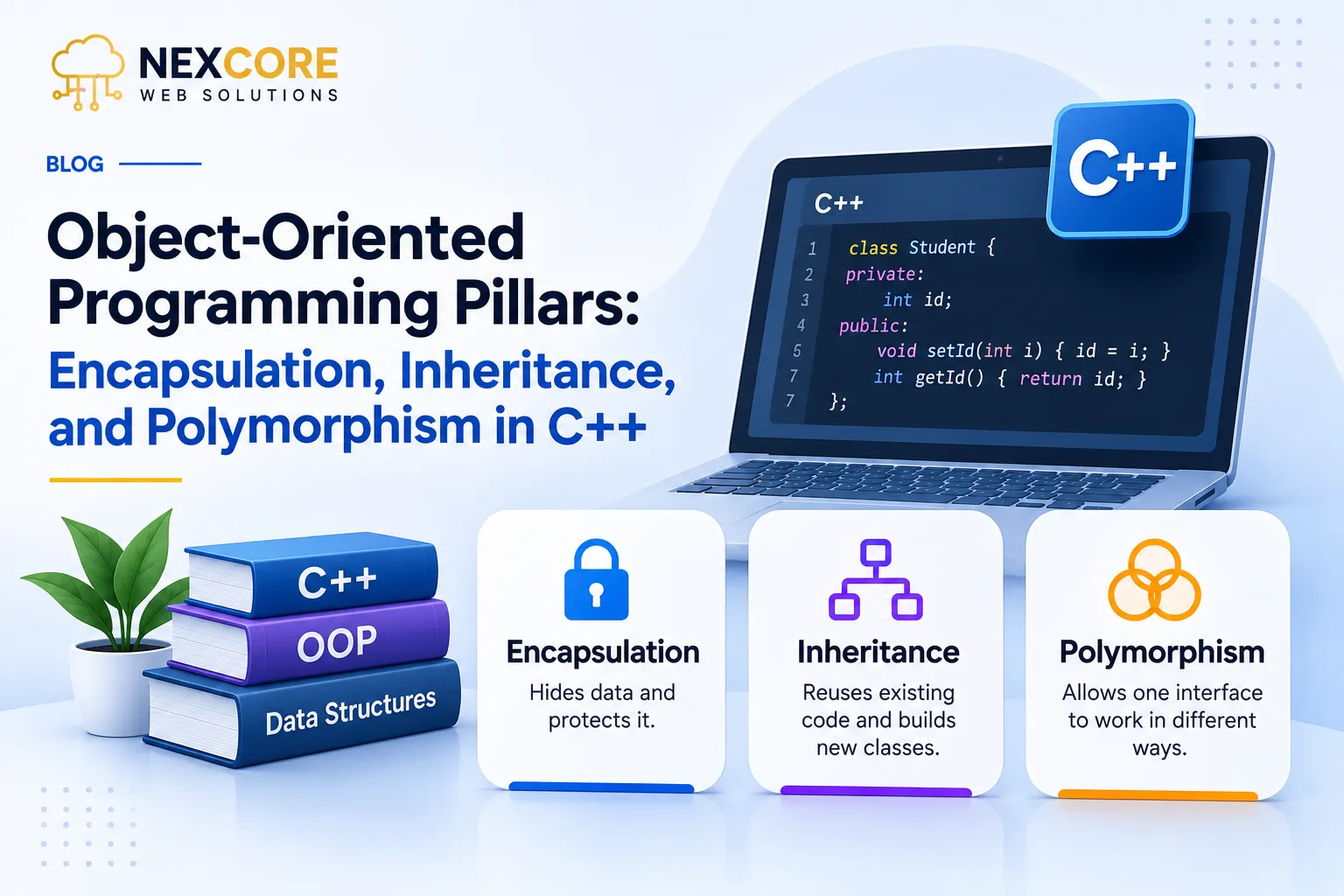
Object-Oriented Programming (OOP) is a programming approach that organizes software around objects rather than relying entirely on functions and procedures. C++ is one of the most widely used languages supporting OOP, making it suitable for applications ranging from game development and desktop software to embedded systems and large-scale enterprise solutions. Its object-oriented architecture helps developers create reusable, modular, and maintainable code. Three fundamental OOP pillars are encapsulation, inheritance, and polymorphism. These concepts work together to control data access, establish relationships between classes, and allow objects to behave differently through common interfaces. Understanding how these principles operate in C++ helps programmers design structured applications and avoid common software development problems.
Understanding Object-Oriented Programming in C++
Object-Oriented Programming uses classes and objects to represent real-world entities and software components. A class acts as a blueprint that defines data members and member functions, while an object is an individual instance created from that blueprint. For example, a Car class may contain properties such as brand, speed, and color, alongside functions that start the engine or accelerate. Multiple car objects can share the same class structure while maintaining different property values.
C++ supports OOP through features such as access specifiers, constructors, destructors, inheritance, and virtual functions. These features allow developers to control how objects are created, how their data is accessed, and how they interact with other classes. The three major pillars provide the foundation for building flexible software architectures. Each pillar solves a different design problem while contributing to better code organization.
1. Encapsulation in C++
What Is Encapsulation?
Encapsulation is the process of combining data and the functions that operate on that data within a single class. It also involves restricting direct access to internal information so that objects maintain control over their own state. C++ provides three primary access specifiers: private, protected, and public. These modifiers determine which parts of a class can be accessed from different locations in a program.
A practical example is a bank account class that stores an account balance. Allowing external code to modify the balance directly could introduce invalid values or unauthorized changes. Encapsulation prevents this by keeping the balance private and providing controlled public methods for deposits and withdrawals. This approach protects data integrity and makes application behavior easier to manage.
Encapsulation Example in C++
#include <iostream>
using namespace std;

class BankAccount {
private:
    double balance;

public:
    BankAccount(double amount) {
        balance = amount;
    }

    void deposit(double amount) {
        if (amount > 0)
            balance += amount;
    }

    double getBalance() {
        return balance;
    }
};

int main() {
    BankAccount account(1000);
    account.deposit(500);

    cout << account.getBalance();
    return 0;
}
In this example, the balance variable is private and cannot be modified directly from outside the class. The deposit() method validates the amount before updating the stored value. The getBalance() function provides controlled access to the account information. This structure reduces accidental modifications and keeps important business rules inside the class.
2. Inheritance in C++
What Is Inheritance?
Inheritance allows one class to acquire accessible properties and functions from another class. The original class is known as the base class, while the class that inherits its functionality is called the derived class. This relationship supports code reuse and helps developers organize related components into logical hierarchies. Instead of implementing common functionality repeatedly, programmers can define shared behavior once and extend it where necessary.
For example, a software application might contain a general Vehicle class with common properties such as speed and registration number. Separate classes such as Car, Bike, and Truck can inherit those properties while adding their own specialized features. C++ supports single, multiple, multilevel, hierarchical, and hybrid inheritance. The appropriate inheritance structure depends on the relationships between the classes and the responsibilities they represent.
Inheritance Example in C++
#include <iostream>
using namespace std;

class Animal {
public:
    void eat() {
        cout << "Animal is eating\n";
    }
};

class Dog : public Animal {
public:
    void bark() {
        cout << "Dog is barking\n";
    }
};

int main() {
    Dog myDog;

    myDog.eat();
    myDog.bark();

    return 0;
}
Here, Dog inherits publicly from Animal, allowing its objects to access the inherited public eat() function. The derived class also introduces its own bark() functionality. This demonstrates how inheritance extends existing functionality without duplicating the original implementation. Developers should use inheritance when a genuine is-a relationship exists, rather than simply using it to avoid writing similar code.
3. Polymorphism in C++
What Is Polymorphism?
Polymorphism means that a common interface can represent different behaviors depending on the object or function involved. It allows developers to write flexible code that works with multiple types without requiring separate instructions for every type. C++ supports two major forms: compile-time polymorphism and runtime polymorphism. Function overloading and operator overloading are common examples of compile-time polymorphism, while virtual functions enable runtime polymorphism.
Compile-time polymorphism is resolved by the compiler before program execution. Runtime polymorphism is determined during execution, typically through virtual function calls and base-class pointers or references. This distinction allows developers to select the most appropriate mechanism for their application architecture. Both forms improve code flexibility and reduce unnecessary duplication.
Runtime Polymorphism Example
#include <iostream>
using namespace std;

class Animal {
public:
    virtual void sound() {
        cout << "Animal makes a sound\n";
    }

    virtual ~Animal() = default;
};

class Dog : public Animal {
public:
    void sound() override {
        cout << "Dog barks\n";
    }
};

class Cat : public Animal {
public:
    void sound() override {
        cout << "Cat meows\n";
    }
};

int main() {
    Animal* animal;

    Dog dog;
    Cat cat;

    animal = &dog;
    animal->sound();

    animal = &cat;
    animal->sound();

    return 0;
}
The sound() function is declared virtual in the base class, allowing derived classes to provide their own implementations. When the pointer refers to a Dog, the dog’s implementation executes, and when it refers to a Cat, the cat’s implementation executes. The override keyword helps the compiler verify that derived functions correctly override virtual functions. This mechanism is particularly useful in extensible applications where new object types may be introduced later.
How the Three OOP Pillars Work Together
Encapsulation, inheritance, and polymorphism become most useful when developers combine them within a well-designed application. Encapsulation protects internal object data, inheritance allows related classes to share common functionality, and polymorphism enables different objects to respond to the same operation in their own ways. Consider a payment processing system containing different payment methods such as credit cards, digital wallets, and bank transfers. A common payment interface can define shared behavior, while individual classes implement their specific processing logic.
The system can protect transaction details through encapsulation and reuse shared payment functionality through inheritance. Runtime polymorphism allows the application to process different payment types using a common base-class interface. This reduces tightly coupled code and makes future extensions easier. Together, these principles support maintainable and scalable C++ software architecture.
Conclusion
The three fundamental pillars of Object-Oriented Programming provide a strong foundation for developing structured C++ applications. Encapsulation protects data and controls access, inheritance encourages code reuse through class relationships, and polymorphism allows different objects to implement common interfaces in different ways. Understanding these concepts helps developers move beyond basic syntax and create software that is easier to extend, test, and maintain. However, applying OOP effectively requires thoughtful class design and appropriate relationships between objects. Developers should avoid unnecessary inheritance and use encapsulation to protect important state. Mastering these principles builds a solid foundation for advanced C++ development and real-world software engineering.
FAQs
1. What are the three main pillars of OOP in C++?
The three main pillars are encapsulation, inheritance, and polymorphism. Encapsulation protects data by controlling access to class members, inheritance allows classes to reuse and extend existing functionality, and polymorphism enables different objects to respond differently through a common interface. Together, these principles help developers create modular, reusable, and maintainable C++ applications.
2. What is the difference between encapsulation and abstraction in C++?
Encapsulation combines data and related functions within a class while controlling access to internal members. Abstraction focuses on exposing essential functionality while hiding unnecessary implementation details. For example, a user can operate a bank account through public methods without understanding its internal calculations. Both concepts simplify software design, but they address different aspects of managing complexity.
3. What are the different types of inheritance in C++?
C++ supports five common inheritance types: single, multiple, multilevel, hierarchical, and hybrid inheritance. Single inheritance involves one base class, while multiple inheritance allows a derived class to inherit from several base classes. Multilevel inheritance creates a chain of classes, hierarchical inheritance gives multiple derived classes a common base, and hybrid inheritance combines different inheritance structures.
4. What is the difference between compile-time and runtime polymorphism?
Compile-time polymorphism is resolved by the compiler before program execution. Function overloading and operator overloading are common examples because the compiler selects the appropriate implementation based on the available information. Runtime polymorphism is resolved during execution using virtual functions and dynamic dispatch. It allows base-class pointers or references to invoke the correct derived-class implementation.
5. Why are virtual functions important in C++ polymorphism?
Virtual functions allow derived classes to override base-class behavior and support runtime polymorphism. When a virtual function is called through a base-class pointer or reference, C++ selects the implementation corresponding to the actual object type. This makes applications easier to extend because new derived classes can introduce specialized behavior without changing existing code that uses the common interface.




