
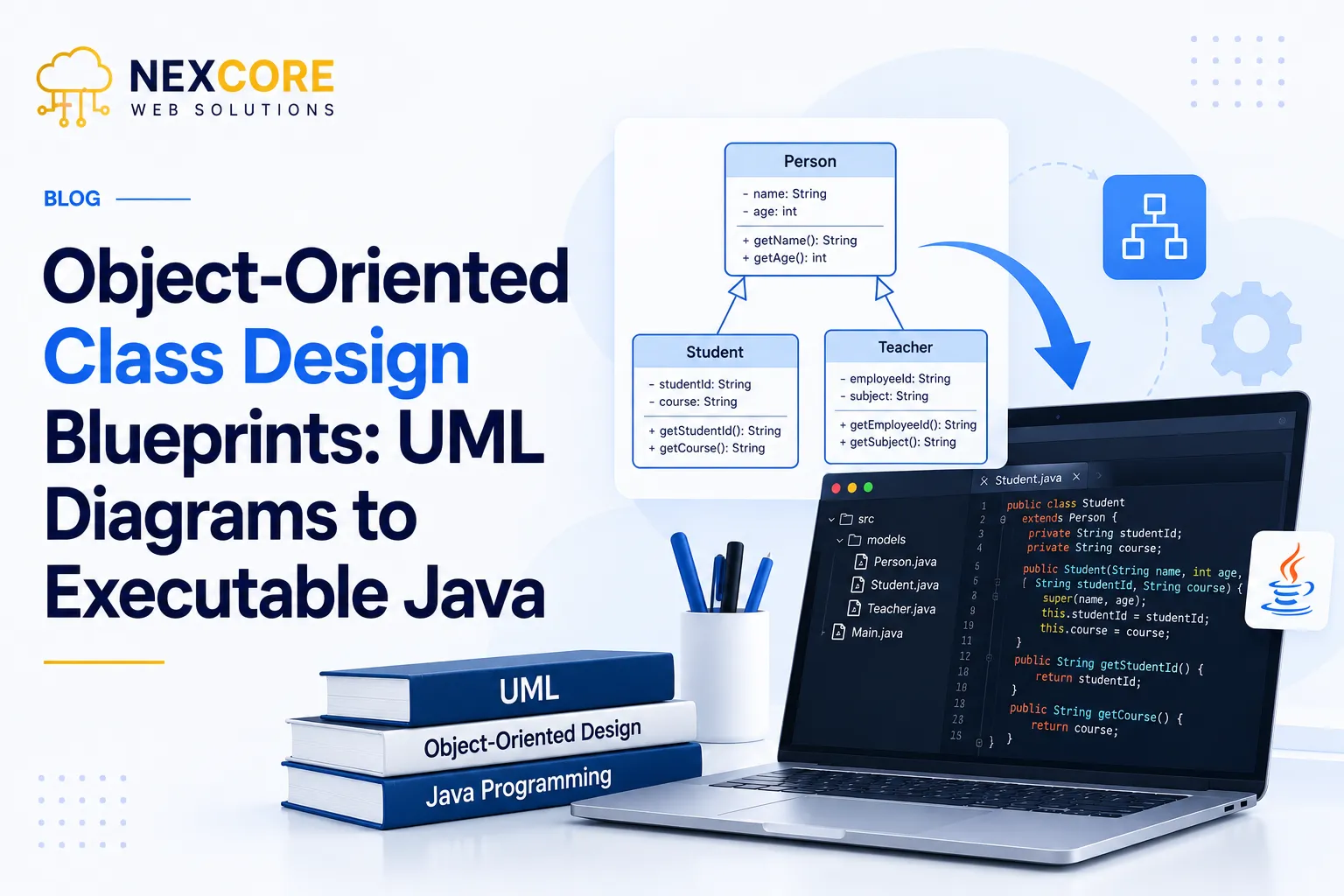
Object-oriented programming becomes easier to manage when developers can visualize software structure before writing implementation code. UML class diagrams provide a practical blueprint for identifying classes, attributes, methods, relationships, and responsibilities before converting those ideas into Java. This approach is especially useful for college projects, enterprise applications, and systems that contain multiple interacting objects. Instead of immediately creating classes and changing them repeatedly, developers can model the design and identify structural problems earlier. A well-designed UML diagram also creates a shared language between developers, analysts, and stakeholders. The real value comes from connecting the diagram to executable Java code without losing the original design intent. Understanding this transition helps developers build software that is organized, maintainable, and easier to extend.
Understanding UML Class Diagrams
A UML class diagram represents the static structure of an object-oriented system. Each class is normally shown as a rectangle divided into sections for the class name, attributes, and operations. Visibility symbols such as +, -, and # indicate public, private, and protected members. For example, a Student class might contain private attributes such as studentId and name, along with public methods for retrieving or updating relevant information.
Identifying Class Responsibilities
Good class design starts by deciding what each class should be responsible for. A Customer class should represent customer-related data and behavior rather than managing database connections, generating invoices, and sending unrelated notifications. Keeping responsibilities focused makes the system easier to understand and test. During UML modeling, developers can ask whether each class has a clear purpose and whether its methods logically belong to that class.
Modeling Attributes and Methods
Attributes describe the information maintained by an object, while methods define the behavior available to that object. In Java, attributes are commonly declared as private fields and accessed through carefully designed methods. For example, a BankAccount class could contain an account number and balance, while methods such as deposit() and withdraw() control how those values change. This design protects internal state and prevents other objects from modifying important data without validation.
Method definitions in UML should communicate more than just names. A diagram can include parameter types and return types so developers understand how operations are expected to work. A method such as calculateTotal(quantity: int, price: double): double provides a clear contract before implementation begins. Translating this contract into Java reduces ambiguity and helps developers maintain consistency between design and code.
Understanding Relationships Between Classes
Relationships are one of the most important parts of a UML class diagram because real systems rarely consist of isolated classes. Association represents a general connection between objects, while aggregation and composition describe stronger whole-part relationships. Inheritance represents an “is-a” relationship, allowing one class to derive behavior and structure from another. Choosing the correct relationship prevents unnecessary dependencies and produces a more logical object model.
Association, Aggregation, and Composition
Consider an online shopping system containing Customer, Order, and OrderItem classes. A customer can have multiple orders, so the UML diagram can represent this association with appropriate multiplicities. An order contains order items, which may be modeled using composition when those items are strongly tied to the lifecycle of the order. These distinctions help developers understand object ownership and determine how relationships should be represented in Java.
Converting UML Into Java Classes
Once the UML design is stable, each class can be translated into a Java class. The class name becomes the Java class declaration, attributes become fields, and UML operations become methods. Visibility indicators map naturally to Java access modifiers such as private, public, and protected. Relationships then guide the fields, constructors, inheritance declarations, and object interactions required by the implementation.
For example, a UML model showing Employee as a parent class and Manager as a specialized class can become a Java inheritance structure using the extends keyword. Shared properties can remain in the parent class, while specialized behavior belongs in the child class. Developers should avoid blindly translating every diagram element into code because UML describes design intent rather than every implementation detail. The final Java structure should preserve the model’s responsibilities while applying appropriate language features.
Applying Encapsulation and Inheritance
Encapsulation is central to reliable object-oriented design. Private fields prevent external code from changing internal state directly, while methods provide controlled access and validation. For example, an Employee salary should not normally be changed by arbitrary code without passing through business rules. UML helps identify these visibility boundaries before implementation, making the resulting Java code more deliberate.
Inheritance should also be used carefully because deep inheritance hierarchies can make systems difficult to maintain. If several classes share common behavior, a base class can reduce duplication, but composition may sometimes provide a cleaner alternative. UML allows developers to compare these relationships before committing to Java implementation. This makes design discussions easier and reduces costly restructuring later.
Validating the Design Before Coding
A UML diagram should be reviewed before developers begin implementing every class. Check whether each class has a clear responsibility, whether relationships reflect real business rules, and whether multiplicities make sense. Developers should also look for duplicated responsibilities, unnecessary dependencies, and classes that contain too many unrelated operations. A short design review can reveal problems that would otherwise appear after hundreds of lines of Java code have been written.
From Blueprint to Testable Software
After implementation, developers should compare the Java code against the UML model rather than treating the diagram as disposable documentation. Unit tests can verify that individual classes perform the behavior represented by their operations. Integration tests can then confirm that relationships between classes work correctly. If implementation requirements change, the UML diagram should also be updated so it remains useful for future development.
Conclusion
UML class diagrams provide a structured way to think about object-oriented systems before implementation begins. They help developers define responsibilities, model attributes and methods, select relationships, and establish clear boundaries between classes. Java then turns those design decisions into executable structures using encapsulation, inheritance, composition, interfaces, and methods. The strongest results come from treating UML and Java as connected parts of the same development process rather than separate activities. A practical workflow is to identify responsibilities, model relationships, review the diagram, implement the classes, and validate the result with tests. This approach reduces design mistakes and creates Java applications that are easier to understand, maintain, and extend.
FAQs
1. What is a UML class diagram in object-oriented programming?
A UML class diagram is a visual representation of the static structure of an object-oriented system. It shows classes, attributes, methods, visibility, and relationships such as association and inheritance. Developers use these diagrams to understand how objects should be organized before writing implementation code. They are particularly useful for communicating system structure and identifying design problems early.
2. How is a UML class converted into Java?
A UML class generally maps to a Java class declaration. Its attributes become fields, while operations become methods with corresponding parameters and return types. Visibility symbols are translated into Java access modifiers such as private or public. Relationships in the UML model guide Java features such as object references, inheritance, constructors, and composition.
3. What is the difference between aggregation and composition in UML?
Aggregation and composition both represent whole-part relationships, but composition indicates stronger ownership. In composition, the part is typically closely tied to the lifecycle of the whole object, while aggregation represents a weaker relationship where the part can exist independently. Choosing the correct relationship helps developers model ownership accurately and later implement object structures that match the intended system behavior.
4. Why is encapsulation important in Java class design?
Encapsulation protects an object’s internal state by limiting direct access to its fields. Java developers commonly use private fields and public methods to control how data is read or modified. This approach allows validation and business rules to remain inside the appropriate class. It also reduces unwanted dependencies and makes future implementation changes easier without affecting unrelated code.
5. Should every UML class become a Java class?
Not necessarily. UML represents design concepts and responsibilities, while Java contains implementation details that may require additional classes, interfaces, utility components, or framework-specific structures. A UML model should guide implementation rather than dictate every line of code. Developers should preserve the important design relationships while adapting the implementation to practical requirements, testing needs, and maintainability.




