
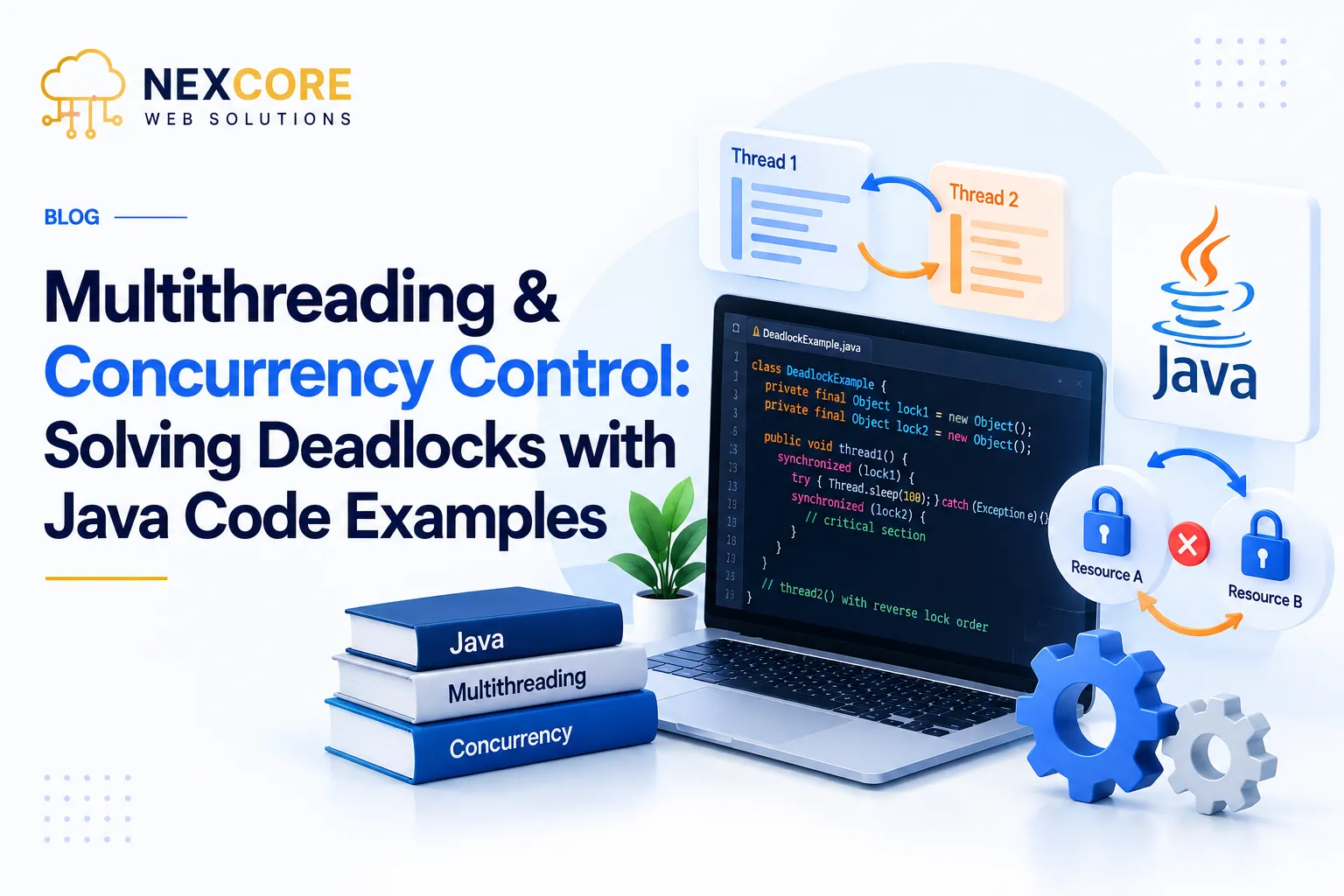
Multithreading allows a Java application to perform multiple tasks concurrently, improving responsiveness and making better use of modern processors. However, running several threads against shared resources introduces synchronization challenges that do not appear in single-threaded programs. One of the most important problems is a deadlock, where two or more threads wait indefinitely for resources held by one another. Concurrency control provides techniques for coordinating access to shared data while reducing race conditions, inconsistent states, and thread-related failures. Understanding these concepts is valuable for students preparing for technical interviews as well as developers building reliable applications. By learning how deadlocks occur and how Java synchronization mechanisms work, developers can design multithreaded programs that remain predictable under concurrent workloads.
Understanding Multithreading in Java
A thread represents an independent path of execution within a program. Java supports multithreading through classes and interfaces such as Thread, Runnable, and ExecutorService, allowing applications to execute tasks concurrently. For example, a web application may use separate threads to process multiple user requests while another background thread handles logging or scheduled work. The benefit comes with a responsibility: when threads share mutable data, their operations must be coordinated carefully.
Why Concurrency Control Matters
Suppose two threads update the same bank account simultaneously. If both read the current balance before either writes the updated value, one transaction can overwrite the other, producing an incorrect result. This is a race condition, and it demonstrates why shared resources require controlled access. Java provides synchronization tools such as synchronized, locks, atomic variables, and concurrent collections to manage these situations. The appropriate mechanism depends on the type of shared state and the performance requirements of the application.
What Is a Deadlock?
A deadlock occurs when threads become permanently blocked because each thread is waiting for a resource locked by another thread. A classic example involves two locks, where Thread A owns Lock 1 and waits for Lock 2, while Thread B owns Lock 2 and waits for Lock 1. Neither thread can continue because releasing the required lock would require the thread to proceed first. This creates a circular dependency that can stop part of an application indefinitely.
Simple Java Deadlock Example
class DeadlockExample {
    static final Object lockA = new Object();
    static final Object lockB = new Object();

    public static void main(String[] args) {
        Thread t1 = new Thread(() -> {
            synchronized (lockA) {
                System.out.println("Thread 1: holding lock A");
                synchronized (lockB) {
                    System.out.println("Thread 1: holding lock B");
                }
            }
        });

        Thread t2 = new Thread(() -> {
            synchronized (lockB) {
                System.out.println("Thread 2: holding lock B");
                synchronized (lockA) {
                    System.out.println("Thread 2: holding lock A");
                }
            }
        });

        t1.start();
        t2.start();
    }
}
The problem is the inconsistent locking order. Thread 1 acquires lockA before lockB, while Thread 2 acquires lockB before lockA. Under the right timing, both threads can acquire their first lock and then wait forever for the second. The program may appear to work during some tests because thread scheduling is nondeterministic, making deadlocks particularly difficult to reproduce.
The Four Conditions Behind Deadlocks
Deadlocks are commonly explained through four necessary conditions: mutual exclusion, hold and wait, no preemption, and circular wait. Mutual exclusion means a resource can be held by only one thread at a time. Hold and wait occurs when a thread keeps one resource while requesting another, while no preemption means resources cannot simply be taken away from a thread. Circular wait completes the cycle because each thread waits for a resource held by another thread.
Preventing Circular Wait
One practical prevention technique is to establish a global lock ordering. If every thread always acquires lockA before lockB, the circular dependency cannot form. The corrected pattern is straightforward because both threads follow exactly the same acquisition sequence. This approach works particularly well when an application has a small, clearly defined set of shared locks. Teams should document the ordering rule so future code does not accidentally introduce an inconsistent sequence.
synchronized (lockA) {
    synchronized (lockB) {
        // Perform operation safely
    }
}
Using ReentrantLock for Better Control
Java’s ReentrantLock provides capabilities that can be useful when simple synchronization is insufficient. Developers can attempt to acquire locks with a timeout instead of waiting forever, allowing an application to recover when contention becomes problematic. The tryLock() method is especially useful for avoiding indefinite waits, although it must be used with careful exception and cleanup handling. Locks should normally be released inside a finally block to ensure they are not accidentally left held.
Lock lock = new ReentrantLock();

if (lock.tryLock()) {
    try {
        // Protected operation
    } finally {
        lock.unlock();
    }
}
Practical Strategies for Safe Concurrency
Developers can reduce concurrency problems by minimizing shared mutable state and keeping synchronized sections as small as practical. Immutable objects are particularly useful because their state cannot change after construction, reducing the need for synchronization. Higher-level utilities from java.util.concurrent, including ExecutorService, ConcurrentHashMap, and atomic classes, can also simplify common concurrency requirements. Testing should include realistic contention because code that works with one or two threads may behave differently under production-level workloads.
Conclusion
Multithreading can significantly improve the performance and responsiveness of Java applications, but concurrency introduces problems that require deliberate design. Deadlocks are especially dangerous because an application may stop making progress without producing an obvious error. Understanding lock ownership, synchronization, circular waits, and resource ordering gives developers the foundation needed to prevent these failures. Java’s synchronized mechanism, ReentrantLock, atomic classes, and concurrent collections provide several ways to build safer concurrent programs. The most effective approach is usually to keep shared state limited, establish consistent locking rules, and prefer higher-level concurrency utilities where appropriate. With disciplined design and realistic testing, developers can use multithreading without sacrificing application reliability.
FAQs
1. What is a deadlock in Java?
A deadlock occurs when two or more threads wait indefinitely for resources held by one another. For example, one thread may hold Lock A while waiting for Lock B, while another holds Lock B and waits for Lock A. Because neither thread can obtain the required resource, both remain blocked. Consistent lock ordering is one common technique for preventing this situation.
2. How can Java developers prevent deadlocks?
Developers can prevent deadlocks by acquiring multiple locks in a consistent global order. Other useful practices include minimizing nested locks, reducing shared mutable state, using timeout-based locking with tryLock(), and avoiding unnecessary synchronization. Higher-level concurrency utilities can also reduce the need for manually managing multiple locks. Careful code review and stress testing are important because deadlocks may depend on timing.
3. What is the difference between synchronized and ReentrantLock?
The synchronized keyword provides straightforward monitor-based synchronization and automatically releases the monitor when execution leaves the synchronized block. ReentrantLock provides additional features such as tryLock(), timed lock acquisition, interruptible locking, and optional fairness policies. However, explicit locks require developers to release them correctly, normally by placing unlock() inside a finally block.
4. Why is lock ordering important in multithreaded programs?
Lock ordering prevents circular wait when multiple resources must be acquired. If every thread follows the same order, such as acquiring Lock A before Lock B, one thread cannot hold B while waiting for A while another holds A and waits for B. Establishing and documenting a consistent ordering policy is therefore an effective way to reduce the risk of deadlocks in larger Java applications.
5. Are deadlocks the same as race conditions?
No, although both are concurrency problems. A race condition occurs when the program’s result depends on unpredictable timing between threads accessing shared state. A deadlock occurs when threads become permanently blocked while waiting for resources. Synchronization can help prevent race conditions, while techniques such as consistent lock ordering, timeout-based acquisition, and careful resource management can help prevent deadlocks.




