
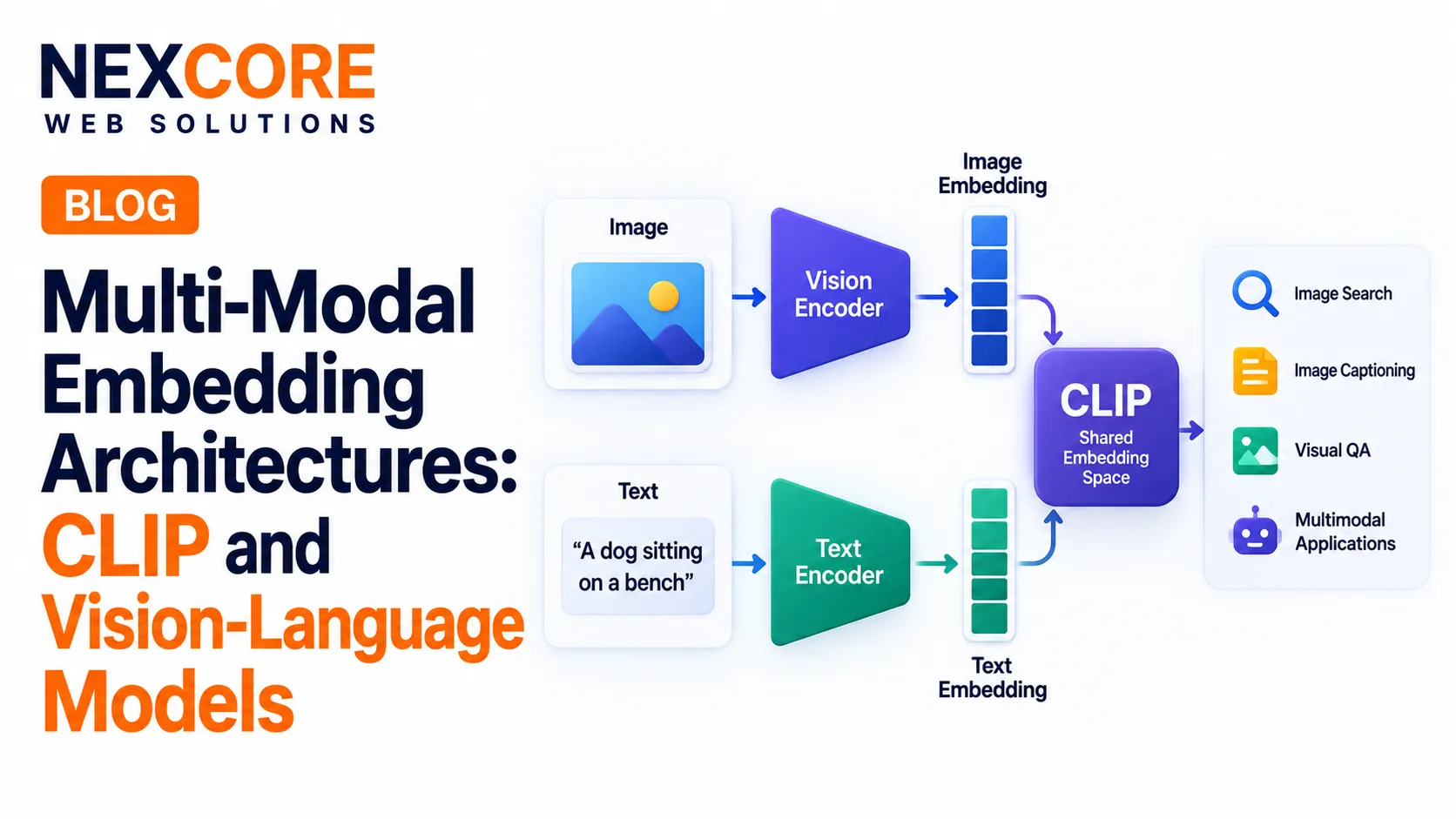
Modern AI systems increasingly need to understand more than text. Images, screenshots, and documents often contain information that cannot be represented adequately through a single data type. Multi-modal embedding architectures convert different inputs into numerical representations that can be compared or processed together. CLIP demonstrated the value of aligning images and text in a shared embedding space, while newer vision-language models extend this concept toward richer reasoning and generation. These technologies support image search, visual question answering, recommendations, document understanding, and retrieval systems. Understanding their architecture helps developers choose solutions that balance accuracy, scalability, latency, and cost.
What Are Multi-Modal Embeddings?
An embedding is a numerical representation that captures relationships between data points. In a multi-modal system, separate encoders can process different inputs, such as an image encoder for pixels and a text encoder for language. Their vectors are placed in a shared or compatible representation space. Similar meanings should produce vectors that are closer together, enabling matching, retrieval, ranking, and classification.
Why Shared Spaces Matter
Consider an online marketplace containing millions of product images. A user could search for “black running shoes” and retrieve relevant images even when that phrase is absent from metadata. The system compares the text embedding with image embeddings and ranks candidates by semantic similarity. This makes search less dependent on manually created labels.
How CLIP Works
CLIP, introduced by OpenAI, uses separate image and text encoders trained to align corresponding images and descriptions. During contrastive training, matching pairs are encouraged to have similar representations, while unrelated pairs are pushed farther apart. After training, the model can compare an image with candidate text descriptions in the same space. This enables zero-shot classification and cross-modal retrieval without creating a new classifier for every category.
Contrastive Learning
A training batch contains images and associated text, and the model calculates similarities across the batch. The learning objective rewards correct image-text matches and penalizes incorrect pairings. Large datasets help encoders learn broad visual-language relationships rather than memorizing a small set of categories. The resulting embeddings can then support different downstream applications.
Vision-Language Models
Vision-language models, or VLMs, extend multi-modal learning by combining visual understanding with language processing. Depending on the architecture, a VLM can connect a vision encoder to a language model through projection layers, cross-attention, or other fusion methods. Instead of only determining whether an image matches text, it can interpret visual content and generate a natural-language response. This makes VLMs useful for assistants, screenshots, charts, and complex documents.
A document assistant is a practical example. A user can upload an invoice and ask for its total or specific line items. The system must recognize visual structure, read text, understand relationships between fields, and formulate an answer. Embeddings can support retrieval, while the VLM performs deeper interpretation.
CLIP vs Vision-Language Models
CLIP and VLMs overlap, but their primary objectives differ. CLIP is especially effective for aligned image-text representations, similarity search, retrieval, and zero-shot classification. A generative VLM typically processes visual information and produces language, enabling interactive reasoning. Therefore, the right choice depends on whether an application mainly needs matching or detailed visual interpretation.
Choosing an Architecture
For large-scale image search, product matching, or semantic filtering, embedding-focused models can be efficient because vectors can be indexed in a vector database. For visual assistants, chart interpretation, screenshots, or complex documents, a VLM may provide richer capabilities. Developers should also consider model size, hardware, latency, inference cost, privacy, and accuracy requirements before selecting an architecture.
Practical System Architecture
A production multi-modal retrieval system commonly separates indexing from query processing. Images are encoded and stored as vectors, while incoming text queries are converted into compatible embeddings. Similarity search retrieves relevant candidates, and a VLM can receive selected visual context when deeper reasoning is required. This design avoids expensive model inference across the entire dataset for every request.
Offline embedding generation can improve scalability for large collections. Teams can encode images once, cache vectors, and update only changed content. At query time, only the incoming request and selected candidates require real-time processing. Metadata filters can further reduce the search space before expensive inference occurs.
Challenges and Best Practices
Multi-modal systems can fail when training data contains weak captions, biased associations, or limited visual coverage. A semantically similar embedding is not automatically factually correct, so evaluation should reflect the application’s real use case. Developers should test ambiguous images, multilingual queries, domain-specific terminology, and difficult edge cases. Privacy controls are also essential when images or embeddings contain sensitive information.
Model selection should rely on measured performance rather than benchmark scores alone. Evaluate retrieval precision, latency, memory consumption, inference cost, and robustness using representative data. For VLM applications, also measure hallucination and whether answers remain grounded in supplied visual context. Monitoring these metrics after deployment helps teams detect changes as data and user behavior evolve.
Conclusion
Multi-modal embeddings provide a practical foundation for connecting visual and linguistic information in modern AI applications. CLIP showed how contrastive learning can align images and text, while vision-language models extend visual understanding into conversational and reasoning workflows. Embedding models are well suited to scalable similarity and retrieval, whereas VLMs are valuable when applications need richer interpretation and generation. In production, teams should separate retrieval from expensive reasoning when possible, test models on real workloads, and protect sensitive data. Careful architecture and measurement can make search, assistants, and intelligent applications significantly more capable.
FAQs
What is a multi-modal embedding?
A multi-modal embedding is a numerical representation designed to connect information from different data types, such as images and text. Compatible encoders map these inputs into a shared or comparable vector space. This allows systems to measure semantic similarity across modalities and supports applications including image search, text-to-image retrieval, product matching, and cross-modal recommendation without requiring identical input formats.
What is CLIP used for?
CLIP is commonly used to connect images and text through aligned embeddings. It can support zero-shot image classification, semantic image search, text-to-image retrieval, and visual similarity tasks. Because its training aligns descriptions with images, developers can compare an image against natural-language labels or queries without necessarily training a dedicated classifier for every new category.
What is the difference between CLIP and a vision-language model?
CLIP primarily learns a shared representation between images and text, making it effective for similarity, retrieval, and zero-shot classification. Vision-language models generally combine visual processing with language generation and can answer questions or explain visual content. In practice, CLIP is often useful for finding relevant content, while a VLM can perform deeper interpretation after receiving that content.
Can multi-modal embeddings be stored in a vector database?
Yes. Multi-modal embeddings can be stored in vector databases when the database supports the required dimensions and similarity operations. A system can index image or text embeddings and retrieve candidates using another modality when the embeddings are compatible. Metadata filters can also be combined with vector search to improve relevance, performance, and access control.
Are vision-language models suitable for production applications?
Vision-language models can be used in production, but suitability depends on accuracy, latency, cost, infrastructure, and risk requirements. Teams should evaluate models using representative images and real user questions rather than relying only on public benchmarks. Applications should also address hallucinations, sensitive information, monitoring, fallback behavior, and human review when incorrect visual interpretation could have serious consequences.




