
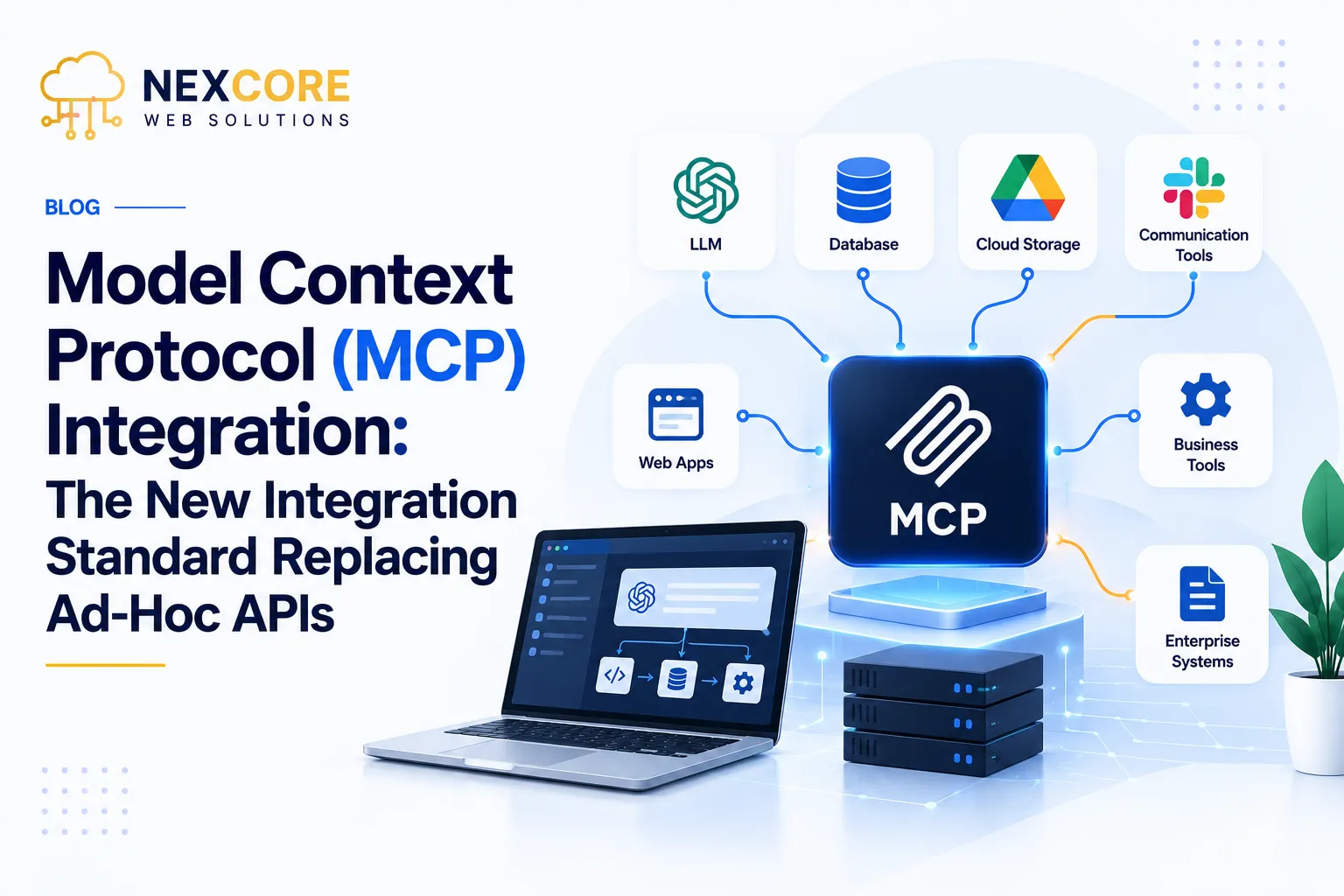
Modern software depends on connections between services, databases, business tools, and external platforms. For years, developers have built these connections using custom APIs, SDKs, webhooks, and one-off integrations. This approach works, but it becomes difficult to manage as applications and AI systems need access to more tools. Model Context Protocol, commonly known as MCP, introduces a standardized way for AI applications to discover and interact with external data sources and services. Instead of building a separate integration pattern for every model and tool, developers can use a common protocol for exchanging context and executing approved actions. MCP is attracting attention because it addresses a growing problem: AI applications need reliable integrations, not another collection of disconnected APIs.
The Problem With Traditional Ad-Hoc Integrations
Traditional APIs remain essential to modern software, but integrating them into AI applications often requires significant custom work. Each service has its own authentication method, request format, documentation, rate limits, and error responses. Developers must write adapters that translate an AI application’s requirements into instructions understood by each external service.
The complexity grows quickly when an application connects to dozens of systems. A customer support assistant, for example, might need access to a knowledge base, CRM, order system, calendar, and internal documentation. Creating and maintaining separate custom integrations for every connection can slow development and introduce inconsistent security controls.
Ad-hoc integrations also create portability problems. A tool built for one AI framework may need substantial changes before another application can use it. This fragmentation makes it harder to reuse engineering work and creates additional maintenance responsibilities as APIs evolve.
What Is Model Context Protocol?
Model Context Protocol is an open integration approach designed to create a standardized connection between AI applications and external tools or data sources. It defines a structured client-server architecture in which an AI application can communicate with an MCP server that exposes specific capabilities.
An MCP server can provide access to resources, tools, and other structured information. The AI client can discover available capabilities instead of relying entirely on hard-coded integrations. This creates a clearer boundary between the application using an AI model and the systems providing external functionality.
The protocol does not eliminate APIs. Instead, it can sit above existing systems and provide a consistent interface for AI applications. An organization can expose an existing database, internal API, or business platform through an MCP server while keeping the underlying infrastructure in place.
How MCP Changes AI Integration Architecture
MCP changes the way developers think about connecting AI systems to external services. Rather than building a unique connector inside every AI application, teams can create a reusable MCP server. Multiple compatible clients can then interact with that server using a shared protocol.
This approach is similar to creating a common integration layer. A company might build one MCP server for its internal product catalog, for example, and allow different approved AI applications to access the same controlled capabilities. The underlying catalog system remains independent from the language model or chat interface.
Standardized Tool Discovery
One important advantage of MCP is structured capability discovery. Instead of manually programming every possible action into an application’s integration layer, clients can obtain information about the tools and resources exposed by a connected server.
This can make AI applications more flexible, particularly when their available tools change over time. However, discovery does not mean that an AI system should automatically receive unrestricted access. Production environments still need permissions, validation, and clear rules about which users and applications can perform sensitive actions.
Moving Beyond One-Off API Connections
Ad-hoc API integrations often become tightly coupled to the application that created them. A developer may build custom code specifically for one chatbot, model provider, or agent framework. When the organization adopts another platform, much of that integration logic may need to be rewritten.
MCP encourages separation between the AI client and the integration itself. The server handles the connection to the external system, while the client focuses on presenting available capabilities to the AI application. This separation can improve reuse and reduce duplicated engineering effort.
The benefit becomes clearer in larger organizations. Instead of five teams independently creating connectors to the same internal system, one team can maintain a well-designed integration layer. Other teams can reuse it while following consistent operational and security practices.
Practical Use Cases for MCP Integration
MCP can support many AI application scenarios where models need controlled access to external information or actions. The most suitable use cases usually involve systems that are already difficult to connect through custom integrations. Common examples include internal knowledge platforms, development tools, databases, customer systems, and business applications.
Consider an engineering assistant that needs to inspect project documentation and retrieve information from approved development services. Without a common integration standard, developers might create separate connectors for each tool. An MCP-based approach can provide a more consistent way to expose these capabilities.
Another example is an enterprise assistant that answers employee questions using internal resources. Different departments may operate separate systems, but each system can expose carefully selected capabilities through its own integration server. The AI application can then work with approved sources without embedding every service-specific API pattern directly into its codebase.
Security and Governance Cannot Be Ignored
Standardized integration does not automatically make an AI system secure. In fact, connecting models to more tools can increase the potential impact of a poorly designed permission system. An AI application should not receive broad access simply because a server exposes a useful capability.
Organizations should apply authentication, authorization, input validation, logging, and least-privilege principles to MCP deployments. Sensitive operations should require explicit controls, especially when a tool can modify records, send messages, access confidential information, or execute business workflows.
Prompt injection also deserves attention when AI systems consume external content. Untrusted data may contain instructions designed to influence a model’s behavior. Applications should treat retrieved content as data rather than automatically trusting it as an instruction, while maintaining clear boundaries between user requests, system policies, and external resources.
Implementation Challenges Teams Should Expect
MCP can simplify integration architecture, but adopting a new standard still requires engineering work. Teams must decide which capabilities should be exposed and how to model them clearly. Poorly designed tools can remain difficult to use even when they follow a standard protocol.
Operational management is another important consideration. Production MCP servers need monitoring, version management, access controls, and reliable error handling. Organizations should also establish ownership so that integrations remain maintained when the underlying services change.
Testing should include realistic workflows rather than only successful requests. Teams need to examine what happens when permissions fail, external systems become unavailable, or the AI application selects an inappropriate tool. These scenarios reveal whether the integration architecture is ready for real business use.
The Future of AI Application Integration
The growth of AI assistants and autonomous workflows is creating demand for common integration standards. Models are becoming capable of working with many tools, but custom connections do not scale efficiently across every application and service. A shared protocol can reduce fragmentation and encourage reusable integration patterns.
MCP is unlikely to replace traditional APIs because underlying systems still need interfaces for applications and services. Its greater role is to standardize how AI clients discover and interact with approved capabilities. This distinction makes MCP an additional architectural layer rather than a complete replacement for existing API infrastructure.
Conclusion
Model Context Protocol represents an important shift in how AI applications connect with external systems. It addresses the limitations of building separate, tightly coupled integrations for every model, framework, and business tool. By providing a common structure for exposing resources and actions, MCP can improve reuse and simplify complex AI integration environments. However, successful adoption requires more than installing a protocol or server. Organizations must carefully design permissions, validate inputs, monitor activity, and expose only the capabilities that applications genuinely need. For teams building AI assistants and agent-based workflows, MCP offers a practical path toward more standardized integrations while preserving the APIs and systems that already power their business.
FAQs
What is Model Context Protocol?
Model Context Protocol, or MCP, is a standardized approach for connecting AI applications with external tools, resources, and data sources. It uses a structured client-server model that allows compatible applications to discover and interact with approved capabilities. MCP can reduce the need for separate custom integrations while still allowing existing APIs and infrastructure to operate underneath the integration layer.
Does MCP completely replace traditional APIs?
No, MCP does not completely replace traditional APIs. APIs remain responsible for connecting applications and services at the underlying infrastructure level. MCP provides a standardized layer designed specifically for AI applications that need to discover and use external capabilities. An MCP server can expose functionality that already exists through internal or external APIs.
Is MCP useful only for large enterprises?
MCP can benefit organizations of different sizes, particularly when an AI application needs access to multiple tools or data sources. Smaller teams may use it to avoid building separate custom connectors for every service. Larger organizations can benefit from reusable integration layers, centralized governance, and more consistent security practices across multiple AI applications.
What security risks should companies consider with MCP?
Companies should consider authentication, authorization, excessive permissions, insecure tool design, and exposure of sensitive information. Prompt injection is also a concern when models process untrusted external content. Organizations should apply least-privilege access, validate tool inputs, maintain activity logs, and separate sensitive instructions from retrieved data to reduce potential security risks.
How should a team start implementing MCP?
A practical starting point is to identify one useful integration with a clear and limited purpose. Define the tools or resources that the AI application genuinely needs and apply appropriate authentication and permissions. Test normal and failure scenarios before expanding access. Once the initial deployment is stable, teams can reuse the same architectural patterns for additional integrations.




