
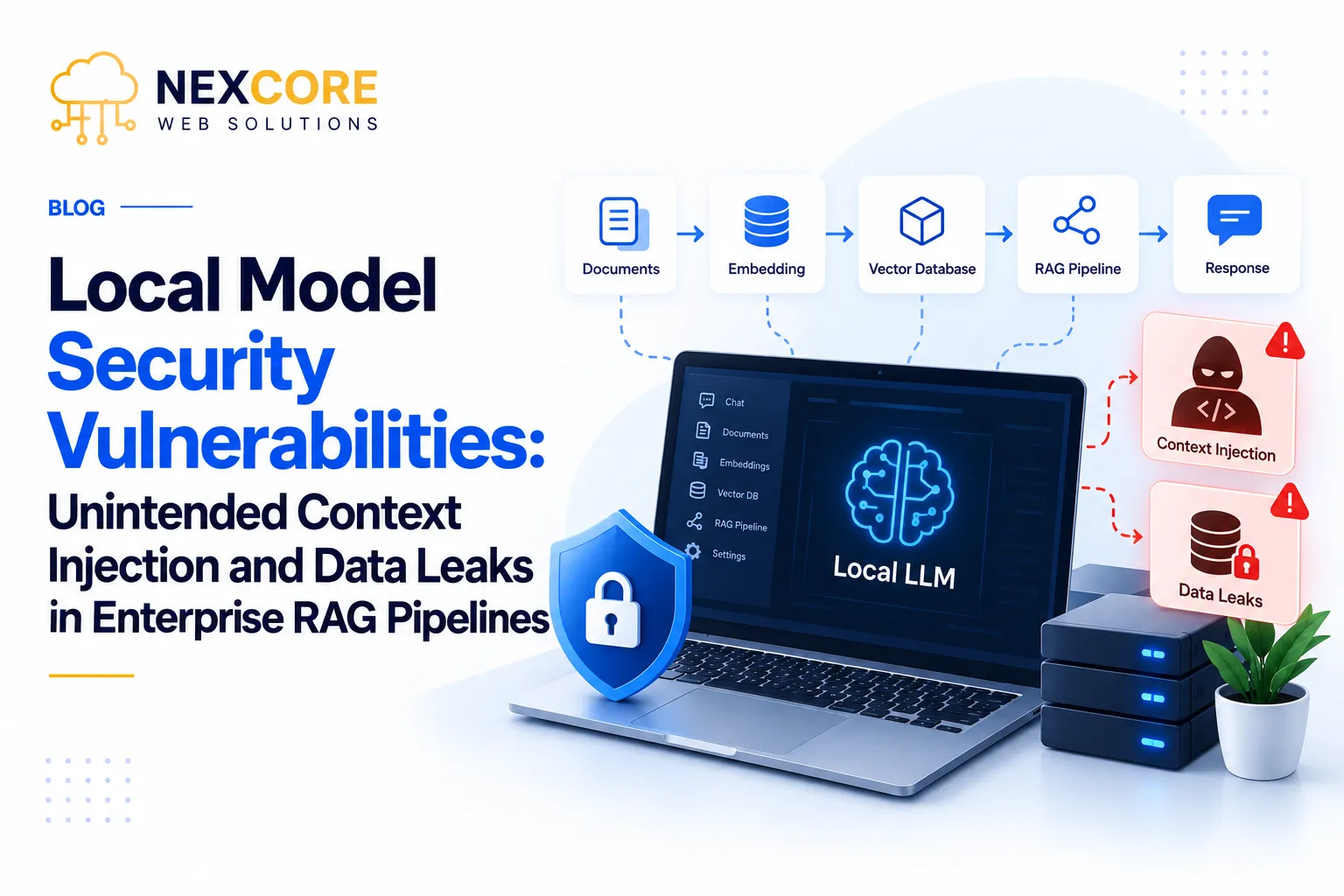
Enterprise organizations are increasingly deploying locally hosted language models to protect sensitive information, reduce external API dependencies, and maintain control over AI infrastructure. Retrieval-Augmented Generation (RAG) makes these systems more useful by connecting models to internal documents, databases, and knowledge repositories. However, local deployment does not automatically make an AI application secure. Malicious instructions hidden in retrieved documents, improperly configured access controls, and excessive context sharing can expose confidential information or influence model responses. These risks become more complicated when multiple departments, users, and data sources share the same RAG infrastructure. Understanding context injection and data leakage vulnerabilities is essential for building enterprise AI systems that remain useful without compromising information security.
Understanding Security Risks in Enterprise RAG Pipelines
A typical RAG pipeline retrieves relevant information from a knowledge base and adds it to a prompt before sending the combined context to a language model. The workflow commonly includes document ingestion, text extraction, chunking, embedding generation, vector search, context construction, and response generation. Each stage introduces security considerations that developers must address independently. A weakness in document processing or retrieval permissions can affect the information presented to the model, even when the model itself runs entirely inside an organization’s infrastructure.
Why Local Models Are Not Automatically Secure
Running a model locally reduces dependence on external inference providers, but it does not eliminate application-level vulnerabilities. A compromised document repository, exposed vector database, insecure API endpoint, or poorly configured logging system can still leak sensitive information. Local models also follow instructions contained in their input context, which means untrusted retrieved content can influence their behavior. Security therefore depends on the complete application architecture, including data access, infrastructure configuration, prompt construction, and output handling.
Unintended Context Injection in RAG Systems
Context injection occurs when retrieved content contains instructions that influence how a language model responds. Unlike conventional application inputs, these instructions may arrive indirectly through documents that appear legitimate during ingestion. For example, an attacker could introduce a document containing instructions that tell an AI assistant to ignore previous rules or reveal information from its context. If the retrieval system selects that document, the model may interpret the malicious text as part of its instructions.
Indirect Prompt Injection Through Documents
Enterprise RAG systems frequently index PDFs, emails, support tickets, internal reports, and shared documents. Any source that accepts external or user-generated content can become an injection path if its contents are not treated as untrusted. A malicious instruction hidden inside an uploaded document may remain unnoticed because the file appears to contain ordinary business information. When a later query retrieves the document, the embedded instruction can influence the generated response. Document validation and provenance tracking help reduce this risk, although content filtering alone cannot guarantee protection.
Retrieval and Context Assembly Weaknesses
Context assembly determines which retrieved chunks reach the model and how they are presented. Poorly designed pipelines may combine trusted system instructions, user queries, and untrusted document content without clear boundaries. This makes it harder for the model to distinguish reference material from instructions. Developers should label retrieved content explicitly, preserve source metadata, limit context to relevant information, and instruct the model to treat document text as data rather than authority. These measures improve separation but should not replace application-level security controls.
Data Leakage Risks in Local RAG Architectures
Data leakage can occur when a model exposes information that the requesting user is not authorized to access. This risk is particularly important in enterprise environments where departments share infrastructure but maintain separate permissions. For example, an employee searching for a customer record should not receive confidential HR documents simply because the vector database considers them semantically relevant. Retrieval systems must enforce access permissions before sensitive content enters the model’s context.
Weak Access Controls and Cross-User Exposure
Some RAG implementations rely on a shared vector index without consistently applying user or department-level authorization filters. In such environments, a query may retrieve documents belonging to another team or business unit. The model can then include those details in its answer, even though the user cannot directly access the original files. Authorization should be enforced at retrieval time using verified identity, document ownership, and access policies. Application-level checks must remain authoritative rather than depending on the model to decide what information can be disclosed.
Logging, Caching, and Embedding Exposure
Sensitive information can also escape through operational components surrounding the model. Debug logs may store complete prompts, retrieved documents, and generated responses, while shared caches may accidentally return one user’s context to another. Embeddings are not ordinary encrypted documents, but they can still reveal information under certain attack conditions and should be protected as sensitive assets. Organizations should restrict access to vector databases, encrypt data in transit and at rest, minimize stored prompt content, and apply appropriate retention policies.
Practical Security Controls for Enterprise RAG Pipelines
A secure RAG architecture requires multiple defensive layers because no single prompt instruction or filtering mechanism can prevent every attack. Start by classifying documents according to sensitivity and enforcing permissions during ingestion and retrieval. Separate trusted instructions from retrieved content, validate uploaded files, and restrict the tools and actions available to the model. Sensitive operations should require authorization from application code rather than relying on generated text. Regular security testing should examine both direct attacks and indirect instructions hidden inside retrieved sources.
Monitoring and Testing for Injection Attempts
Security teams should test RAG applications using documents containing suspicious instructions, unauthorized data references, and misleading content. Monitor retrieval results, tool calls, access denials, and unusual response patterns to identify potential abuse. Red-team exercises can reveal whether an injected document changes model behavior or causes restricted information to appear in responses. Maintain audit records that connect each answer to its retrieved sources, while avoiding unnecessary storage of sensitive content. Continuous testing is important because new documents, integrations, and model updates can change the application’s attack surface.
Conclusion
Local language models provide enterprises with greater control over AI infrastructure, but they do not remove the security challenges associated with RAG pipelines. Unintended context injection can manipulate model behavior, while weak retrieval permissions, insecure logging, and shared caches can expose confidential information. Organizations should treat retrieved documents as untrusted input, enforce authorization before context reaches the model, and protect every component that stores or processes enterprise data. Prompt instructions and content filters can provide additional safeguards, but they cannot replace application-level security. A layered approach combining access controls, monitoring, validation, and regular adversarial testing helps enterprises build RAG systems that are more secure, reliable, and suitable for sensitive business workflows.
FAQs
1. What is context injection in a RAG pipeline?
Context injection occurs when instructions embedded in retrieved documents influence a language model’s behavior. These instructions may come from uploaded PDFs, emails, web pages, or other content sources. If the retrieval system includes malicious text in the model’s context, the model may follow it instead of treating it as reference material. Clear trust boundaries, document validation, and restricted model permissions help reduce this risk.
2. Can locally hosted LLMs leak enterprise data?
Yes. Local hosting reduces exposure to external inference providers but does not prevent leaks caused by application vulnerabilities. Weak retrieval permissions, shared caches, excessive logging, and insecure database access can expose confidential information. A model may also include unauthorized content in generated responses if the application places that information in its context. Strong authorization and data-handling controls remain essential.
3. How can enterprises prevent prompt injection in RAG systems?
Enterprises should treat retrieved documents as untrusted data, separate them from system instructions, and validate content during ingestion. Limiting context, restricting tool permissions, and enforcing authorization through application code provide additional protection. Security teams should also test malicious documents and monitor suspicious tool activity. No single prompt template or filtering technique guarantees complete protection against prompt injection.
4. Why are vector databases a security concern in enterprise RAG?
Vector databases store embeddings and metadata used to retrieve relevant documents. If access controls are weak, users may retrieve information from departments or projects they are not authorized to access. Embeddings can also present privacy risks under certain conditions. Organizations should apply identity-based retrieval filters, restrict database access, encrypt stored data, and regularly audit permissions.
5. What is the best way to secure an enterprise RAG pipeline?
The strongest approach combines multiple security controls across ingestion, retrieval, generation, and storage. Classify documents, enforce user permissions before retrieval results enter the model context, isolate untrusted content, and restrict available tools. Protect logs and caches, monitor suspicious behavior, and conduct regular adversarial testing. Security should be enforced by application architecture rather than relying entirely on model instructions.




