
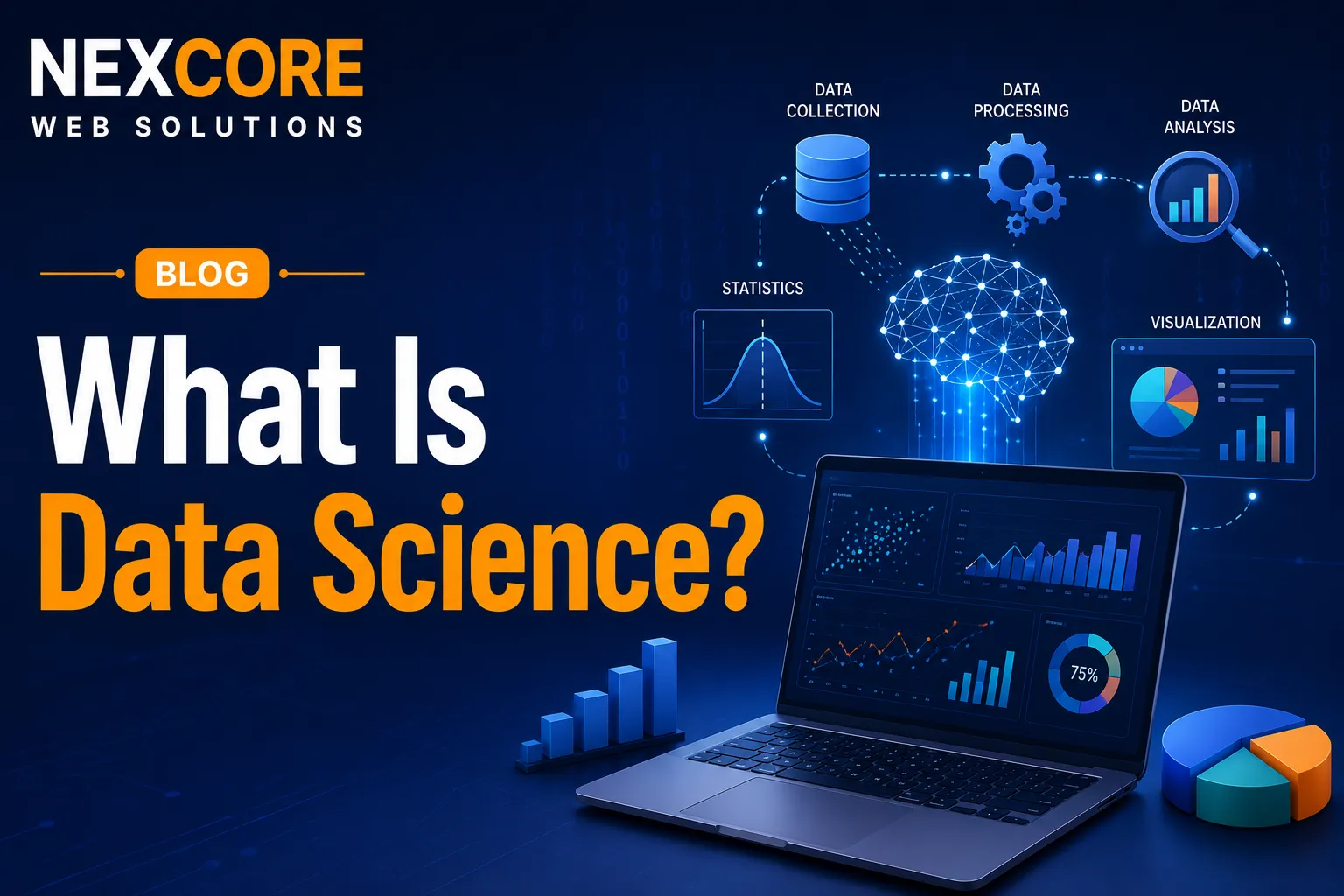
Data science is the field of using data, statistics, computing, and analytical methods to understand problems and support better decisions. Almost every modern organization generates data through websites, mobile applications, transactions, sensors, customer interactions, and business operations. Data science helps turn that raw information into useful findings, predictions, and measurable insights. It combines several disciplines rather than relying on a single technology or programming language. A data scientist might clean a large dataset, identify patterns, build a predictive model, and explain the results to business stakeholders. For example, an online retailer can use data science to understand purchasing behavior, predict demand, identify unusual transactions, and improve product recommendations. Understanding what data science involves is useful for students, professionals, businesses, and anyone interested in how data-driven systems work.
What Does Data Science Mean?
Data science is a multidisciplinary approach to collecting, processing, analyzing, and interpreting data to solve practical problems. It combines statistics, mathematics, programming, machine learning, databases, and domain knowledge. The goal is not simply to produce charts or calculate averages, but to discover useful information that can guide decisions or automate certain tasks. A successful data science project connects technical analysis with a clearly defined real-world objective.
A Simple Example
Imagine a food delivery company wants to reduce late deliveries. A data science team could analyze delivery times, traffic conditions, restaurant preparation times, weather, locations, and order volumes. After identifying patterns, the team might build a model that predicts which orders are likely to be delayed. The company could then assign drivers differently or provide earlier alerts to customers. This example shows how data science connects raw information with an operational decision.
Key Components of Data Science
Data Collection
Every data science project begins with data, which may come from databases, APIs, surveys, sensors, applications, websites, or business systems. The quality and relevance of the collected information strongly influence the final results. Data scientists must understand where information comes from, how frequently it changes, and whether it contains missing or inconsistent values. Collecting unnecessary data can increase complexity without improving the analysis.
Data Cleaning and Preparation
Raw data is rarely ready for immediate analysis. It may contain duplicate records, missing values, incorrect formats, inconsistent categories, or obvious errors. Data preparation involves cleaning these problems and transforming information into a structure suitable for analysis or modeling. This stage can take significant effort because unreliable input can produce misleading conclusions even when sophisticated algorithms are used later.
Data Analysis and Statistics
Statistics provides many of the techniques used to understand datasets. Data scientists may calculate averages, distributions, correlations, probabilities, and other measures to identify relationships and unusual patterns. Statistical reasoning also helps determine whether an observed result is meaningful or could have occurred by chance. For example, a business might compare conversion rates between two customer groups before deciding whether a marketing change actually improved performance.
Exploratory Data Analysis
Exploratory data analysis involves examining data before building complex models. Analysts can use tables, visualizations, summaries, and statistical measures to understand trends and relationships. This process can reveal unexpected patterns that were not included in the original assumptions. It also helps identify data-quality problems before they affect later stages of a project.
Machine Learning in Data Science
Machine learning is an important part of modern data science, but data science is broader than machine learning alone. Machine learning algorithms can learn patterns from historical data and use those patterns to make predictions or classifications. Common applications include fraud detection, recommendation systems, customer churn prediction, demand forecasting, and image recognition. The choice of model should depend on the problem, available data, performance requirements, and the consequences of incorrect predictions.
Training and Evaluation
A predictive model should not simply be evaluated on the same data used to train it. Data scientists commonly divide available data into training and evaluation portions so they can measure how well a model performs on information it has not previously seen. Metrics vary according to the problem, such as accuracy, precision, recall, mean absolute error, or other measures. Evaluation helps determine whether a model is genuinely useful rather than merely memorizing its training examples.
Programming and Tools
Programming is a practical skill in data science because datasets often require automated processing and analysis. Python and R are widely associated with data science, while SQL is essential for retrieving and manipulating information stored in relational databases. Libraries and tools can simplify tasks such as data processing, visualization, statistical analysis, and machine learning. However, knowing a library is not enough; professionals also need to understand the concepts behind the operations they perform.
Data Visualization and Communication
A technically accurate analysis has limited value if decision-makers cannot understand it. Data visualization helps communicate trends, comparisons, distributions, and relationships using appropriate charts and graphical representations. Data scientists may create dashboards, reports, or presentations for technical and non-technical audiences. Choosing the right visualization and explaining its limitations are important because poorly designed charts can create misleading impressions.
Business Understanding
Domain knowledge is another major part of effective data science. A model may achieve strong statistical performance but still fail to solve the actual business problem. Data scientists need to understand objectives, constraints, costs, risks, and how predictions will be used in practice. Collaboration with subject-matter experts can therefore be as important as selecting an algorithm.
Data Science vs Data Analytics
Data science and data analytics overlap, but they are not identical. Data analytics often focuses on examining existing information to understand what happened, why it happened, and what the organization should do next. Data science can include those activities while also involving predictive modeling, machine learning, experimentation, and more complex computational techniques. The exact responsibilities vary between organizations, and job titles are not always standardized.
Applications of Data Science
Data science is used across many industries and functions. Banks can analyze transactions for potential fraud, hospitals can study operational and clinical data, manufacturers can predict equipment failures, and retailers can forecast demand. Sports organizations can evaluate player performance, while technology companies can personalize products based on user behavior. These applications demonstrate that data science is primarily a problem-solving discipline rather than a technology limited to one industry.
Challenges and Responsible Use
Data science also creates challenges involving privacy, security, bias, data quality, and responsible decision-making. A model trained on biased historical information can reproduce or amplify those patterns. Organizations should therefore consider how data was collected, whether people are represented fairly, and how automated decisions affect individuals. Protecting sensitive information and communicating uncertainty are equally important parts of responsible data science.
Conclusion
Data science combines data, statistics, programming, machine learning, and domain knowledge to solve practical problems and support informed decisions. Its workflow can include collecting information, cleaning datasets, exploring patterns, building models, evaluating results, and communicating findings to stakeholders. The most valuable data science projects are not necessarily those with the most complicated algorithms; they are the ones that solve meaningful problems with reliable evidence. Anyone starting in this field should build strong foundations in statistics, SQL, programming, data visualization, and analytical thinking. With those skills, learners can gradually move toward machine learning, predictive modeling, and specialized applications across different industries.
FAQs
1. What is data science in simple words?
Data science is the process of using data to understand problems, discover patterns, make predictions, and support decisions. It combines areas such as statistics, programming, mathematics, databases, and machine learning. A data scientist may work with raw information, clean it, analyze it, build predictive models, and communicate the results so an organization can take practical action based on evidence.
2. Is data science the same as machine learning?
No, machine learning is one component of data science rather than a complete replacement for it. Data science also includes data collection, cleaning, statistical analysis, visualization, experimentation, communication, and domain understanding. Machine learning becomes particularly useful when a project requires systems that can identify patterns in historical data and use them to make predictions or classifications.
3. What programming language is best for data science?
Python is one of the most popular choices because it has a large ecosystem for data processing, visualization, statistics, and machine learning. R is also widely used for statistical computing and research. SQL is essential because many real-world datasets are stored in databases. Beginners should focus on understanding programming and data concepts rather than limiting themselves to a single language.
4. What skills are needed to become a data scientist?
Important skills include statistics, programming, SQL, data cleaning, visualization, machine learning, and problem-solving. Communication is equally important because data scientists often need to explain technical findings to people without a technical background. Domain knowledge can also improve results because understanding the industry helps professionals choose meaningful questions, appropriate metrics, and practical solutions.
5. Where is data science used?
Data science is used in finance, healthcare, retail, manufacturing, technology, education, logistics, sports, marketing, and many other industries. Organizations use it for tasks such as forecasting demand, detecting fraud, predicting customer behavior, improving operations, analyzing performance, and supporting strategic decisions. Its applications continue to expand as organizations collect larger and more varied datasets.




