
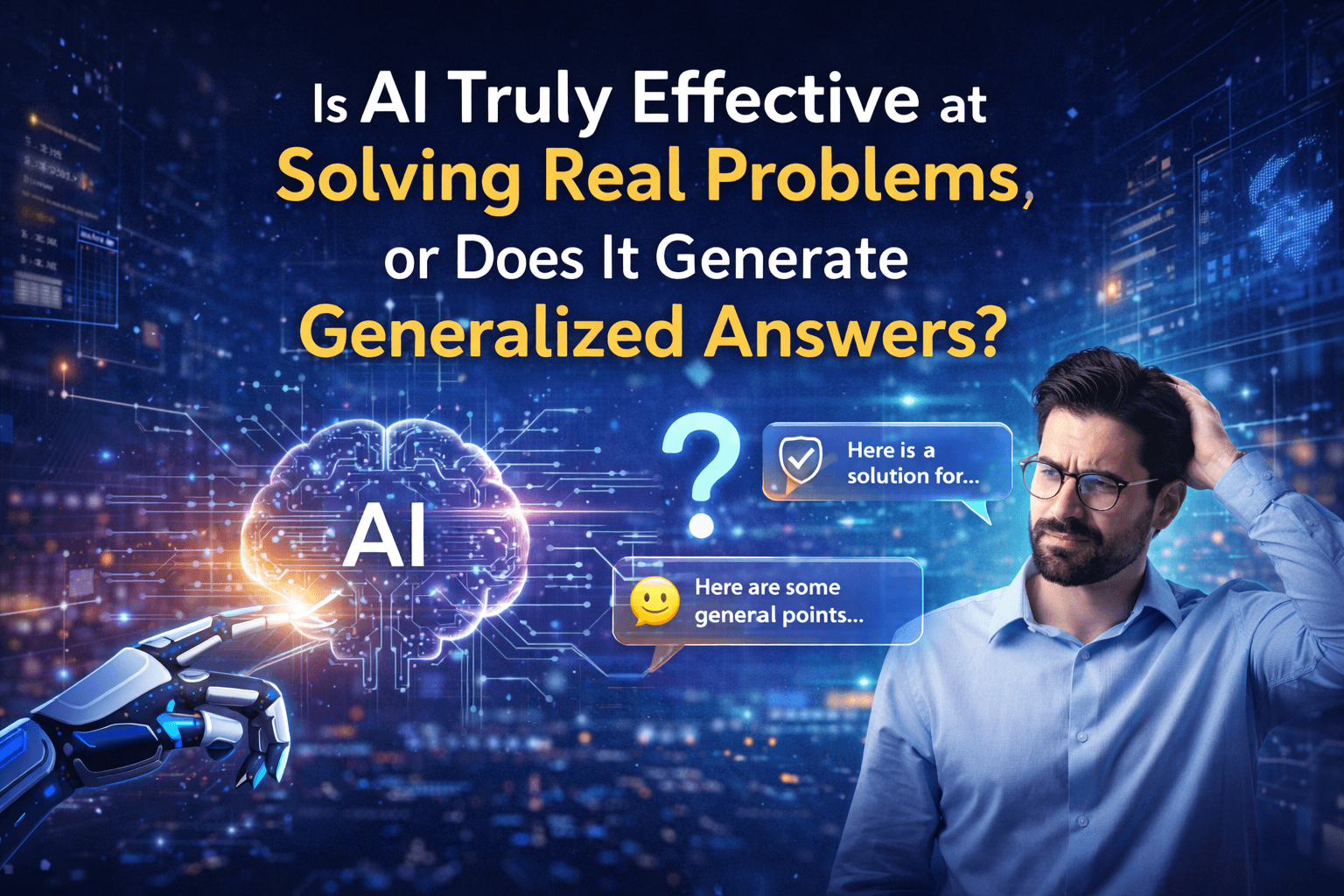
Artificial Intelligence (AI) has rapidly become part of everyday life — from search engines and chat assistants to healthcare tools and business automation systems. While AI can process massive amounts of data and provide instant responses, an important question remains: Is AI genuinely solving real-world problems, or is it simply generating generalized answers based on patterns? The reality lies somewhere between powerful problem-solving capability and limitations that still require human judgment.
The Rise of AI in Everyday Problem Solvers
Over the past few years, AI technology has moved beyond experimental labs into practical applications. Businesses, students, developers, and even governments now rely on AI systems to assist with decision-making, automation, and research.
Examples of AI solving real problems include:
- Detecting diseases through medical imaging.
- Automating customer support responses.
- Predicting financial risks.
- Optimizing delivery routes and logistics.
- Assisting programmers with code development.
These use cases show that AI is no longer just a chatbot or search tool. In many industries, it actively helps reduce workload and increase efficiency.
However, effectiveness depends heavily on how AI is used and the quality of data behind it.
How AI Actually Generates Answers
To understand whether AI solves problems or produces generalized responses, it’s important to know how it works.
Modern AI models learn from extremely large datasets that include books, articles, research papers, and public information. Instead of thinking like humans, AI analyzes patterns between words, images, or numbers.
When asked a question, AI does not “remember” facts in the same way a human expert does. Instead, it predicts the most logical and relevant response based on learned patterns.
This means AI can:
- Summarize complex information quickly.
- Provide structured explanations.
- Suggest solutions based on common scenarios.
But it also means AI may sometimes produce answers that sound confident even when context is incomplete.
Where AI Truly Excels at Solving Problems
AI becomes extremely powerful when tasks involve data-heavy analysis or repetitive work.
1. Healthcare and Diagnostics
AI systems can analyze thousands of medical scans within seconds. In some cases, AI helps doctors detect tumors or abnormalities earlier than manual review alone.
Instead of replacing doctors, AI acts as a second layer of analysis.
2. Software Development
Developers use AI tools to:
- Debug code.
- Generate scripts.
- Optimize performance.
This reduces development time significantly.
3. Fraud Detection
Banks and financial companies use AI to monitor millions of transactions simultaneously.
Unusual patterns — such as suspicious purchases — can be flagged instantly, preventing fraud.
4. Education and Research
Students and researchers use AI to simplify large topics, summarize documents, or brainstorm ideas.
AI speeds up learning but still requires verification.
In these environments, AI clearly contributes to real problem-solving.
When AI Produces Generalized Answers
Despite impressive capabilities, AI does have limitations.
Because responses are based on probability and patterns, AI may generate answers that are:
- Broad rather than highly specific.
- Lacking real-time context.
- Incorrect in specialized or rare scenarios.
For example:
- Legal advice may miss local regulations.
- Medical suggestions cannot replace professional diagnosis.
- Business strategies may ignore unique market conditions.
AI tends to provide average best-fit solutions rather than deeply personalized expertise unless given very detailed input.
This is why human review remains important.
The Importance of Human Input
AI performs best when users provide clear instructions.
A vague question often results in a generalized response.
For example:
- Asking “How do I grow a business?” may generate broad advice.
- Asking “How can a small e-commerce website increase traffic with a ₹10,000 monthly budget?” produces more targeted insights.
The more context AI receives, the more accurate and useful the response becomes.
In many ways, AI works like a highly skilled assistant — powerful but dependent on direction.
Can AI Replace Experts?
One common fear is whether AI will replace professionals.
The current reality suggests otherwise.
AI can assist experts but struggles with:
- Emotional intelligence.
- Ethical decision-making.
- Complex judgment calls.
- Deep real-world experience.
Doctors, lawyers, engineers, and teachers rely on human understanding developed through years of experience.
AI can provide research support or suggestions, but responsibility still rests with humans.
Instead of replacement, collaboration appears to be the future.
AI Bias and Data Limitations
Another reason AI sometimes produces generalized answers is data bias.
If training data contains gaps or outdated information, responses may reflect those limitations.
For example:
- Cultural differences may not always be perfectly understood.
- Emerging technologies may lack updated examples.
- Regional policies may vary widely.
Developers continuously update AI systems, but perfect accuracy remains a challenge.
Users should treat AI as a tool rather than a final authority.
Businesses Using AI for Real Solutions
Many companies already rely heavily on AI-driven solutions.
Examples include:
- Customer chat automation reducing response time.
- Marketing analytics predicting customer behavior.
- Supply chains using AI forecasts to avoid shortages.
In these situations, AI directly saves money and improves efficiency.
However, successful companies combine AI insights with human strategy teams.
The strongest results come from blending both strengths.
The Future: Smarter, More Personalized AI
AI technology is evolving rapidly.
Future improvements may include:
- Better real-time understanding.
- Personalized responses based on verified data.
- Improved reasoning ability.
- Reduced hallucinations or incorrect assumptions.
As systems improve, the line between generalized answers and true problem-solving will continue to narrow.
Already, newer AI tools are becoming better at understanding intent rather than just keywords.
Conclusion
AI is neither a magic solution nor merely a generator of generic answers. It is a powerful analytical tool capable of solving real problems when used correctly. In structured environments such as healthcare analysis, fraud detection, software development, and education support, AI delivers measurable results.
At the same time, AI can still produce generalized responses when questions lack detail or when problems require deep human judgment and real-world experience.
The most effective approach is collaboration — using AI for speed, research, and analysis while relying on human expertise for decision-making and accountability.
As technology advances, AI will likely become even more capable of addressing complex challenges. But for now, its greatest strength lies in assisting humans rather than replacing them.
Written by Divyam Roy
Published on: February 28, 2026
Reading Time: 8–10 Minutes
Author Background: Web Developer & Software Engineer with 5+ Years of Experience in Website and Application Development.




