
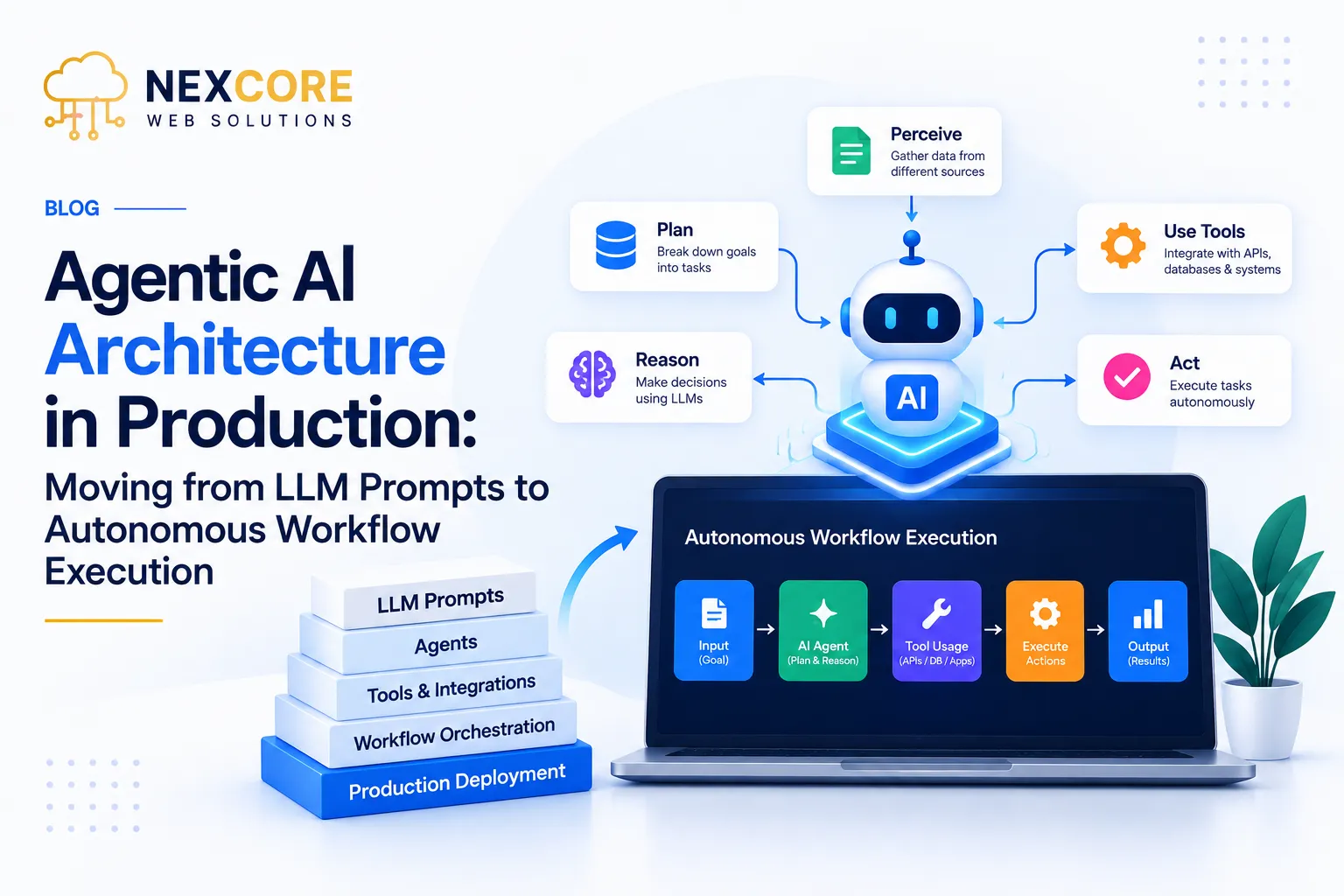
Large language models have changed how businesses automate writing, research, customer support, and software development. However, a prompt that generates a useful answer does not automatically create a reliable production system. Enterprise applications increasingly need AI that can interpret objectives, select tools, execute multiple steps, evaluate results, and recover from failures. This shift has brought agentic AI architecture into focus, moving beyond isolated model responses toward controlled workflow execution. An agent may retrieve customer information, analyze a request, call an approved API, and prepare an action for review within one coordinated process. Delivering this capability requires more than a powerful model. Production-ready systems need clear execution boundaries, reliable integrations, persistent state, monitoring, and safeguards that keep autonomous behavior aligned with business requirements.
From Prompt Engineering to Agentic Workflows
Why Traditional LLM Applications Reach Their Limits
A conventional LLM application typically sends a prompt to a model and returns its generated response to the user. This approach works well for summarization, classification, drafting, and other tasks with clearly defined inputs and outputs. More complicated objectives often require several dependent operations, such as retrieving records, checking policies, comparing information, and updating an external system. Hardcoding every possible sequence can become difficult to maintain when requests vary significantly. Agentic workflows address this limitation by allowing a model to select from predefined actions while an application controls how those actions execute.
What Makes an AI System Agentic?
An agentic system combines model reasoning with tools, context, state, and an execution mechanism. The model interprets the current situation and proposes an action, while the surrounding runtime determines whether that action is valid and permitted. For example, a support agent might inspect an order, check its delivery status, and draft a response using information from approved services. The system can continue through multiple steps until it reaches a defined completion condition or encounters a situation requiring human intervention. Autonomy therefore comes from the interaction between the model and its execution environment, not from the model operating without constraints.
Core Components of Production Agentic AI Architecture
The Orchestrator and Execution Loop
The orchestrator manages the workflow from the initial request through completion. It tracks the current state, sends relevant context to the model, validates proposed tool calls, executes approved actions, and determines what happens next. A typical execution loop includes planning, action selection, tool execution, result evaluation, and termination. The implementation should enforce maximum step counts, deadlines, and retry limits to prevent endless loops. Keeping orchestration logic separate from model-specific prompts also makes workflows easier to test, maintain, and migrate between providers.
Tools, APIs, and Permission Boundaries
Tools connect AI agents to business systems such as databases, ticketing platforms, inventory services, and internal APIs. Each tool should expose a clear interface with documented inputs, outputs, permissions, and failure behavior. Instead of giving an agent unrestricted database access, a production application can provide a limited function that retrieves only the records required for a particular task. The execution layer must validate arguments and enforce authorization independently of the model’s recommendations. This separation reduces the risk of unintended changes and makes tool behavior easier to audit.
State and Context Management
Multi-step workflows need a reliable way to preserve information between actions. Short-term state may include the current task, completed steps, tool results, and pending approvals, while longer-term memory may store selected preferences or previously established facts. These categories should not be treated interchangeably because persistent memory introduces additional privacy, accuracy, and retention concerns. Store essential workflow state outside transient execution contexts when recovery or continuation is required. Before each model call, retrieve only the context relevant to the current decision to control token usage and reduce confusion.
Designing Reliable Autonomous Execution
Use Structured Workflows Instead of Unlimited Autonomy
Not every business process benefits from unrestricted agent behavior. A useful architecture combines flexible model decisions with deterministic application rules for critical transitions, validations, and business calculations. For example, an expense-processing agent can extract receipt details and classify spending, while conventional code checks required fields and enforces spending limits. The agent may recommend an outcome, but the application decides whether the request satisfies the rules. This hybrid approach preserves flexibility without allowing probabilistic model output to replace essential business logic.
Handle Failures and Retries Deliberately
Tool calls can fail because of network interruptions, rate limits, invalid arguments, or unavailable services. Production workflows should distinguish temporary failures from permanent errors and apply bounded retries only where repeating an operation is safe. For actions such as issuing refunds or creating orders, idempotency controls help prevent duplicate transactions after timeouts. When an operation cannot be completed, the workflow should preserve its state, record the failure, and either recover through an approved path or escalate to a person. Clear stopping conditions prevent failed tasks from consuming unlimited resources.
Security, Evaluation, and Observability
Protect Systems Against Unsafe Actions
Agentic systems introduce security concerns because models process instructions and interact with external tools. Prompt injection can appear in user messages, documents, retrieved webpages, or other untrusted content, potentially influencing the agent’s proposed actions. Treat retrieved content as data rather than authoritative instructions, and enforce permissions through application code rather than prompt wording alone. Sensitive operations should require explicit approval when the business risk warrants it. Audit logs should record important decisions and tool outcomes while avoiding unnecessary exposure of personal information or credentials.
Measure Outcomes Beyond Model Accuracy
A model that produces convincing text can still fail at completing a workflow correctly. Evaluation should measure task completion rate, tool-call accuracy, policy violations, execution time, cost per successful task, and the frequency of human intervention. Test workflows against realistic scenarios, including ambiguous requests, unavailable tools, contradictory information, and malicious input. Production traces should connect model decisions with tool calls, errors, and final outcomes so engineers can identify where failures occur. Regular evaluation helps teams detect regressions when prompts, models, APIs, or workflow logic change.
Conclusion
Moving from LLM prompts to autonomous workflow execution requires a shift from generating responses to engineering dependable systems. Production agentic AI combines model reasoning with orchestration, controlled tools, persistent state, explicit stopping rules, and measurable evaluation. The strongest implementations use autonomy where flexible decisions create value while keeping security checks, business rules, and high-impact actions under deterministic control. Teams should begin with a narrow workflow, define what successful completion means, and test failure scenarios before expanding the agent’s permissions. By tracking reliability, operational cost, and business outcomes, organizations can determine whether agentic automation delivers practical benefits. Responsible autonomy is not the absence of limits; it is the ability to complete useful work within clearly defined boundaries.
FAQs
1. What is agentic AI architecture?
Agentic AI architecture combines a language model with tools, workflow orchestration, state management, and execution controls to complete multi-step tasks. Rather than returning only a generated response, the system can retrieve information, invoke approved services, evaluate results, and continue toward a defined objective. Production implementations also include permissions, monitoring, failure handling, and stopping conditions to keep actions controlled and measurable.
2. How is agentic AI different from a traditional LLM chatbot?
A traditional chatbot generally responds to user messages with generated text, although it may also use retrieval or tools. An agentic system can coordinate multiple actions across several steps, using results from earlier operations to guide later decisions. For example, it may retrieve an order, verify a policy, and prepare a refund request. The key difference is controlled workflow execution rather than text generation alone.
3. How can developers prevent AI agents from entering infinite loops?
Developers should enforce maximum execution steps, deadlines, bounded retries, and explicit completion criteria within the orchestration layer. The runtime can detect repeated tool calls or unchanged workflow states and stop when progress stalls. Failed operations should trigger defined recovery paths instead of unlimited repetition. Monitoring execution limits and escalating unresolved tasks to a human helps control costs and improve reliability.
4. Is human approval necessary for production AI agents?
Human approval is especially important for high-impact actions involving payments, account permissions, sensitive records, or legal commitments. Low-risk tasks, such as summarizing documents or categorizing support requests, may operate with less direct supervision when appropriate controls exist. Approval requirements should reflect the consequences of an incorrect action. Clear escalation rules help organizations balance automation, accountability, and operational efficiency.
5. How should enterprises measure agentic AI performance?
Enterprises should measure whether workflows complete correctly, follow policies, and deliver useful business outcomes. Relevant metrics include completion rate, tool-call success, execution latency, cost per successful task, security violations, and human escalation frequency. Testing should include realistic edge cases and tool failures, not just straightforward requests. Production traces and regular evaluations help teams identify weaknesses and verify that system changes improve reliability.




